The Moon, a celestial body long thought to be magnetically inert, is revealing secrets about its fiery past through the analysis of its very soil. A groundbreaking study, published in the prestigious journal Proceedings of the National Academy of Sciences (PNAS) on September 16, has identified a rare form of iron, face-centered cubic (fcc) γ-Fe, within impact glass fragments collected by China’s Chang’e-6 lunar mission. This discovery provides scientists with a crucial new tool to reconstruct the Moon’s lost global magnetic field, offering a deeper understanding of its geological evolution and the processes that shaped its surface billions of years ago.
The research, spearheaded by Professor Haifeng Du of the High Magnetic Field Laboratory at the Hefei Institutes of Physical Science (HFIPS) of the Chinese Academy of Sciences (CAS), utilized advanced analytical techniques to probe the nanoscale magnetic minerals embedded in the lunar regolith. "This tiny magnetic fossil may help us better understand the Moon’s ancient magnetic history," remarked Dr. Long Li, a team member from HFIPS, emphasizing the significance of these microscopic findings.
Unearthing a Magnetic Anomaly: The Significance of fcc γ-Fe
The Moon, unlike Earth, does not possess a global magnetic field today. However, evidence suggests that it once harbored a powerful dynamo, similar to Earth’s, that generated a magnetic field billions of years ago. The remnants of this ancient magnetism are locked within lunar rocks and soil, serving as "magnetic fossils" that scientists meticulously study. The identification of fcc γ-Fe in natural lunar samples marks a significant advancement in this field.
Traditionally, iron in lunar samples is found in its more common body-centered cubic (bcc) α-Fe form, which is stable at lower temperatures. The fcc γ-Fe phase, however, is typically stable only at much higher temperatures, usually above 912 degrees Celsius. Its presence at the lunar surface, where temperatures are considerably cooler, implies that extraordinary conditions must have been present to preserve this high-temperature phase.
The research team employed a suite of sophisticated techniques, including focused ion beam (FIB) preparation, transmission electron microscopy (TEM), and detailed chemical analysis. These methods allowed them to isolate and examine numerous nanoscale iron particles dispersed throughout the glassy matrix of the impact glass. The investigation revealed that fcc γ-Fe was not merely a trace element but the dominant form of iron within the two impact-glass samples analyzed.
The Role of Lunar Impacts in Preserving Magnetic Signatures
The survival of fcc γ-Fe at the lunar surface is attributed to the extreme conditions generated by asteroid and meteoroid impacts. These cataclysmic events melt lunar rocks, creating impact glass. The rapid cooling of this molten material, coupled with the presence of certain stabilizing elements like carbon and other minor constituents, appears to have "quenched" the iron into its high-temperature fcc γ-Fe form, preventing it from transforming into the more stable bcc α-Fe as it cooled. The surrounding glassy matrix likely also played a protective role, shielding these delicate iron structures.
This preservation mechanism is crucial because the magnetic properties of fcc γ-Fe differ from those of bcc α-Fe. The study utilized off-axis electron holography, a technique sensitive to magnetic domains, to investigate the magnetic behavior of individual fcc γ-Fe nanoparticles. The findings indicated that relatively large fcc γ-Fe particles could form stable single-vortex magnetic states. Furthermore, these particles exhibited a consistent magnetic response even when subjected to an external magnetic field. This stability suggests that fcc γ-Fe is an exceptionally robust recorder of magnetic information, capable of preserving clues about the ancient magnetic environment of the Moon.
Chronology of Lunar Magnetism: A Developing Timeline
The Moon’s magnetic history is believed to have spanned from approximately 4.2 to 3.5 billion years ago, a period when its core was likely molten and generating a magnetic field through a dynamo process. This internal dynamo is thought to have produced a global magnetic field of significant strength, possibly even exceeding Earth’s field in certain periods. The cessation of this dynamo is attributed to the Moon’s cooling and solidification of its core, which occurred much earlier than Earth’s.
The discovery of fcc γ-Fe adds a new layer to this understanding. While other magnetic minerals like titanomagnetite have long been studied as proxies for the ancient lunar magnetic field, the identification of fcc γ-Fe opens up new avenues of research. The different formation conditions and magnetic behaviors of fcc γ-Fe and bcc α-Fe mean that each could potentially record information from distinct stages or types of lunar impact events. For instance, impacts occurring during the peak of the lunar dynamo might have created fcc γ-Fe that reflects the strength and orientation of that global field, while later impacts could preserve signatures of a weakening or decaying field.
The Chang’e-6 Mission: A Catalyst for Discovery
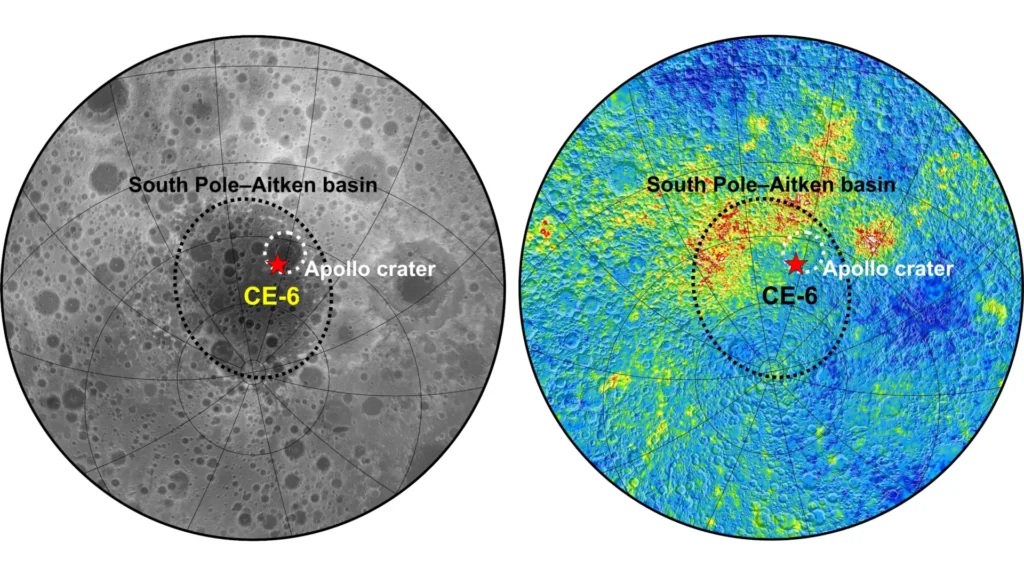
The Chang’e-6 mission, launched by the China National Space Administration (CNSA) on May 3, 2024, successfully landed in the South Pole-Aitken Basin on the far side of the Moon on June 2, 2024. This region is one of the largest and oldest impact basins in the solar system, making it an ideal location to study the Moon’s early history. The mission’s primary objective was to collect samples from this geologically significant area, which had never been explored by previous lunar missions. The successful return of these samples to Earth on June 25, 2024, marked a historic achievement, providing scientists with pristine material for analysis. The lunar soil analyzed in this study was collected from the Chang’e-6 landing site, underscoring the mission’s crucial role in advancing lunar science.
Broader Implications and Future Research
The implications of this discovery are far-reaching. By understanding how and when fcc γ-Fe forms and preserves magnetic signals, scientists can refine their models of the Moon’s ancient magnetic field. This, in turn, can shed light on the Moon’s internal structure and thermal evolution during its early history. The presence of a strong magnetic field in the early Moon is thought to have played a crucial role in protecting its atmosphere from solar wind erosion, potentially influencing its surface processes and habitability in its nascent stages.
While this study provides a significant leap forward, further research is essential. Scientists will need to determine the quantitative relationship between the presence and characteristics of fcc γ-Fe and the strength and duration of the ancient lunar magnetic field. Investigating a wider range of lunar samples, including those from different geological regions and impact events, will be critical to build a comprehensive picture. Future missions equipped with in-situ magnetic measurement capabilities, coupled with detailed laboratory analysis of returned samples, will undoubtedly build upon these findings.
The identification of fcc γ-Fe in Chang’e-6 lunar samples is not just a triumph of analytical chemistry and physics; it represents a new chapter in our quest to understand the Moon’s enigmatic past. These "tiny magnetic fossils" are poised to unlock secrets that have been buried for billions of years, offering a clearer view of the dynamic and magnetically active Moon that once was. The international scientific community eagerly anticipates the insights that will emerge from continued study of these extraordinary lunar treasures.