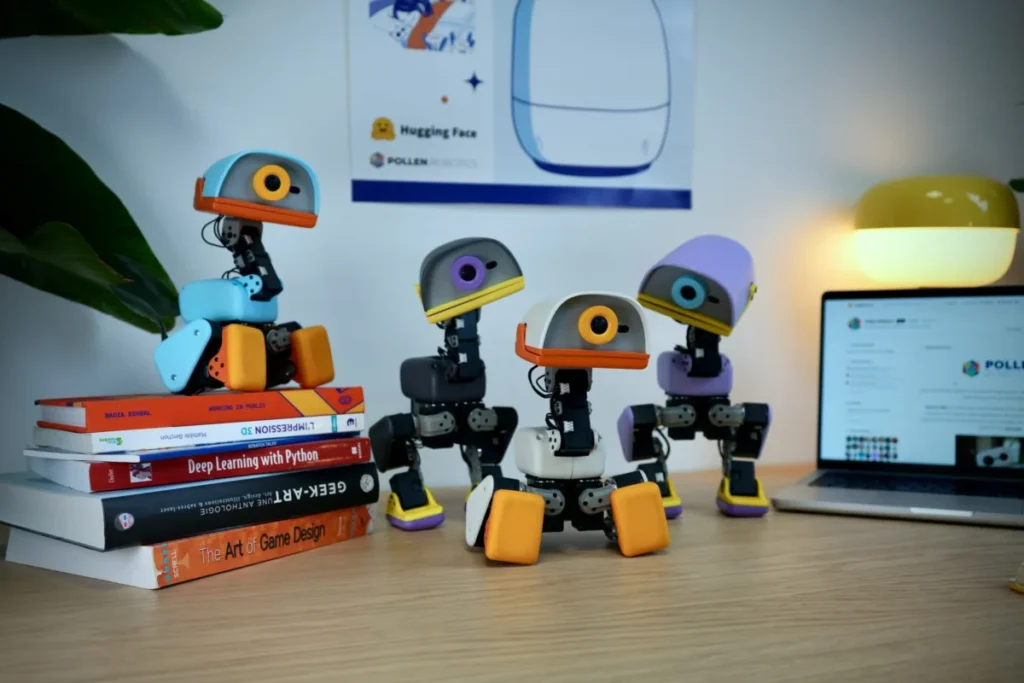
The world of robotics is witnessing a fascinating trend: the smaller the automaton, the larger its potential to captivate and educate. Following the lineage of groundbreaking bipedal bots, from Disney’s innovative BDX droid to the community-driven Open Duck Mini, a new contender has emerged, promising to democratize advanced AI learning. This is the Microduck, an adorable, open-source, and trainable robot priced at an accessible $400, launched by a collaborative effort between AI powerhouse Hugging Face and robotics innovator Pollen Robotics. Designed as an experimental platform for reinforcement learning, Microduck encapsulates a blend of advanced technology, open-source philosophy, and undeniable charm, signaling a pivotal moment in making complex AI and robotics concepts tangible for a broad audience.
The Genesis of a Waddling Wonder: From Disney’s Vision to Community Innovation
The journey of the Microduck is rooted in a rich history of bipedal robotics, a field long considered one of the most challenging in engineering due to the complexities of balance, locomotion, and dynamic interaction with varied environments. For decades, roboticists have strived to mimic the efficiency and adaptability of animal movement, with bipedalism representing a significant hurdle. Early attempts often resulted in clunky, expensive machines primarily confined to research laboratories. However, recent advancements in motor control, sensor technology, and computational power have begun to shift this paradigm, bringing sophisticated bipedal motion within reach of more compact and affordable designs.
A significant milestone in this evolution was the unveiling of Disney’s BDX droid. While details about the BDX droid were often proprietary and its primary purpose likely entertainment and research within Disney’s formidable R&D division, its existence demonstrated the increasing feasibility of creating small, expressive bipedal robots. The BDX droid garnered considerable attention within the robotics community, inspiring a wave of interest in compact, dynamic walking mechanisms. Its sophisticated movements and engaging design hinted at a future where robots could be both functional and endearing.
It was this inspiration that sparked the creation of the Open Duck Mini. Recognizing the potential of Disney’s concept but driven by a commitment to open access and community-driven development, a coalition of enthusiasts and experts began to adapt and expand upon the core ideas. This initiative gained substantial momentum with the backing of Hugging Face, a company renowned for its dedication to open-source artificial intelligence, and Pollen Robotics, a firm at the forefront of developing innovative robotic hardware and software. The Open Duck Mini became a testament to the power of collaborative innovation, allowing individuals to build and experiment with their own waddling robots, fostering a vibrant ecosystem of learning and development. The project underscored the belief that foundational robotics and AI knowledge should not be confined to elite institutions but should be accessible to anyone with curiosity and a desire to build. This community-led genesis laid the groundwork for the commercialization and refinement that would eventually lead to the Microduck.
Microduck: A Purpose-Built Platform for Reinforcement Learning
At its core, the Microduck is not merely a toy but a sophisticated educational tool specifically engineered to facilitate hands-on learning in reinforcement learning (RL). RL, a branch of machine learning, involves training an agent to make a sequence of decisions in an environment to maximize some notion of cumulative reward. It’s how AI learns to play complex games, navigate autonomously, or even control robotic limbs with precision. However, teaching RL traditionally requires access to complex simulations or expensive, fragile hardware, posing a significant barrier to entry for many aspiring AI developers and roboticists.

Microduck directly addresses this challenge. Its design is a deliberate exercise in creating an approachable, robust, and cost-effective platform where "failure" is not only expected but encouraged as an integral part of the learning process. The robot’s compact dimensions, durable construction, and expressive movements make it an ideal candidate for iterative experimentation. Whether it’s the charmingly "pigeon-toed walk" or the comically "bowlegged skating," these deliberate design choices contribute to a persona that makes the inevitable tumbles and errors of an RL training session feel less like setbacks and more like amusing steps toward progress. This psychological aspect is crucial; an endearing robot makes the learning journey more engaging and less intimidating, especially for beginners.
The technical foundation of Microduck is robust and entirely open-source. Its Software Development Kit (SDK) is freely available, empowering users to delve into the robot’s inner workings, modify its behavior, and develop novel applications. The project’s repository is hosted on GitHub, a testament to its commitment to transparency and community collaboration. This open-source model allows researchers, students, and hobbyists worldwide to contribute to the Microduck’s evolution, share their findings, and collectively push the boundaries of what this small robot can achieve. For instance, the quote from the development team highlights a key expectation: "It’s technically feasible and could be a future development. Even if we’re not the ones doing it, I expect the community to build it in a matter of weeks after the first users get their robots." This statement, likely from a representative of Pollen Robotics or Hugging Face, underscores the confidence in the open-source community’s ability to rapidly innovate, especially in areas like integrating natural language processing.
Technical Specifications and Unique Charms
While specific technical specifications like processor type, memory, and sensor suite are not exhaustively detailed in the initial announcement, the emphasis on Microduck’s ability to perform complex movements and learn through reinforcement implies a capable embedded system. It would likely feature a micro-controller or single-board computer, motor drivers for its numerous joints, and possibly IMU (Inertial Measurement Unit) sensors for balance and orientation feedback. The small form factor suggests careful optimization of power consumption and component integration.
Beyond its technical capabilities, Microduck possesses distinct features that amplify its appeal. Each robot is said to have its "own individual voice," a subtle yet powerful touch that imbues it with personality. This could range from unique sound profiles associated with different movements to customizable vocalizations that react to its environment or training progress. Such personalization fosters a deeper connection between the user and the robot, enhancing the learning experience. The deliberate imperfections in its gait – the pigeon-toed walk and bowlegged skating – are not flaws but endearing characteristics that make Microduck feel more relatable and less like a sterile machine. This blend of high-tech functionality and deliberate charm is a hallmark of good design, ensuring that Microduck is not just a tool but a companion in the learning process.
The Democratization of Robotics and AI: Hugging Face and Pollen Robotics’ Vision
The collaboration between Hugging Face and Pollen Robotics on Microduck is a strategic alignment of two organizations deeply committed to making advanced technology accessible. Hugging Face has emerged as a titan in the open-source AI landscape, particularly known for its contributions to natural language processing and machine learning models. Their mission revolves around democratizing AI, providing tools, models, and platforms that empower developers and researchers globally. Sponsoring projects like the Open Duck Mini and now launching Microduck perfectly aligns with this ethos, extending their reach from purely software-based AI to embodied AI – robots that interact with the physical world. For Hugging Face, Microduck represents an opportunity to bring their AI frameworks and training methodologies into a tangible, interactive format, allowing users to see the direct impact of their code on a physical agent.
Pollen Robotics, on the other hand, brings its extensive expertise in designing and manufacturing sophisticated, yet user-friendly, robotic hardware. Their experience in creating modular, adaptable robot platforms makes them an ideal partner for developing a durable and scalable robot like Microduck. Their contribution likely encompasses the mechanical design, embedded systems, and robust firmware that enable Microduck’s movements and learning capabilities. For Pollen Robotics, Microduck could serve as an entry point for a new generation of roboticists, fostering a community that will eventually engage with their more advanced robotic systems. Their shared vision is clear: to lower the barriers to entry for robotics and AI research, making it possible for students, educators, and hobbyists to engage with complex concepts without the prohibitive costs or technical complexities previously associated with such endeavors.

Future Horizons: Language, Dexterity, and Beyond
The potential future developments for Microduck are vast and exciting, particularly concerning the integration of language processing. While not currently onboard, the technical feasibility is high, and the open-source community is expected to rapidly develop this capability. Imagine a Microduck that not only learns to walk and interact with its environment through reinforcement learning but can also understand and respond to verbal commands. This would transform it from a purely experimental platform into a more interactive and assistive robot. Users could potentially train their Microduck using natural language instructions, further simplifying the learning process and opening up new avenues for human-robot interaction research.
Beyond language, the continuous improvement in training models and the inherent adaptability of reinforcement learning suggest that Microduck’s capabilities will expand significantly over time. While the current example of "cleaning your room" is tempered by the caveat of lightweight debris, it hints at aspirations for greater dexterity and object manipulation. As the community develops more sophisticated control algorithms and perhaps even adds minor modifications to the robot’s "bill" or appendages, Microduck could learn to pick up small objects, sort items, or perform simple household tasks. This progression would bridge the gap between abstract algorithmic learning and practical, real-world applications, providing invaluable experience for future robotic engineers.
The impact of affordable, open-source platforms like Microduck on education and research cannot be overstated. In academic settings, they can serve as accessible tools for teaching robotics, AI, and programming concepts. For independent researchers and hobbyists, they provide a low-cost alternative to expensive laboratory equipment, enabling grassroots innovation. This democratization accelerates the pace of discovery and fosters a more diverse and inclusive community of roboticists and AI developers, ultimately benefiting the entire field. The "charm factor" of Microduck also plays a critical role in this broader impact. Cute and engaging robots tend to lower psychological barriers, making complex subjects more approachable and inspiring greater interest among younger learners, potentially nurturing the next generation of STEM professionals.
Market Context and Availability
The robotics market has seen a surge in educational and hobbyist platforms in recent years, ranging from simple programmable kits to more advanced humanoid robots. Microduck enters this landscape with a compelling value proposition: a highly capable bipedal robot specifically designed for reinforcement learning, backed by prominent AI and robotics companies, and offered at a competitive price point of $400. While there are other affordable walking robots available, Microduck differentiates itself through its strong emphasis on open-source RL, its direct lineage from notable research projects, and its endearing, personality-driven design. This positions it not just as another robot kit but as a dedicated learning instrument for a cutting-edge field of AI.
The Microduck is currently available for pre-order, with initial deliveries targeted before Christmas 2026. This timeline allows for further refinement and scaling of production, ensuring a robust product reaches early adopters. For those who prefer a more hands-on approach from the ground up, the option to build one’s own robot from scratch, leveraging the open-source spirit that birthed the Open Duck Mini, remains a viable and encouraged path. More information and pre-order details can be found on the Pollen Robotics website: pollen-robotics.com/microduck.
In conclusion, Microduck represents more than just an adorable, waddling robot; it symbolizes a significant step forward in making advanced artificial intelligence and robotics accessible to a wider audience. By combining an engaging design with an open-source framework and a focus on reinforcement learning, Hugging Face and Pollen Robotics have created a platform poised to inspire a new generation of innovators, democratize complex technological education, and accelerate the collective understanding of intelligent systems. As the list of affordable, capable walking robots grows, the excuses for not diving into the fascinating world of robotics and AI are rapidly diminishing. Microduck is set to waddle its way into laboratories, classrooms, and homes, leaving a trail of learning and innovation in its wake.