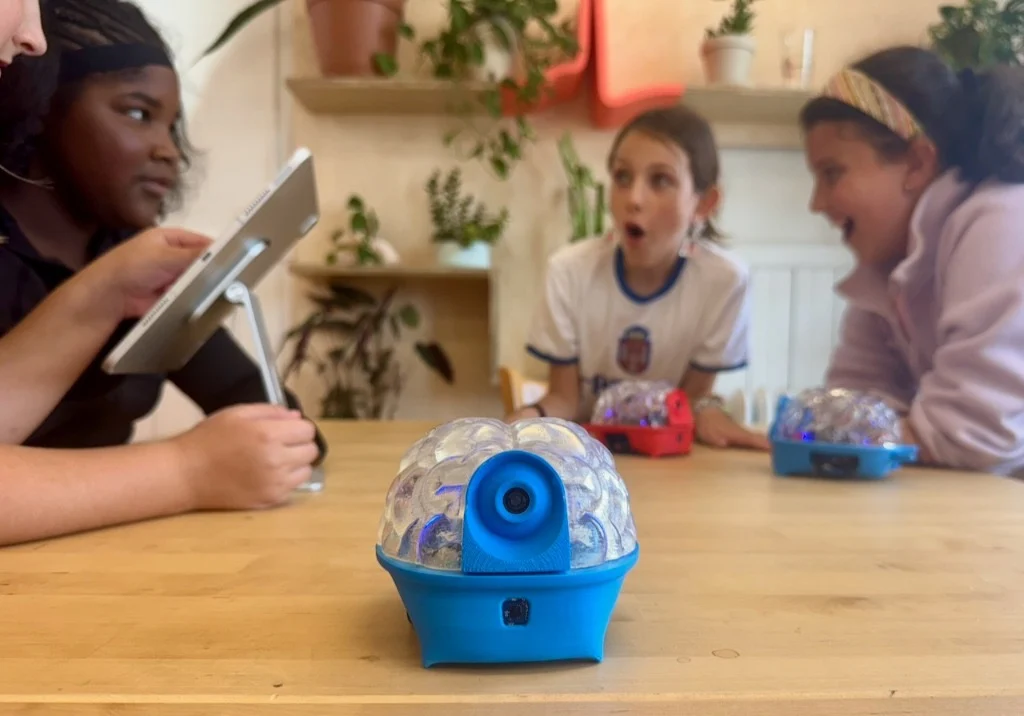
A groundbreaking educational robot, SpikerBot, developed by Backyard Brains, is poised to redefine how students engage with robotics and neuroscience, offering an intuitive, neuron-based programming interface that eschews traditional code in favor of virtual neural circuits. This innovative platform, introduced by Co-Founder & CEO Greg Gage and Designer Alex Hatch, aims to make complex biological intelligence accessible, allowing users to program lifelike behaviors in a wheeled robot by simulating the fundamental principles of the brain. The project, currently gaining significant traction on Kickstarter, represents a substantial leap in bridging the long-standing educational gap in neuroscience, transforming abstract concepts into tangible, interactive experiences.
Revolutionizing Robotics and Neuroscience Education
Traditional robotics often presents a steep learning curve, demanding proficiency in computer logic and programming languages like Python or C++. This initial barrier can deter budding engineers and scientists, draining the excitement out of hands-on learning. SpikerBot offers a radical departure from this paradigm. Instead of writing lines of code or grappling with complex if-then statements, users interact with a visual application that allows them to construct "sketches" entirely out of virtual neurons. As articulated by the Backyard Brains team, the core philosophy is simple yet profound: "there’s no code, no LLMs, just neurons, synapses, and behavior emerging from a circuit a kid designed." This approach is deeply rooted in the principles outlined in Valentino Braitenberg’s seminal work, Vehicles, which demonstrated how surprisingly complex, lifelike behaviors can emerge from simple, direct connections between sensors and motors. SpikerBot embodies this philosophy, enabling its robotic chassis to respond directly to environmental stimuli through an elegantly designed neural network.

The development of SpikerBot stems from Backyard Brains’ long-standing commitment to democratizing neuroscience education. For years, the company has created accessible tools, such as the SpikerBox and Spiker:bit, to allow individuals to conduct real neuroscience experiments outside of traditional laboratory settings. Their mission highlights a critical void in contemporary science education: while elementary school students may learn about the basic function of a single neuron, the continuity of neuroscience education often ceases until higher education, where students are suddenly expected to grasp the intricate workings of millions of interconnected neurons. This significant educational lacuna creates what Backyard Brains terms "neuroscience illiteracy," a parallel to expecting someone to understand Python without any foundational knowledge of transistors or basic electronics. SpikerBot directly addresses this challenge by providing an intermediate, hands-on platform for understanding how simple neural circuits give rise to complex behaviors, effectively bridging the chasm between rudimentary and advanced neurological concepts.
The Architecture of a Bionic Brain: Hardware and Software Synergy
The SpikerBot system is a sophisticated blend of purpose-built hardware and an intuitive, visually driven software interface. The robot itself is housed within a distinctive, brain-shaped chassis, echoing the Backyard Brains logo. This mobile platform is equipped with an array of sensors designed to perceive its environment in a manner analogous to biological organisms. These include a camera for visual input, a microphone for auditory perception, and a distance sensor for spatial awareness. Beyond mere data collection, SpikerBot also features carefully crafted actuators: lights that illuminate and fade with a bioluminescent quality, and charming, quirky sound effects that lend a natural, almost organic responsiveness to the machine. Furthermore, the chassis incorporates convenient connection points that allow for the attachment of 3D-printed accessories, empowering users to customize their bot’s appearance and personality, extending the creative possibilities beyond its core functionality.
The true innovation, however, lies in SpikerBot’s programming application. This user-friendly interface transforms the abstract world of neural networks into a tangible, interactive canvas. Programmers drag and drop virtual neurons and axons onto a digital brain, forming circuits that dictate the robot’s behavior. This visual programming paradigm diverges sharply from the linear, text-based code prevalent in most robotics platforms. Instead, it offers a holistic, "patch synthesizer" like experience where the entire neural circuit can be viewed and understood at a glance. One of the most compelling features of this system is its instantaneous feedback loop: any modification to a neuron – changing it from excitatory to inhibitory, for instance – yields an immediate, observable effect on the robot’s behavior. This real-time experimentation fosters a dynamic learning environment, allowing users to rapidly iterate on their designs and observe the consequences of their neural modifications without the delays of compilation or code uploads.

This neural programming paradigm introduces a fascinating inversion of complexity. Behaviors typically considered challenging for beginner robotics enthusiasts, such as object following or mimicry, become remarkably straightforward with SpikerBot. For example, a creature that chases objects can be constructed with as few as two neurons, demonstrating the emergent properties of simple neural connections. Conversely, tasks that are trivial in traditional computer logic, such as counting in binary, transform into intricate webs of connections within SpikerBot’s neural environment. This unexpected shift in complexity underscores the unique thought process required for neural programming, pushing users to think like a biologist rather than a computer scientist. This emphasis on natural behaviors and intuitive design is a deliberate choice, intended to sustain user engagement longer than conventional robotics kits by allowing immediate gratification in creating "lifelike" robots, gradually building towards more complex, dog-like responses at a natural learning pace.
Grounded in Scientific Pedagogy and Educational Impact
The educational framework underpinning SpikerBot is meticulously designed, drawing on insights from both child educators and professional neuroscientists. This collaborative approach ensures that the platform is not only engaging but also pedagogically sound, introducing users to genuine neuroscience principles. The app includes a comprehensive library of sample brain models, allowing users to dissect, modify, and learn from pre-built neural architectures. Through hands-on experimentation, users can discover fundamental neurological patterns such as recurrent pairs, which are crucial for memory and oscillation, and lateral inhibition, a mechanism essential for sensory perception and signal sharpening. The platform also enables exploration of concepts like working memory, providing a tangible model for understanding how temporary information storage influences behavior.
Beyond the immediate learning experience, SpikerBot addresses a broader societal need for enhanced neuroscience literacy. With approximately one in five individuals affected by a neurological condition, a foundational understanding of brain function is increasingly vital. SpikerBot provides a shared language and a practical understanding of building-block brain patterns, which can significantly aid in comprehending various neurological conditions, fostering empathy, and potentially inspiring future researchers and medical professionals. By making these complex topics accessible at an earlier age, SpikerBot has the potential to cultivate a generation more informed about brain health and function, reducing stigma and promoting scientific inquiry.

Furthermore, SpikerBot’s integration with existing Backyard Brains peripherals, such as the Spiker:bit board, expands its educational utility. This compatibility allows users to extend their learning by, for example, controlling their SpikerBot using actual muscle signals from their own arm, directly connecting their biological nervous system to the robot’s artificial one. This multimodal approach reinforces the concept of neural control and bio-interfacing, pushing the boundaries of what is possible in home and classroom STEM education.
A Commitment to Longevity and Community-Driven Innovation
Backyard Brains has also demonstrated a thoughtful commitment to the long-term sustainability and user-friendliness of SpikerBot. Recognizing common frustrations with modern electronics, the team has implemented several design choices aimed at maximizing longevity and accessibility. The accompanying app is entirely free and does not necessitate cloud-based authentication, ensuring that access to the core functionality remains unimpeded by connectivity issues or subscription models. Powering the robot are easily swappable AA batteries, a deliberate departure from the increasingly common trend of non-replaceable, constantly decaying lithium-ion cells. To further support this choice, Backyard Brains offers its own custom, high-performance NiMh AA batteries, promoting a rechargeable and environmentally conscious power solution. These decisions reflect a user-centric design philosophy that prioritizes independence and durability, making SpikerBot a robust tool for sustained learning and experimentation.
The SpikerBot project initially launched via a Kickstarter campaign, a testament to Backyard Brains’ established track record in crowdfunding successful educational tools. Their history of delivering innovative projects provides a strong foundation of confidence for backers, mitigating the inherent risks associated with crowdfunding. The campaign, which is scheduled to conclude on June 14, offers early pledges the opportunity to acquire the bot at $219, a significant discount from its eventual retail price of $299. This pricing strategy makes cutting-edge neuroscience education more accessible to a broader audience.

Looking ahead, Backyard Brains envisions a dynamic future for SpikerBot, with numerous features and capabilities already in the pipeline. However, a significant part of the ongoing development strategy involves observing how the general public interacts with and innovates using the platform. As Alex Hatch aptly noted, despite the wealth of existing behaviors and sample models, "a lot we haven’t seen because you guys haven’t built anything yet." This open-ended approach fosters a vibrant community of creators and learners, encouraging users to push the boundaries of neural programming and discover unforeseen applications and emergent behaviors. The emphasis on user-driven innovation ensures that SpikerBot will not merely be a static educational tool but a constantly evolving platform for discovery, powered by the collective imagination of its global community. Through SpikerBot, Backyard Brains is not just offering a robot; they are offering a new way to think about thinking, inviting everyone to program a brain on wheels and explore the fascinating world of neuroscience firsthand.