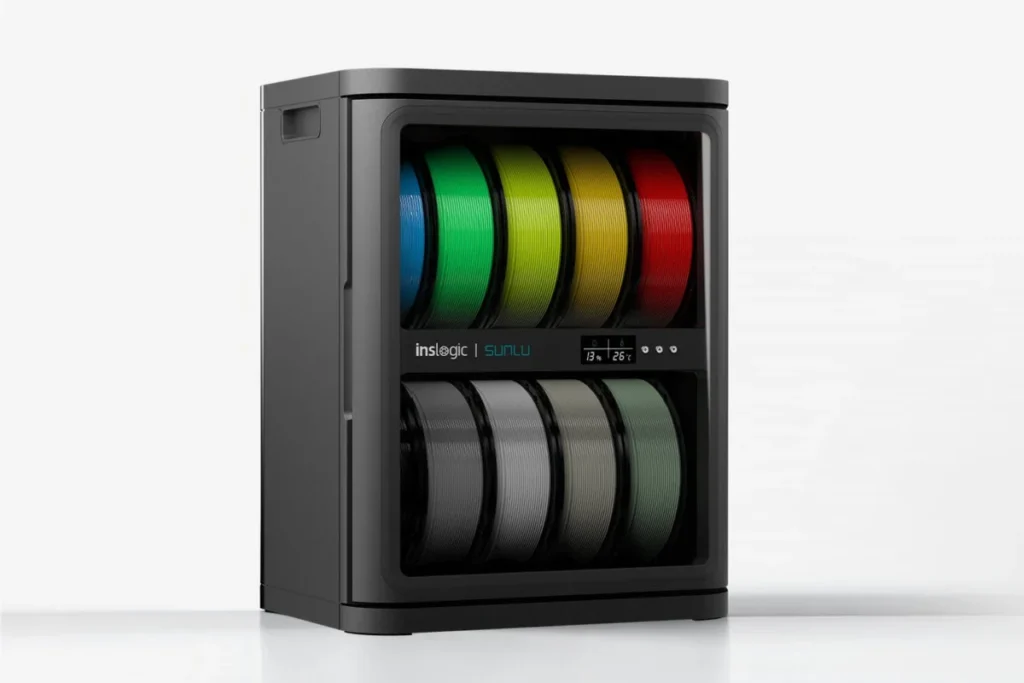
The FilaDC i10 filament dehumidifying cabinet, a collaborative engineering effort between 3D printing accessory specialist Inslogic and industry giant Sunlu, has officially entered the market, targeting a critical pain point for additive manufacturing enthusiasts and professionals alike. Priced at $199, the i10 represents a shift away from traditional active-heat drying methods toward a more sophisticated, passive moisture-management system. By integrating a dual-effect dehumidification technology that utilizes Positive Temperature Coefficient (PTC) heating alongside a molecular sieve, the device offers a room-temperature drying solution designed to maintain the structural integrity of various thermoplastic filaments while significantly reducing energy consumption.
In the rapidly evolving landscape of 3D printing, the quality of the raw material is often the primary determinant of the final print’s success. Most common 3D printing filaments, such as PLA, PETG, Nylon, and TPU, are hygroscopic, meaning they actively absorb moisture from the surrounding environment. This moisture absorption leads to a variety of print defects, including bubbling, excessive stringing, poor layer adhesion, and weakened structural properties. The FilaDC i10 aims to mitigate these issues by providing a controlled environment capable of housing up to 10 standard 1kg spools, offering a high-capacity storage solution that doubles as an active maintenance tool for filament health.
Technical Innovation: PTC and Molecular Sieve Dual-Effect Dehumidification
The core innovation of the FilaDC i10 lies in its departure from the "hot-air box" model that has dominated the consumer market for years. Traditional filament dryers typically rely on a heating element and a fan to circulate hot air around the spool. While effective for rapid drying, prolonged exposure to high heat can sometimes lead to the "cooking" of certain polymers, causing them to become brittle or causing the spool itself to warp.
In contrast, the i10 utilizes a molecular sieve technology. Molecular sieves are crystalline aluminosilicates with uniform pores that act as a high-efficiency desiccant. Unlike silica gel, which can become saturated and lose effectiveness quickly in high-humidity environments, molecular sieves can be engineered to target specific water molecule sizes, providing a much deeper level of dehumidification. Within the FilaDC i10, the PTC heater is used primarily to regenerate the molecular sieve—driving off collected moisture—rather than directly heating the filament storage area to high temperatures.
This "non-damaging" drying process ensures that the filament remains at or near room temperature, preserving its mechanical properties and preventing the premature degradation of the polymer chains. This approach is particularly beneficial for heat-sensitive materials or for users who wish to store their filament long-term without the risk of thermal fatigue.
Evolution of Filament Storage Solutions
To understand the significance of the FilaDC i10, one must look at the chronology of filament management in the maker community. In the early days of desktop 3D printing, filament was often stored in open air, leading to frequent print failures in humid climates. The first evolution involved DIY "dry boxes"—plastic airtight containers filled with desiccant beads. While inexpensive, these boxes were passive and lacked the ability to actively lower the humidity once the container was opened.
The second phase saw the adaptation of food dehydrators and the subsequent release of dedicated active filament dryers. These devices brought the humidity down quickly but were often limited to one or two spools and consumed considerable power. They were also frequently criticized for being noisy, as the internal fans had to run constantly to maintain temperatures.
The arrival of the FilaDC i10 marks the third phase: the professionalization of filament storage for the home and small-office workshop. By offering a cabinet-style form factor with a 10-spool capacity, Inslogic and Sunlu are catering to the growing number of "prosumers" and small print farms that operate multiple machines simultaneously. The i10 bridges the gap between affordable hobbyist tools and the expensive industrial-grade dry cabinets used in aerospace and medical manufacturing.
Performance Analysis and Empirical Results
Initial testing and user reports indicate that the FilaDC i10 performs exceptionally well in real-world conditions. When loaded with five to ten spools of filament—some of which may have been exposed to ambient humidity for extended periods—the cabinet demonstrates a rapid descent to the user-defined humidity setpoint. Digital controls allow users to specify the exact percentage of relative humidity (RH) required for their specific materials.

One of the most notable outcomes of using the i10 is the immediate improvement in print quality. Filaments that previously exhibited "stringing"—the fine, hair-like strands left behind when the print head moves between two points—showed a marked reduction in these artifacts after a period of storage in the i10. This is attributed to the removal of internal moisture that would otherwise turn into steam at the printer’s nozzle, creating internal pressure that forces excess plastic out during non-printing movements.
Furthermore, the operational noise of the i10 is significantly lower than that of fan-based dryers. Because the system focuses on maintaining a state of equilibrium through the molecular sieve rather than constant forced-air induction, the unit remains nearly silent during its maintenance cycles. The intelligent control system monitors the internal environment; once the desired humidity is reached, the unit powers down, only restarting when the sensors detect a rise in moisture levels. This "smart" cycling not only ensures a stable environment but also contributes to the unit’s energy efficiency.
Market Positioning and Manufacturer Collaboration
The partnership between Inslogic and Sunlu is a strategic move that leverages the strengths of both entities. Sunlu is widely recognized as one of the world’s largest manufacturers of 3D printing filament and has a long history of producing entry-level drying hardware. Inslogic, on the other hand, has focused on more specialized accessories and ergonomic solutions for the 3D printing workspace.
By co-branding the FilaDC i10, the companies are signaling a commitment to higher quality standards. The $199 price point is positioned competitively. While it is more expensive than a basic single-spool dryer (which typically ranges from $40 to $60), the i10 provides roughly ten times the storage capacity and a more advanced dehumidification technology. For a user with a collection of 20 or 30 spools, two i10 units provide a comprehensive storage solution that is more organized and efficient than a dozen individual small dryers.
Industry analysts suggest that as 3D printing moves further into the realm of functional parts—where material strength is non-negotiable—the demand for precision storage solutions like the i10 will continue to grow. "We are seeing a shift in the market," says one industry consultant. "Users are no longer satisfied with ‘good enough’ prints. They want industrial reliability, and that starts with the environment in which the filament is kept."
Implications for the 3D Printing Ecosystem
The introduction of the FilaDC i10 has several broader implications for the 3D printing ecosystem. First, it addresses the "waste" factor. Millions of kilograms of filament are discarded annually because they have become "wet" and the user lacks the tools or the patience to dry them effectively. By providing an easy-to-use, high-capacity cabinet, the i10 encourages better material stewardship and reduces the environmental impact of failed prints.
Second, the unit’s ease of setup—essentially a "plug-and-play" experience with a single power cord and a straightforward interface—lowers the barrier to entry for professional-grade material management. The inclusion of a comprehensive humidity guide for different materials within the instruction manual further educates the user base on the science of polymers.
Third, the design of the cabinet reflects a growing trend toward aesthetic and organized workspaces. The i10’s sleek, black enclosure and transparent door allow it to fit seamlessly into a modern office or studio, moving the 3D printing setup away from the "cluttered garage" look toward a more professional laboratory appearance.
Conclusion and Future Outlook
The FilaDC i10 filament dehumidifying cabinet stands as a robust solution to one of the most persistent problems in Fused Deposition Modeling (FDM). By combining high capacity, energy-efficient passive drying technology, and a user-friendly interface, Inslogic and Sunlu have created a product that serves both the aesthetic and functional needs of the modern maker.
As the 3D printing industry continues to mature, the focus is increasingly shifting from the machines themselves to the entire workflow. The FilaDC i10 is a testament to this maturation, proving that the background processes—such as material storage and preparation—are just as vital as the movement of the X, Y, and Z axes. With its successful implementation of PTC and molecular sieve technology, the i10 sets a new benchmark for what hobbyists and professionals should expect from their filament management hardware. For those serious about the quality of their output and the longevity of their materials, the i10 represents a sound investment in the future of their additive manufacturing capabilities.