In a landmark achievement for the field of quantum science, an international collaboration led by the Duke Quantum Center (DQC) has successfully utilized a quantum simulator to observe the complex dynamics of "string breaking." This phenomenon, which is intrinsically linked to the formation of matter and antimatter, represents one of the most elusive processes in high-energy physics. The study, published on September 23 in the prestigious journal Nature Physics, provides a rare glimpse into the subatomic mechanisms that governed the early universe, marking a significant milestone in our ability to simulate fundamental physical laws using advanced computing architectures.
The experiment focuses on the behavior of quarks—the fundamental building blocks of matter that constitute protons and neutrons. Under normal conditions, quarks are never found in isolation; they are perpetually bound together by the strong nuclear force, a phenomenon known as "confinement." The Duke-led research successfully simulated the process by which these bonds are stretched and eventually broken, leading to the spontaneous creation of new particle-antiparticle pairs. This breakthrough underscores the growing utility of trapped-ion quantum computers as precision instruments for exploring the deepest questions in theoretical and experimental physics.
The Fundamental Physics of Quark Confinement and String Breaking
To understand the significance of the DQC experiment, one must first look at the Standard Model of particle physics. Within this framework, quarks are held together by the exchange of particles called gluons. Unlike the electromagnetic force, which weakens as two charged particles move apart, the strong force between quarks remains constant or even increases with distance.
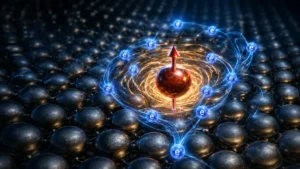
Physicists often use the "string" or "rubber band" analogy to describe this interaction. When two quarks are pulled apart, the energy in the "string" (the gluon field) between them intensifies. In the macroscopic world, stretching a rubber band eventually causes it to snap. In the subatomic world, however, the energy stored in the stretched string becomes so great that it is converted into mass, following Albert Einstein’s mass-energy equivalence principle, $E=mc^2$. When the "string" breaks, the energy manifests as a new quark and antiquark, which immediately pair up with the original particles.
This process of string breaking is what prevents quarks from existing in a "free" state. Historically, observing this dynamic has required the immense energy scales of the Large Hadron Collider (LHC) or the extreme temperatures of the moments immediately following the Big Bang. By recreating these dynamics within a controlled, atomic-level quantum simulator, the Duke researchers have bypassed the need for multi-billion-dollar particle accelerators to study specific aspects of quark behavior.
Technical Methodology: The Trapped-Ion Quantum Platform
The DQC research team utilized a trapped-ion quantum computer to perform the simulation. This specific architecture involves suspending individual atoms (ions) in a vacuum using electromagnetic fields. These ions serve as "qubits," the fundamental units of quantum information. Unlike classical bits, which are either 0 or 1, qubits can exist in a superposition of states, allowing them to represent and process vast amounts of complex data simultaneously.
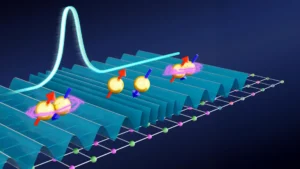
For this experiment, the researchers encoded a specialized physical model—the Schwinger model—into a chain of 13 trapped ions. The Schwinger model is a mathematical framework that describes quantum electrodynamics in one spatial dimension, providing a simplified but highly accurate analogue for the more complex dynamics of quantum chromodynamics (QCD) found in the real world.
To manipulate the system, the team employed precisely tuned laser beams. These lasers acted as the "programmers" of the quantum system, adjusting the interactions between the ions to mimic the tension and energy accumulation of a subatomic string. By carefully controlling the quantum states of the ions, the researchers were able to prepare the system in an "out-of-equilibrium" state and then monitor its evolution in real-time. This allowed them to detect the emergence of "effective charges" and witness the simulated string snap, resulting in the formation of new particle pairs.
A Comparative Milestone in Quantum Hardware
The Duke-led study does not stand alone; it is part of a broader, synchronized advancement in the global quantum computing community. Simultaneously with the DQC publication, research teams from Google and QuEra Computing released findings demonstrating similar string-breaking physics using different hardware platforms.
- Duke Quantum Center (Trapped Ions): Known for high connectivity and long coherence times, trapped-ion systems allow for very precise control over individual qubits and their interactions.
- Google (Superconducting Circuits): Google’s Sycamore processor uses superconducting loops to simulate quantum states. This platform is noted for its high speed and scalability, though it faces different noise and error challenges compared to ions.
- QuEra Computing (Neutral Atoms): This approach uses "Rydberg atoms" held in place by laser "tweezers." Neutral atom arrays are highly effective for simulating many-body physics and large-scale quantum lattices.
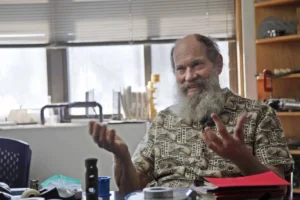
Christopher Monroe, the Gilhuly Family Presidential Distinguished Professor of Electrical and Computer Engineering and Physics at Duke and the lead researcher on the project, noted the importance of this multi-platform validation. "These are the three platforms leading the charge in quantum computing," Monroe stated. "Having all three reproduce these complex dynamics provides a vital benchmark for the quantum community, confirming that our tools are becoming reliable enough to tackle real-world physics problems."
Data Validation and the Path to Quantum Advantage
One of the critical challenges in quantum computing is verification. How do researchers know the quantum machine is producing the correct answer? In the DQC experiment, the team compared the results from their 13-ion simulator with calculations performed on a traditional classical supercomputer.
The data sets showed a high degree of correlation, confirming that the quantum simulator was accurately modeling the intended physics. While a 13-qubit system can still be simulated by a powerful classical computer, the complexity of these physics problems grows exponentially with the number of particles.
"As we scale these systems up to 50, 100, or 500 qubits, classical computers will simply run out of memory and processing power," said Arinjoy De, the study’s first author and former PhD student at Duke. "At that point, quantum simulators will be the only tools capable of answering these questions. We are currently in the ‘validation phase,’ proving that the hardware works so that we can trust it when we move into territory where classical machines cannot follow."
Implications for Fundamental Science and Cosmology
The ability to simulate string breaking has profound implications for our understanding of the early universe. Cosmologists believe that in the microseconds after the Big Bang, the universe was a "quark-gluon plasma"—a hot, dense soup of fundamental particles that had not yet cooled enough to form protons or neutrons.
By studying how matter forms out of energy in a controlled environment, scientists can gain insights into the "baryogenesis" problem—the mystery of why the universe contains so much more matter than antimatter. Zohreh Davoudi, an associate professor of physics at the University of Maryland and a key member of the research team, emphasized the philosophical and scientific weight of the work.
"As a physicist, it is incredibly exciting to investigate the conditions of the early universe in an atomic-level computing machine," Davoudi said. "Even the slightest insights from an out-of-equilibrium physics model will guide us in the future as we attempt to reconstruct the history of everything."
Furthermore, this research bridges the gap between high-energy particle physics and condensed matter physics. The techniques used to simulate quark strings can also be applied to understand exotic materials, such as high-temperature superconductors and topological insulators, which rely on similar "many-body" quantum interactions.
Timeline of Development and Institutional Support
The success of the DQC experiment is the result of years of interdisciplinary collaboration. The project involved researchers from the University of Maryland, Oxford University, the California Institute of Technology (Caltech), Cornell University, and KU Leuven in Belgium.
- 2020-2022: Initial development of the quantum algorithms and the encoding of the Schwinger model for trapped-ion hardware.
- 2023: Execution of the experimental runs at the Duke Quantum Center and parallel efforts at Google and QuEra.
- September 2024: Formal publication in Nature Physics, following rigorous peer review and cross-platform benchmarking.
The research was heavily supported by a coalition of government and private entities, reflecting the strategic importance of quantum technology. Funding was provided by the U.S. Department of Energy (DOE), the National Science Foundation (NSF), the Air Force Office of Scientific Research (AFOSR), the Defense Advanced Research Projects Agency (DARPA), and Amazon Web Services (AWS).
Future Outlook: Beyond the Supercomputer
The Duke Quantum Center’s achievement is a signal to the scientific community that the era of "quantum utility" is arriving. While "quantum supremacy"—the point where a quantum computer performs a task impossible for a classical one—has been claimed in specific mathematical contexts, this research represents a move toward "quantum advantage" in practical, scientific applications.
Future experiments at the DQC and elsewhere aim to increase the number of ions and the complexity of the simulated dimensions. Moving from a 1D Schwinger model to a 3D simulation of quantum chromodynamics remains one of the "holy grails" of the field. Such a feat would allow researchers to calculate the properties of matter from first principles, potentially revealing new physics beyond the Standard Model.
As quantum hardware continues to evolve, the laboratory at Duke stands as a testament to the power of simulating the universe’s most violent and fundamental acts—like the breaking of a subatomic string—within the quiet, frozen confines of an ion trap. The findings published this month ensure that quantum computers will remain at the forefront of human efforts to decode the fabric of reality.