The scientific community’s quest to harness the most elusive particles in the known universe has met a definitive theoretical roadblock. Neutrinos, often referred to as "ghost particles" due to their ability to pass through planets and human bodies without a trace, were recently the subject of a revolutionary proposal: the creation of a "neutrino laser." However, new research from the Massachusetts Institute of Technology (MIT) has demonstrated that such a device is physically and fundamentally impossible. In two landmark papers published in Physical Review Letters, Nobel laureate Wolfgang Ketterle and his team have dismantled the concept, citing the violent recoil of nuclear reactions and the inherent quantum nature of the particles themselves as insurmountable barriers.
The Elusive Nature of the Ghost Particle
To understand why the concept of a neutrino laser was so enticing—and why its debunking is so significant—one must first grasp the extraordinary nature of the neutrino. Since their experimental discovery in 1956 by Clyde Cowan and Frederick Reines, neutrinos have remained among the most mysterious components of the Standard Model of particle physics. They are elementary particles with near-zero mass and no electric charge, meaning they are unaffected by the electromagnetic forces that govern most of the matter we interact with daily.
Trillions of neutrinos stream through every square inch of the Earth’s surface every second, originating from the sun’s nuclear fusion, cosmic ray interactions in the atmosphere, and the radioactive decay of elements within the Earth’s crust. Despite their ubiquity, they are notoriously difficult to detect. Large-scale experiments, such as the IceCube Neutrino Observatory in Antarctica or the Super-Kamiokande in Japan, require massive volumes of water or ice buried deep underground to catch the rarest of interactions.
Over the decades, neutrinos have surprised physicists with their "flavors"—electron, muon, and tau—and their ability to oscillate between these states. Some theories even suggest neutrinos could be Majorana fermions, meaning they are their own anti-particles. Because they carry information from the interiors of stars and the early universe that light cannot reach, the ability to control or concentrate them into a beam—a neutrino laser—would represent a paradigm shift in communications, geology, and fundamental physics.
The Rise of the Neutrino Laser Proposal
In 2024, the physics world was energized by a proposal put forward by Joe Formaggio, a professor of physics at MIT, and Ben Jones, then an associate professor at the University of Texas at Arlington. They suggested that a phenomenon known as "superradiance" could be applied to neutrinos. Superradiance is a quantum mechanical effect where a group of emitters, such as atoms, interact with a common light field to emit radiation in a highly synchronized, amplified burst.
The Formaggio-Jones proposal envisioned cooling a cloud of radioactive atoms to nanokelvin temperatures—one-billionth of a degree above absolute zero. At this extreme cold, the atoms would enter a state known as a Bose-Einstein Condensate (BEC). In a BEC, individual atoms lose their distinct identities and behave as a single, coherent quantum wave. The researchers hypothesized that if these radioactive atoms decayed while in this state, the resulting neutrinos would not be emitted randomly. Instead, the quantum coherence of the BEC would force the neutrinos into a concentrated, laser-like beam.
The theoretical implications were staggering. Formaggio and Jones calculated that such a process could drastically accelerate radioactive decay. For instance, a sample of radioactive rubidium with a natural half-life of 86 days could potentially decay in just one minute if successfully stimulated into a superradiant state. This would not only create a controllable beam of neutrinos but also provide a new method for managing radioactive materials.
The MIT Critique: A Two-Pronged Rebuttal
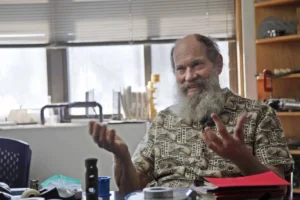
The excitement surrounding the neutrino laser was short-lived. Wolfgang Ketterle, the John D. MacArthur Professor of Physics at MIT and a co-recipient of the 2001 Nobel Prize for the discovery of Bose-Einstein Condensates, approached the proposal with skepticism. Ketterle’s career has been defined by exploring the limits of ultracold matter, and his intuition suggested that the violent energy of nuclear decay was incompatible with the delicate stability of a BEC.
Working with postdocs Hanzhen Lin and Yu-Kun Lu, Ketterle conducted a rigorous theoretical analysis that resulted in two companion papers. These documents serve as a "punch one and punch two" combo, as Ketterle described it, each independently proving the neutrino laser’s impossibility.
The Recoil Problem: A Violent Disruption
The first fatal flaw identified by the MIT team involves the physics of recoil. In traditional optical superradiance, atoms scatter visible photons. These photons have an energy of approximately 1 electron volt (eV). When an atom emits such a photon, the "kick" or recoil it receives is minimal, allowing the atom to remain within the collective quantum state of the BEC.
Neutrinos, however, are born of much more energetic processes. When a radioactive atom decays, the emitted neutrino carries millions of electron volts (MeV) of energy. According to the laws of conservation of momentum, the decaying atom must recoil with equal and opposite force. Ketterle’s calculations showed that this recoil is so powerful that the atom would be launched at velocities exceeding Mach 10—ten times the speed of sound.
"As long as the recoil atom stays in the condensate, it can make the condensate superradiant," Ketterle explained. "But when a neutrino is emitted at a million electronvolts, the atom recoils… faster than a fighter jet. This is so fast that the atom would almost instantly disappear."
The original proposal suggested that even if the atom left the condensate, a "quantum imprint" or memory would remain, guiding future emissions into the same path. Ketterle’s team proved this was not the case. The atom moves so quickly that the BEC loses all "memory" of the event in a fraction of a second—specifically, about 10,000 billion times too fast for any amplifying effect to take hold. Without this memory, the neutrinos continue to emit in random directions, just as they do in room-temperature matter.
The Fermionic Barrier: Anti-Memory and Quantum Statistics
The second paper addressed a more fundamental quantum mechanical hurdle: the nature of the neutrino as a fermion. In the universe, all particles are categorized as either bosons or fermions based on their "spin." Bosons (like photons) have whole-integer spins and are "social" particles; they prefer to occupy the same quantum state, which is the principle that allows lasers to work.
Fermions (like electrons and neutrinos) have half-integer spins and obey the Pauli Exclusion Principle, which states that no two fermions can occupy the exact same quantum state simultaneously. Ketterle’s team discovered that this distinction is critical for superradiance.
Even if the recoil issue could be ignored, the fermionic nature of neutrinos creates what the researchers call "anti-memory." While a BEC emitting bosons develops a memory that encourages further emission in the same direction, a BEC emitting fermions develops a correlation that actively discourages it. The quantum state effectively tells the condensate to emit the next neutrino in any direction except the one previously taken. This "anti-correlation" prevents the buildup of a coherent beam, making the very concept of a "laser" (which stands for Light Amplification by Stimulated Emission of Radiation) fundamentally inapplicable to neutrinos.
Scientific Discourse and the Path Forward
The debunking of the neutrino laser is not viewed by the participants as a failure, but rather as a successful application of the scientific method. Joe Formaggio, despite his original proposal being challenged, welcomed the scrutiny. He noted that the role of the scientific community is to test new ideas to their breaking point.
"Indeed, it was great to see how our paper generated a lot of thinking outside of our original concept," Formaggio said. He remains optimistic about the future of neutrino research, noting that "every prior prediction about neutrinos has been wrong," and that the particles may yet have more surprises in store.
The timeline of this discovery reflects the rapid pace of modern theoretical physics:
- 1956: Neutrinos are first detected experimentally.
- 1995: Wolfgang Ketterle and colleagues create the first Bose-Einstein Condensate.
- 2024: The Formaggio-Jones proposal for a neutrino laser is published, sparking global interest.
- 2025: Ketterle’s group publishes the definitive rebuttal in Physical Review Letters.
Broader Implications for Physics
While the neutrino laser may be a "surprise that was too good to be true," the research conducted by Ketterle’s team has broader implications for the study of ultracold atoms and high-energy physics. It clarifies the limits of Bose-Einstein Condensates, showing that while they are powerful tools for simulating low-energy quantum phenomena, they cannot easily bridge the gap to the high-energy world of nuclear reactions.
Furthermore, the discovery of "anti-memory" in fermionic emissions provides a new theoretical framework for understanding how different classes of particles interact with collective quantum states. This could influence future research into "gamma-ray lasers," another long-theorized technology that Ketterle’s work suggests may face similar insurmountable obstacles due to recoil.
The quest to master the neutrino continues, albeit with a more grounded understanding of the constraints imposed by nature. Scientists will continue to look for ways to detect and utilize these "ghostly" messengers, perhaps through more advanced detector technology or yet-undiscovered quantum interactions. For now, the neutrino remains as elusive as ever—a particle that refuses to be tamed by the conventional tools of human artifice.