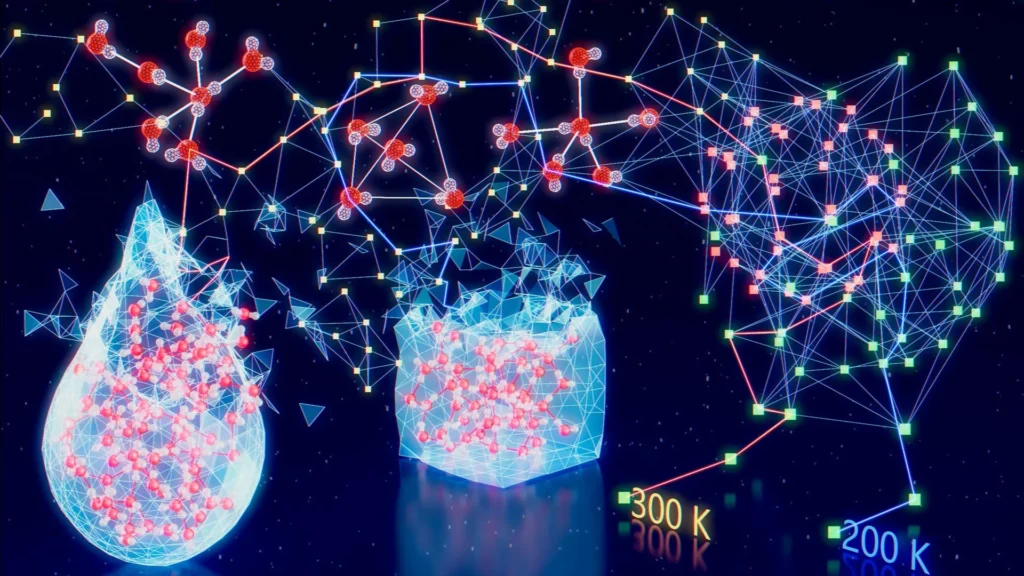
Water covers most of Earth’s surface, yet it behaves in ways that set it apart from nearly every other liquid, a paradox that has long baffled scientists and engineers alike. One of its most unusual traits is its expansion upon freezing, a counterintuitive property that sees ice float on water, unlike most solids that sink in their liquid forms. This singular characteristic is fundamental to life on Earth, enabling aquatic ecosystems to survive frigid temperatures. Beyond this, water exhibits a host of other anomalies, including an exceptionally high specific heat capacity, high surface tension, and maximum density at 4 degrees Celsius, not at its freezing point. For decades, researchers have linked these peculiar behaviors to intricate changes in water’s microscopic structure as temperature and pressure fluctuate. However, the scientific community has consistently struggled with the lack of a unified, consistent methodology to describe, compare, and ultimately understand these structural transformations.
Now, a significant breakthrough has emerged from the University of Osaka, where a team of dedicated researchers has leveraged the power of artificial intelligence (AI) to address this long-standing challenge. Their innovative AI system offers a groundbreaking, unified framework for comparing various existing methods used to describe the complex structure of supercooled water. This advancement is crucial for identifying which descriptive models most accurately and comprehensively capture the essential features of water’s molecular arrangements. The pioneering research, which promises to reshape our understanding of this ubiquitous substance, was recently published in the esteemed scientific journal Communications Chemistry.
The Enduring Enigma of Water’s Anomalies
The journey to understand water’s unique properties spans centuries, from ancient philosophers observing its life-giving and destructive forces to modern physicists employing quantum mechanics. Early scientists marveled at water’s ability to sustain life, transport nutrients, and moderate global temperatures. As scientific tools evolved, so did the depth of inquiry into water’s molecular underpinnings. The 18th and 19th centuries brought about a more systematic understanding of its chemical composition (H₂O), but the how and why of its anomalous physical properties remained largely elusive.
One of the most profound anomalies is water’s expansion upon freezing. When most liquids freeze, their molecules pack more closely together, increasing density. Water, however, behaves differently. As it cools from 4°C to 0°C, its molecules begin to arrange themselves into a more open, tetrahedral structure held together by hydrogen bonds, causing it to expand by approximately 9% in volume. This decrease in density means ice floats, insulating the water below and preventing entire bodies of water from freezing solid from the bottom up—a critical factor for the survival of aquatic life in cold climates. Without this property, Earth’s oceans and lakes might freeze solid, rendering the planet inhospitable.
Why Supercooled Water Behaves So Strangely: The Two-State Hypothesis
For liquid water to transition into ice, its molecules must align themselves into an orderly crystal lattice. This process typically initiates at a "nucleation site," which can be a microscopic impurity within the water, a tiny air bubble, or even minute scratches on the surface of a container. These sites act as templates, facilitating the initial formation of ice crystals.
However, if these nucleation sites are meticulously absent or sufficiently suppressed, water can persist in a liquid state even when cooled significantly below its normal freezing point of 0°C. This extraordinary state is known as supercooled water. It’s a metastable phase, meaning it’s inherently unstable and can rapidly crystallize into ice if disturbed or if a nucleation site suddenly appears. Supercooling has been observed down to temperatures as low as approximately -48°C in bulk water before homogeneous nucleation (spontaneous freezing without external sites) becomes unavoidable.
Under these extreme conditions of supercooling, water’s already unusual properties become even more pronounced and enigmatic. Scientists theorize that these intensified behaviors are intricately linked to a delicate balance between two competing structural forms of liquid water: a high-density liquid (HDL) and a low-density liquid (LDL). At the molecular level, water molecules are in a constant, dynamic dance, continuously forming, breaking, and reforming networks of hydrogen bonds. The HDL structure is characterized by a more compact arrangement of molecules, with a higher coordination number (more neighboring molecules). In contrast, the LDL structure is more open, featuring a more pronounced tetrahedral arrangement and fewer intermolecular contacts, leading to a lower density.
As the temperature of supercooled water fluctuates, the equilibrium between these two states shifts. Generally, as temperature rises, the more compact HDL structures become increasingly dominant over the more open, cage-like LDL arrangements. Conversely, as temperature drops into the supercooled regime, the LDL structures are believed to become more prevalent, contributing to the observed anomalies. Understanding this dynamic interplay between HDL and LDL is considered paramount to fully deciphering water’s unusual behavior.
A Historical Challenge: Describing Water’s Molecular Architecture
The quest to accurately describe the local arrangement of water molecules has been a formidable challenge for theoretical chemists and physicists. Over many decades, researchers have proposed a multitude of different ways to characterize these molecular structures, employing various "descriptors." These include measurements such as tetrahedral bond order, which quantifies the degree of tetrahedral arrangement around a central water molecule, and local density, which measures the number of molecules within a specific radius. Other descriptors might focus on hydrogen bond counts, angular distributions, or radial distribution functions.
The inherent difficulty arose because these structural descriptors were developed largely independently, often within different research groups and for specific theoretical models. Consequently, they utilize disparate scales, dimensions, and types of information. One descriptor might be unitless, another might have units of inverse length, and yet another might be a complex function. This lack of standardization has made direct comparison exceptionally challenging, hindering the scientific community’s ability to definitively determine which descriptors are the most robust, efficient, and useful for capturing the most critical structural information that dictates water’s macroscopic properties. The absence of a consistent evaluation framework meant that progress in understanding the microscopic origins of water’s anomalies was often fragmented.
AI Compares Competing Models of Water: The Osaka University Approach
Recognizing this critical bottleneck, researchers at the University of Osaka embarked on a novel approach, turning to artificial intelligence. Their core idea was to employ machine learning to objectively evaluate and compare these diverse structural descriptors. Corresponding author Kang Kim elucidated the rationale behind this innovative strategy: "Past studies have shown that using machine learning to classify and understand structural data is effective. We specifically wanted to incorporate a neural network model into this study to evaluate how accurate the descriptors were at capturing key structural information, in a way that is like human cognition." This statement highlights the ambition to create a system that can learn and discern patterns in a manner analogous to a human expert, but with far greater speed and objectivity.
To achieve this, the researchers meticulously trained their AI system, specifically a neural network, using a vast dataset of structural information. This data was not generated experimentally but rather derived from sophisticated molecular dynamics simulations of supercooled water. Molecular dynamics simulations are computational methods that model the physical movements of atoms and molecules. By applying Newton’s laws of motion to individual particles, these simulations can track the positions and velocities of thousands or millions of water molecules over time, providing a detailed, albeit theoretical, microscopic view of their interactions and structural arrangements under various temperature and pressure conditions.
Through a rigorous process of repeated trial and error, the neural network was iteratively exposed to these simulated structural data points. Over countless training cycles, the system gradually "learned" to recognize meaningful patterns within the molecular structures, distinguishing between the characteristics of HDL and LDL states, and how these states evolve with temperature. The power of machine learning lies in its ability to identify subtle, complex correlations within large datasets that might be imperceptible to human analysis, thereby extracting latent information.
New Clues to Water’s Hidden Structure: Identifying Efficient Descriptors
The culmination of this intensive training process allowed the AI network to perform its primary function: an objective comparison of the various structural descriptors. Senior author Nobuyuki Matubayasi elaborated on the findings: "The network used what it had learned to compare how 16 descriptors differentiated between LDL and HDL structures at different temperatures. In this way, we determined the most efficient descriptors."
The AI system’s ability to systematically evaluate 16 distinct descriptors, each with its own methodology and inherent biases, marks a significant leap forward. By assessing how well each descriptor could distinguish between the subtle structural nuances of HDL and LDL at varying supercooled temperatures, the AI provided an unbiased ranking of their effectiveness. This allowed the Osaka team to pinpoint which mathematical constructs and physical principles most accurately and parsimoniously capture the critical structural information that governs water’s behavior. Identifying these "most efficient" descriptors provides a clearer roadmap for future theoretical and computational studies of water. It means researchers can now focus their efforts on the most potent tools, streamlining future investigations and reducing computational overhead.
Broader Impact and Future Implications
The framework developed by the Osaka University team holds profound implications that extend far beyond the immediate understanding of supercooled water. Researchers believe their methodology could substantially improve scientists’ understanding of how microscopic structural changes are intimately connected to the macroscopic thermodynamic behavior of water. This connection is vital for predicting how water will behave under different environmental conditions, from high-altitude clouds to deep-sea hydrothermal vents.
The findings may also play a crucial role in explaining the fundamental origin of water’s myriad unusual properties. By refining the tools used to characterize its molecular structure, scientists can build more accurate theoretical models, leading to a more complete and coherent picture of this essential substance. This deeper understanding has far-reaching consequences across numerous scientific and technological domains:
- Climate Science: Water in its various phases (liquid, ice, vapor) is a primary driver of Earth’s climate. A better understanding of its phase transitions and structural anomalies, especially in supercooled conditions found in clouds, could lead to more accurate climate models and improved predictions of weather patterns and climate change impacts.
- Cryopreservation: The ability to preserve biological materials (cells, tissues, organs) at ultra-low temperatures without damage from ice formation is a holy grail in medicine. Understanding supercooled water’s behavior and the conditions under which it resists freezing could inform the development of more effective cryoprotectants and freezing protocols, revolutionizing organ transplantation and regenerative medicine.
- Materials Science and Engineering: Water is a ubiquitous solvent and often interacts with materials in complex ways. A precise understanding of its molecular structure and interactions could aid in the design of novel materials with specific properties, such as antifouling surfaces, advanced membranes for water purification, or materials that resist ice formation.
- Biological Processes: Water is the solvent of life, and its unique properties are essential for protein folding, enzyme activity, and membrane dynamics. Insights into water’s microscopic structure could shed light on fundamental biological processes, including how cells respond to temperature changes or how biological molecules interact within an aqueous environment.
- Fundamental Physics and Chemistry: The research pushes the boundaries of statistical mechanics and liquid state theory. It provides a robust, AI-driven methodology for characterizing complex liquids, a method that could be adapted to study other anomalous liquids or complex fluid systems.
Moreover, this research serves as a powerful testament to the growing utility of artificial intelligence as a scientific discovery tool. By automating the arduous task of comparing and validating complex theoretical models, AI can accelerate the pace of scientific progress, allowing human researchers to focus on hypothesis generation and experimental design. The Osaka University team’s framework for evaluating structural descriptors not only illuminates the enigmatic nature of water but also guides the development of even better computational tools for probing its intricate molecular structure, opening new avenues for scientific inquiry and innovation in the years to come. The era of AI-accelerated scientific discovery is rapidly expanding, and this work stands as a prominent example of its transformative potential in understanding the most fundamental aspects of our natural world.