Physicists at the University of Oxford have played a pivotal role in demonstrating that quantum entanglement, one of the most perplexing and fundamental phenomena of quantum physics, can persist even among some of the heaviest and shortest-lived particles ever produced in a laboratory. This groundbreaking finding, achieved with the immense power of CERN’s Large Hadron Collider (LHC), has been formally published in the prestigious journal Physical Review Letters, marking a significant advance in our understanding of quantum mechanics at extreme energy scales. The research not only validates the robustness of entanglement but also opens new avenues for integrating quantum information science with high-energy particle physics, promising insights into the deepest mysteries of the universe.
The Enduring Mystery of Quantum Entanglement
At its core, quantum entanglement describes a profound connection between two or more particles, where their quantum states become inextricably linked. This means that measurements performed on one entangled particle can instantaneously influence or reveal information about the properties of the other, regardless of the distance separating them. This seemingly magical connection, which appears to defy classical notions of locality and causality, has captivated and confounded physicists for decades. Albert Einstein famously derided it as "spooky action at a distance," a phrase that perfectly encapsulates the counterintuitive nature of this quantum bond.
The conceptual origins of entanglement trace back to the early days of quantum mechanics in the 1930s, particularly with the Einstein-Podolsky-Rosen (EPR) paradox. Einstein and his colleagues believed that quantum mechanics must be an incomplete theory if it allowed for such "spooky" correlations, suggesting that there must be some hidden variables dictating the particles’ properties from the outset. However, decades later, in the 1960s, physicist John Stewart Bell devised a theoretical framework, now known as Bell’s inequalities, which provided a testable distinction between quantum mechanics and any local hidden variable theory. Subsequent experiments, notably those by Alain Aspect in the 1980s, unequivocally confirmed the predictions of quantum mechanics, solidifying entanglement as an undeniable feature of reality.
Historically, entanglement has been predominantly observed and studied in highly controlled laboratory environments involving relatively lightweight and long-lived quantum systems. Photons, the fundamental particles of light, are a common medium for demonstrating entanglement due to their weak interaction with the environment, allowing their entangled states to be preserved over distances. Electrons, with their intrinsic spin, have also been entangled, as have trapped ions, where individual atoms are isolated and manipulated with precise laser pulses. These controlled experiments have been instrumental in advancing our fundamental understanding of quantum mechanics and in laying the groundwork for emerging quantum technologies.
Indeed, entanglement has transcended its status as a mere curiosity of fundamental physics to become a cornerstone of several revolutionary technologies. In quantum computing, for instance, entangled qubits (quantum bits) enable parallel processing, allowing multiple calculations to be performed simultaneously, vastly exceeding the capabilities of classical computers for certain problems. Quantum communication networks leverage entanglement for ultra-secure data transmission through quantum key distribution (QKD), where any attempt to eavesdrop on the communication instantly breaks the entanglement, alerting the parties involved. Furthermore, advanced quantum sensors utilize entanglement to achieve unprecedented levels of precision in measurements, with applications ranging from medical imaging to gravitational wave detection. The common thread in these applications is the delicate nature of entanglement, often requiring extreme isolation and cryogenic temperatures to maintain the fragile quantum coherence.
Pushing the Boundaries: Entanglement at Extreme Energies
While entanglement’s existence and utility in controlled settings are well-established, a crucial question remained: could this seemingly fragile quantum connection survive under far more extreme conditions, such as the violent, high-energy particle collisions produced at CERN’s Large Hadron Collider? The LHC, a colossal scientific instrument buried 100 meters beneath the Franco-Swiss border, is designed to recreate the conditions that existed mere moments after the Big Bang. It accelerates protons to 99.9999991% the speed of light, smashing them together at unprecedented energies, reaching up to thirteen trillion electron volts (13 TeV) in the center of mass. These collisions generate a flurry of exotic particles that exist for only an infinitesimal fraction of a second before decaying.
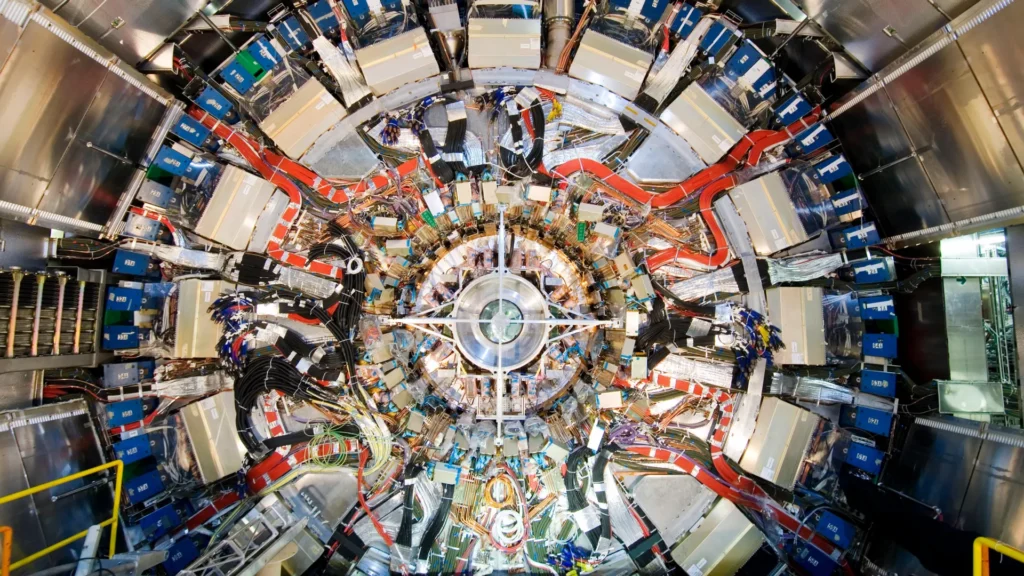
To investigate whether entanglement could withstand such a tumultuous environment, an international team of scientists, prominently featuring researchers from Oxford University, utilized the ATLAS experiment – one of the four massive particle detectors situated around the LHC ring near Geneva, Switzerland. Unlike previous entanglement experiments that focused on photons or other relatively long-lived quantum systems, the ATLAS collaboration embarked on a far more ambitious quest: to search for entanglement between pairs of Z bosons.
Z bosons are massive fundamental particles, approximately 91 times the mass of a proton, and are responsible for mediating the weak nuclear force. Crucially for this experiment, they are incredibly short-lived, with a mean lifetime of approximately 2.6 x 10^-25 seconds. This makes them significantly heavier and more ephemeral than any particle in which entanglement had previously been definitively observed. The Z bosons examined in this experiment were not directly produced in the proton collisions but rather emerged from the decay of a Higgs boson, the particle discovered at the LHC in 2012, which gives mass to other fundamental particles. A Higgs boson, itself a product of these high-energy collisions, can briefly decay into two Z bosons, which then almost instantaneously decay further into pairs of electrons or muons – stable, detectable particles.
Fleeting Z Bosons Leave Enduring Quantum Clues
The ephemeral nature of Z bosons presented a formidable experimental challenge. Since they vanish almost immediately after their creation, direct measurement of their properties, let alone their entangled states, is impossible. However, the sophisticated ATLAS detector is engineered to accurately measure the trajectories, energies, and momenta of the stable "daughter" particles produced by their decay, namely electrons and muons.
The researchers meticulously analyzed the angles at which these electrons and muons emerged from the decay points within the ATLAS detector. By carefully reconstructing the kinematics of these decay products, they were able to infer and reconstruct the "spins" of the original, short-lived Z bosons. In quantum mechanics, spin is an intrinsic form of angular momentum, a fundamental property of particles that can be thought of as an internal rotation, though it does not correspond to a literal spinning motion in space. Just like a classical top, a particle’s spin has a direction, and in entangled pairs, these spins are correlated in a specific quantum mechanical way, far beyond what classical physics would allow.
Through this intricate reconstruction process, the team was able to determine whether the two Z bosons exhibited the precise correlations in their inferred spins that are characteristic of quantum entanglement. The measurements provided strong, compelling evidence that they did. This result represents one of the highest energy confirmations of quantum entanglement ever achieved, pushing the boundaries of where and how entanglement can manifest. The energy scale of 13 TeV and the mass of the Z bosons place this experiment in a unique domain, far removed from the typical energy scales (often in the electron-volt or milli-electron-volt range) of traditional quantum optics or condensed matter entanglement experiments.
A Vision Realized: The Chronology of Extreme Entanglement
The journey to this discovery was not sudden but built upon years of theoretical insight and technological development. A key figure in this evolving field is Professor Alan Barr, based at Oxford’s Department of Physics. Professor Barr was among the first researchers to propose the audacious idea that particle colliders, traditionally used for discovering new particles and probing fundamental forces, could also be repurposed to investigate quantum entanglement at energies far exceeding those accessible in conventional quantum experiments.
Professor Barr, who was himself involved in the construction and commissioning of the LHC, recognized the immense potential of this colossal machine beyond its primary mission. His pioneering ideas helped inspire a previous, landmark ATLAS experiment in 2023, which successfully demonstrated entanglement between pairs of top quarks. Top quarks are the heaviest known elementary particles, with a mass of approximately 173 GeV/c^2, making that finding an unprecedented achievement in itself. The current Z boson entanglement confirmation builds upon this success, further validating Barr’s vision and demonstrating the versatility of the LHC as a quantum laboratory. This chronology highlights a deliberate and strategic pivot in particle physics, moving beyond mere particle discovery to explore the foundational quantum nature of the universe at its most energetic scales.
Expert Perspectives: Robustness, Philosophy, and Collaboration
The implications of this finding have resonated deeply within the scientific community, prompting insightful reflections from the researchers involved. Professor Alan Barr articulated the profound shift in perspective this discovery represents: "We’re used to thinking of entanglement as something delicate, seen in laboratory experiments with single photons. Finding it alive and well among particles as heavy and short-lived as Z bosons, created in some of the most violent collisions we can produce on Earth, shows just how fundamental and robust this quantum effect really is." He added, "It’s a nice reminder that the same strange rules of quantum mechanics that may one day power quantum computers are at work everywhere in nature, even at the extreme energies of the Large Hadron Collider." This statement underscores a paradigm shift: entanglement is not a fragile anomaly confined to carefully isolated systems but an inherent, robust feature of the quantum fabric of reality, persisting even amidst the chaotic inferno of particle collisions.
The work also extends beyond experimental physics into the realm of philosophy. Professor Chris Timpson, from Oxford’s Faculty of Philosophy and a co-PI on a related interdisciplinary project, offered a philosophical lens on the discovery: "Entanglement is both the most promising and the most puzzling aspect of quantum reality; these collider experiments detecting entanglement present a new frontier in investigations of the foundations of quantum mechanics." This highlights the ongoing dialogue between physics and philosophy in understanding the implications of quantum phenomena for our perception of reality itself. The experiments challenge our intuitive understanding of space, time, and causality, prompting deeper philosophical inquiry into the nature of existence.
The successful execution of such a complex experiment is a testament to the power of international collaboration and cutting-edge technology. Professor Daniela Bortoletto, from the Department of Physics at Oxford University, who serves as the UK coordinator for producing the modules for the upgraded ATLAS detector’s pixel system, emphasized this point: "This measurement demonstrates the scientific power of the ATLAS collaboration and the unique capabilities of CERN’s Large Hadron Collider. Oxford researchers have played a leading role in developing these new approaches to studying quantum phenomena at the highest energies, and we are proud to contribute to an international effort that is opening new ways to explore the fundamental laws of nature." Her statement underscores the vital role of sustained investment in infrastructure and international scientific cooperation.
Broader Impact: Quantum Information Meets Particle Physics
This pioneering research is part of a much broader, burgeoning effort to bridge the gap between quantum information science – the field underpinning quantum computing and communication – and high-energy particle physics. This interdisciplinary fusion holds immense promise for both fields.
By applying concepts and techniques developed for sensitive quantum systems to the enormous datasets generated by particle colliders, researchers hope to create more sensitive and nuanced ways of detecting subtle patterns. Traditional particle physics often relies on statistical deviations from predictions of the Standard Model. However, quantum information techniques, such as quantum machine learning algorithms or advanced entanglement measures, could potentially enhance the signal-to-noise ratio, allowing physicists to uncover correlations or effects that are currently too faint or complex to discern with classical methods. These enhanced analytical tools could eventually reveal phenomena that do not fit within physicists’ current understanding of the universe, potentially offering tantalizing clues about physics beyond the existing Standard Model – theories that could explain dark matter, dark energy, or reconcile gravity with quantum mechanics.
At Oxford University, Professor Barr co-leads a major interdisciplinary project specifically focused on the foundations of quantum mechanics at high energies. This project is not only pushing the experimental boundaries of quantum behavior at extremely small scales and very high energies but also delving into the profound philosophical questions raised by such experiments, examining what they may reveal about the underlying nature of reality itself. This holistic approach ensures that the scientific advancements are accompanied by a critical examination of their broader implications.
Future Horizons: Deeper Quantum Probes at CERN
The journey into extreme quantum entanglement is far from over. Oxford University scientists are actively contributing to the ongoing upgrade of the ATLAS detector, a massive undertaking designed to enhance its capabilities. These improvements, combined with the upcoming High-Luminosity Large Hadron Collider (HL-LHC), are expected to usher in a new era of discovery. The HL-LHC, slated to begin operations in the late 2020s, will increase the number of proton-proton collisions by a factor of ten, providing vastly larger datasets and offering physicists unprecedented opportunities to investigate quantum phenomena at even greater precision and statistical power at extreme energies.
The sheer volume of additional data expected from the HL-LHC will also allow researchers to apply even more sophisticated quantum information techniques to particle physics analyses. This enhanced analytical power is anticipated to significantly increase the sensitivity of future searches for previously unknown phenomena, potentially leading to breakthroughs in our understanding of the fundamental forces and particles that govern the cosmos. The synergy between technological advancements in detector design, computational prowess, and theoretical insights from quantum information science is poised to unlock new frontiers in fundamental physics, continuing CERN’s legacy as a crucible for scientific discovery.
The study, officially titled "Measurements of Z-boson pair entanglement in decays of Higgs bosons at the ATLAS experiment," published in Physical Review Letters, represents a monumental step. It confirms that the "spooky action at a distance" is not merely a delicate laboratory phenomenon but a robust, ubiquitous feature of the quantum universe, influencing even the most energetic and transient particles. This finding not only deepens our appreciation for the strange beauty of quantum mechanics but also ignites new pathways for discovery, potentially leading us closer to a unified understanding of the fundamental laws of nature.