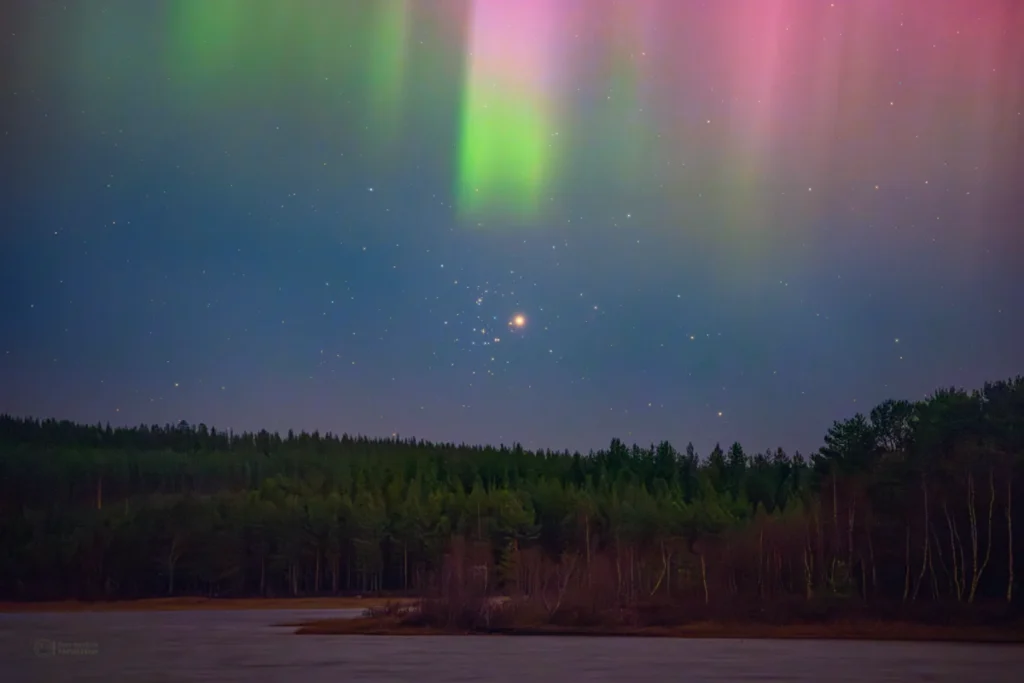
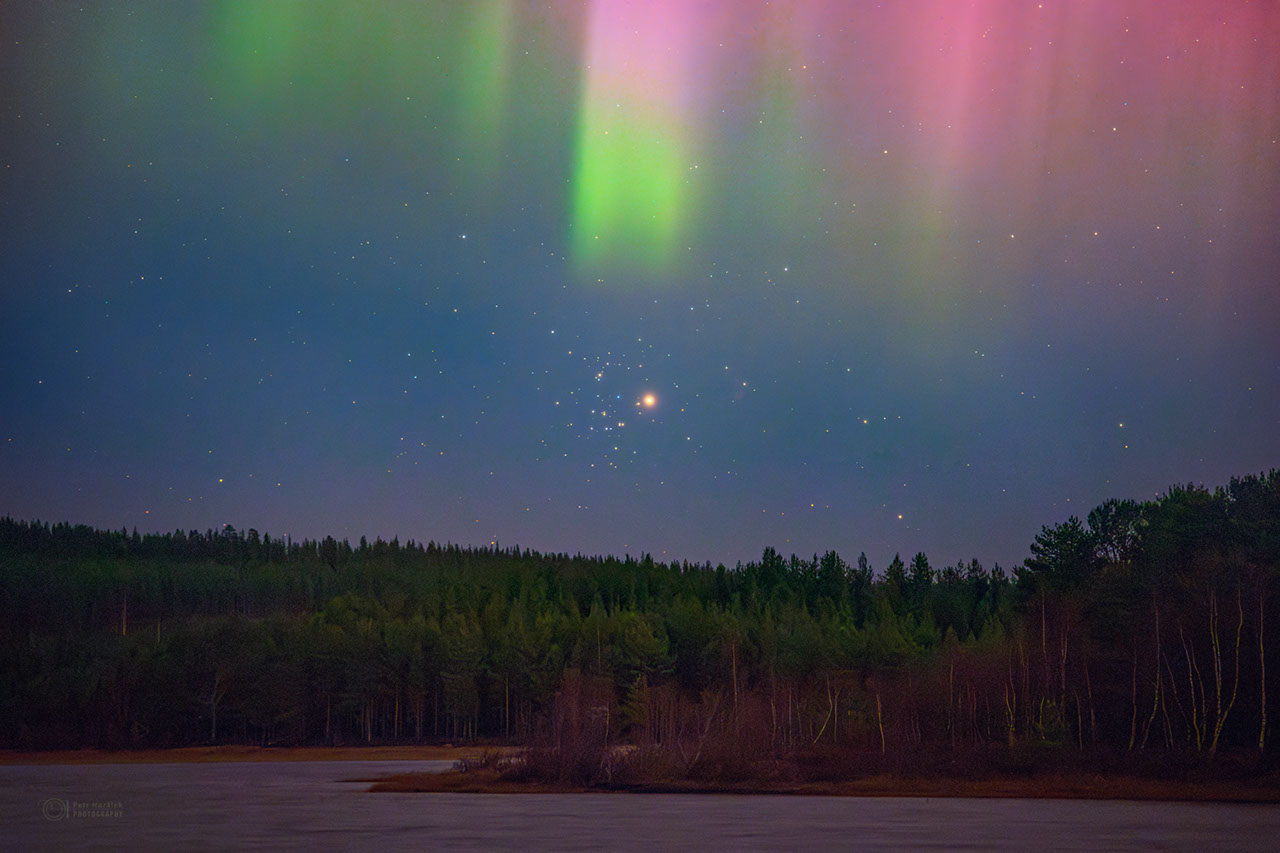
October 14, 2026 – In a celestial ballet of rare alignment and vibrant atmospheric phenomena, the planet Mars has graced the night sky, appearing in close proximity to the Beehive Cluster (M44). This astronomical spectacle, captured in a breathtaking image from Lansjärv, Sweden, was further amplified by a spectacular aurora, a luminous curtain of light painting the horizon. The confluence of these events, occurring on October 10th, 2026, offers a unique opportunity to explore not only the beauty of the cosmos but also the intricate workings of solar activity and stellar evolution.
A Celestial Encounter: Mars and the Beehive Cluster
The image prominently features the reddish hue of Mars, positioned near the heart of the Beehive Cluster, also known as Praesepe. This open star cluster, located in the constellation Cancer, is a collection of thousands of stars that formed together and have since dispersed. While Mars is a familiar neighbor in our solar system, its apparent close alignment with a distant star cluster is a matter of perspective, a result of our viewing angle from Earth. This particular alignment, where Mars appeared closest to the center of the Beehive Cluster, was a serendipitous occurrence, adding a layer of wonder to the night’s observation.
The Beehive Cluster itself is a fascinating astronomical object. Composed of approximately 1,000 stars, it is estimated to be around 600 million years old. Its stars, like many in open clusters, are thought to be relatively young in cosmic terms. Studying the rotation periods of these stars has provided astronomers with invaluable data, shedding light on how stars evolve and slow down over time. As stars age, they tend to lose mass through stellar winds – streams of charged particles ejected from their outer layers. This mass loss directly influences their rotational speed, causing them to spin more slowly as they mature. Understanding these processes is crucial for comprehending the life cycles of stars and the formation of planetary systems.
Aurora Borealis: A Solar Storm’s Fiery Dance
The vibrant aurora that dominates the upper portion of the captured image is a direct consequence of a significant solar event. On October 10th, 2026, an eruption from the Sun, specifically a coronal mass ejection (CME), reached Earth. CMEs are massive bursts of solar wind and magnetic fields that can travel at incredible speeds through space. When these charged particles from the Sun collide with Earth’s magnetic field, they are channeled towards the planet’s poles.
The interaction of these energetic particles with molecules in Earth’s upper atmosphere triggers the spectacular light show we know as the aurora. Oxygen atoms, for instance, emit green and red light, while nitrogen atoms can produce blue and purple hues. The intensity and colors of the aurora depend on the energy of the incoming particles and the composition of the atmospheric gases they encounter. The aurora seen in the image, described as a "curtain of light," is a classic manifestation of this phenomenon, often influenced by the strength and direction of the Earth’s magnetic field lines.
The geomagnetic storm associated with this CME was classified as strong, indicating a significant disturbance in Earth’s magnetic field. Such storms can have various effects, from disrupting satellite communications and power grids to enhancing auroral displays. In this instance, the storm provided a spectacular backdrop for the celestial alignment, transforming a clear night sky into a canvas of cosmic art.
Indigenous Perspectives and Cultural Significance
The aurora, known as "guovssahasat" in the North Sámi language, holds deep cultural significance for the Sámi people, an indigenous group indigenous to the Arctic regions of Sweden, Norway, Finland, and Russia. Traditionally, the aurora has been viewed with a mixture of awe and respect, often interwoven with folklore and spiritual beliefs. Understanding these cultural connections adds another layer to the appreciation of such natural wonders, reminding us of humanity’s long-standing relationship with the cosmos.
A Photographer’s Vision: Capturing the Moment
The stunning photograph is credited to Petr Horálek, in collaboration with Josef Kujal and Vojan Höffer. Horálek, an accomplished astrophotographer known for his work capturing celestial events in natural landscapes, expertly framed the scene in Lansjärv, Sweden. The foreground features the dark silhouettes of trees and a river, grounding the cosmic spectacle in a terrestrial setting and enhancing the sense of scale and wonder. The inclusion of "happy little trees," as alluded to in the explanation, suggests a deliberate artistic choice to imbue the image with a sense of peace and connection to nature, reminiscent of Bob Ross’s iconic painting style.
The Science Behind the Scenes: NASA’s Role
This astronomical picture of the day (APOD) is a service provided by NASA, specifically the Astrophysics Science Division (ASD) at Goddard Space Flight Center, in collaboration with NASA Science Activation and Michigan Technological University. The APOD project aims to educate and inspire the public by showcasing a different image of the universe each day, accompanied by an explanation from a professional astronomer. This initiative plays a vital role in disseminating scientific knowledge and fostering a broader understanding of our place in the cosmos.
The explanation accompanying the image delves into the scientific underpinnings of the event, linking the aurora to solar activity and providing context for the Beehive Cluster’s stellar properties. The authors and editors, including Keighley Rockcliffe, Robert Nemiroff, and Jerry Bonnell, are instrumental in curating and presenting these astronomical highlights to a global audience.
Broader Implications and Future Research
The confluence of Mars, the Beehive Cluster, and a vibrant aurora serves as a potent reminder of the dynamic and interconnected nature of the universe. The study of solar storms and their impact on Earth’s magnetosphere is an ongoing area of research, with significant implications for space weather forecasting and the protection of our technological infrastructure. Understanding how stars evolve, as exemplified by the Beehive Cluster, is fundamental to our comprehension of stellar life cycles and the potential for habitability on exoplanets.
The very notion of "cosmic coincidence" highlights the statistical probabilities inherent in astronomical observations. While Mars and the Beehive Cluster may appear close in the sky, their physical separation is immense. However, these apparent alignments offer opportunities for engaging public interest in astronomy and for scientists to gather unique observational data.
As humanity continues to explore space, both through robotic missions and potential human endeavors, understanding phenomena like solar storms and the behavior of celestial bodies becomes increasingly critical. The images and explanations provided by programs like APOD serve as invaluable educational tools, bridging the gap between complex scientific concepts and public understanding. The October 10th, 2026, event, captured so vividly, stands as a testament to the enduring allure of the night sky and the continuous quest to unravel its mysteries.
Looking ahead, the "picture of the day" for the following day is announced as "open space," suggesting a continued exploration of the vastness and wonders of the universe, promising further insights and captivating visuals for astronomy enthusiasts worldwide. The legacy of such events lies not only in the breathtaking imagery but also in the scientific knowledge they inspire and disseminate, pushing the boundaries of human understanding.