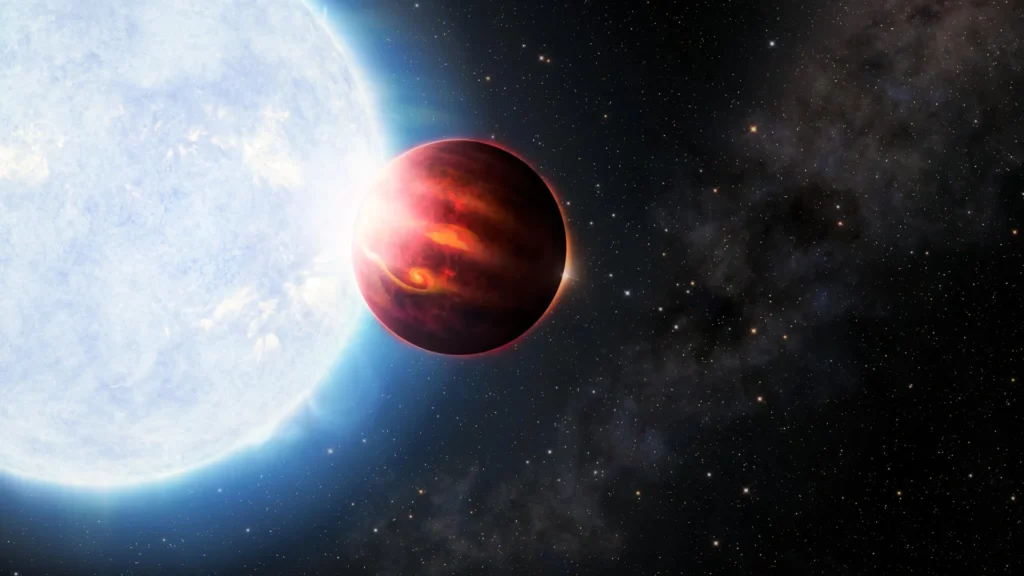
In a groundbreaking astronomical discovery, scientists have obtained the first direct observational evidence supporting a fundamental assumption about how planets form. The ultra-hot Jupiter exoplanet WASP-189b, located nearly 320 light-years away in the constellation Libra, has revealed a shared chemical signature with its host star. This finding not only validates a long-held scientific tenet but also offers a powerful new tool for astronomers seeking to identify and characterize potentially habitable worlds beyond our solar system. The breakthrough was achieved through the simultaneous measurement of gaseous magnesium and silicon in WASP-189b’s atmosphere, an accomplishment made possible by the advanced capabilities of the Gemini South telescope, a key instrument of the International Gemini Observatory, which receives partial funding from the U.S. National Science Foundation and is operated by NSF NOIRLab.
Unveiling the Chemistry of an Extreme World
WASP-189b belongs to a rare and extreme class of planets known as ultra-hot Jupiters (UHJs). These gas giants are characterized by their immense size and exceptionally high temperatures, reaching levels so intense that even materials typically found in solid rock can vaporize into a gaseous state. This extreme environment makes elements such as magnesium (Mg), silicon (Si), and iron (Fe) readily detectable in their atmospheres. Astronomers employ spectroscopy, a technique that dissects light into its constituent wavelengths, to identify the chemical composition of these distant atmospheres.
An international research consortium, spearheaded by Jorge Antonio Sanchez, a graduate student at Arizona State University (ASU), focused its observational efforts on WASP-189b using the high-resolution Immersion GRating INfrared Spectrograph (IGRINS). At the time of the observations, IGRINS was installed on the Gemini South telescope in Chile, a facility renowned for its cutting-edge astronomical instrumentation.
The team’s meticulous analysis resulted in the unprecedented simultaneous measurement of both magnesium and silicon in the atmosphere of an exoplanet. The data revealed a striking consistency: the ratio of magnesium to silicon in WASP-189b’s atmosphere closely mirrors the proportion of these elements found in its parent star. This remarkable congruence provides the first direct observational confirmation of a principle that has long guided planetary science – the assumption that planets and their host stars share a similar primordial chemical makeup.
The Long-Held Assumption: A Cosmic Connection
The prevailing scientific model for planetary formation posits that giant planets like WASP-189b originate from vast, swirling disks of gas and dust that surround young stars. These structures, known as protoplanetary disks, serve as the cosmic nurseries, providing the essential raw materials from which planets coalesce. A crucial element of this theory is the understanding that the chemical composition of a planet’s atmosphere, particularly its outer layers, retains imprints of the environment in which it originally formed.
Because stars and the protoplanetary disks from which they form arise from the same interstellar cloud of gas and dust, scientists have long inferred that they would possess comparable proportions of key rock-forming elements. Specifically, the elemental ratios within a protoplanetary disk are expected to closely resemble those observed in its central star. This presumed chemical kinship has become an invaluable tool for astronomers, enabling them to predict the likely composition of rocky exoplanets by analyzing the light from their host stars.
However, until the recent findings concerning WASP-189b, this foundational assumption had been primarily substantiated by data from our own Solar System. Direct observational proof of this star-planet chemical correlation in planetary systems beyond our own had remained elusive. The study of WASP-189b fills this critical observational gap, providing robust empirical support for the methodology that relies on stellar chemistry to decipher the building blocks of distant planets.
"WASP-189b gives us a much-needed observational anchor in our understanding of terrestrial planet formation since it offers a measurable quantity that validates the presumed resemblance of stellar composition and the proportion of rocky material around host stars used to form planets," stated Sanchez. This validation is a significant step forward, strengthening the scientific basis for existing models and opening new avenues for research.
Implications for Astrobiology and the Search for Life
The implications of this discovery extend far beyond the fundamental mechanics of planet formation. The confirmed chemical relationship between stars and their planets holds significant promise for the field of astrobiology, the scientific endeavor dedicated to exploring the potential for life beyond Earth and the conditions that might foster it.
By accurately assessing the elemental composition of a star, astronomers can now gain a more reliable estimate of the abundance of rock-forming materials available in its planetary system. These materials are instrumental in shaping a planet’s internal structure, driving its geological activity, and dictating its overall chemical environment – all factors that critically influence the development of potentially habitable conditions.
Earth itself serves as a compelling terrestrial example. The specific elements that constitute our planet are directly responsible for fundamental geological and atmospheric processes, including the dynamic nature of plate tectonics, the generation of our protective magnetic field, and the intricate cycling of essential chemicals between the atmosphere, oceans, and soil. Collectively, these processes have created and sustained the environment that allows life as we know it to flourish.
As the scientific community strives to characterize smaller, rocky exoplanets with increasing detail, establishing a dependable link between stellar chemistry and planetary composition becomes paramount. The findings from WASP-189b represent a substantial leap toward achieving this goal, offering a tangible connection that was previously inferred but not directly observed.
Technological Advancements Pave the Way
The ability to detect and measure specific elements in the faint light filtered through exoplanet atmospheres is a testament to the remarkable advancements in astronomical instrumentation. Obtaining these precise measurements necessitates instruments capable of discerning extremely subtle variations in the spectral signatures of light collected from distant celestial bodies. According to the researchers involved, the required spectral resolution for such detailed analysis is currently achievable only through sophisticated ground-based telescopes.
"Our study demonstrates the capability of ground-based, high-resolution spectrographs to constrain critical species like magnesium and silicon, which are two elemental building blocks from which rocky planets form," commented Dr. Michael Line, an Associate Professor at ASU and a co-author of the study. "This advancing capability opens an entirely new dimension in our study of exoplanet atmospheres."
The team anticipates that future observations, employing a wider range of wavelengths and similarly advanced instruments, will enable the detection of an even broader spectrum of elements in exoplanet atmospheres. As our understanding of their chemical compositions becomes more comprehensive, scientists will be better equipped to uncover additional clues regarding the processes of planet formation, the evolutionary pathways of planetary systems, and the specific conditions that might favor the emergence and sustenance of life.
By forging a direct link between the chemistry of a distant planet and that of its parent star, astronomers have now acquired compelling new evidence supporting a principle that could significantly refine and guide the ongoing global quest for potentially habitable worlds scattered throughout the Milky Way galaxy and beyond.
A Timeline of Discovery
The journey leading to this significant discovery involved several key stages:
- Early Theoretical Framework: For decades, astronomers have operated under the assumption that planets inherit their primary elemental composition from the same protoplanetary disks that gave rise to their host stars. This was largely based on observations within our own Solar System.
- Target Identification: WASP-189b, an ultra-hot Jupiter, was identified as an ideal candidate for atmospheric study due to its extreme temperature, which would likely vaporize rocky materials, making their constituent elements detectable.
- Instrumental Development: The development and deployment of advanced spectrographs like IGRINS on telescopes such as Gemini South were crucial for achieving the necessary spectral resolution.
- Observational Campaign: The research team conducted targeted observations of WASP-189b using IGRINS on the Gemini South telescope.
- Data Analysis and Breakthrough: Meticulous analysis of the spectroscopic data led to the simultaneous detection and quantification of gaseous magnesium and silicon in the exoplanet’s atmosphere.
- Confirmation of Stellar-Planetary Ratio: The researchers compared the measured atmospheric ratios to the known elemental composition of the host star, revealing a significant correlation.
- Publication and Dissemination: The findings were published in a peer-reviewed scientific journal, making the discovery accessible to the wider scientific community and the public.
Expert Reactions and Broader Impact
The scientific community has reacted with enthusiasm to this pivotal discovery. Dr. Chris Davis, NSF Program Director for NOIRLab, highlighted the significance of the findings: "These discoveries show Gemini’s ability to help us understand the characteristics of the remarkable zoo of exoplanets in our solar neighborhood. Such discoveries are only possible because of Gemini’s cutting-edge instruments." This statement underscores the instrumental role of advanced observatories in pushing the boundaries of astronomical knowledge.
The implications of this research are multifaceted. For planet formation theorists, it provides much-needed empirical validation for their models, allowing for more refined predictions and deeper insights into the diverse processes that sculpt planetary systems. For astrobiologists, it offers a powerful new method for assessing the potential habitability of exoplanets. By understanding the raw materials available to a planet based on its star’s chemistry, scientists can better prioritize targets for future, more detailed investigations, including the search for biosignatures – indicators of life.
Furthermore, this research exemplifies the power of international collaboration and the critical importance of sustained investment in fundamental scientific research and cutting-edge astronomical facilities. The ability to probe the atmospheres of distant worlds is a relatively recent development, and breakthroughs like this highlight the accelerating pace of discovery in exoplanet science. As telescopes become more sensitive and analytical techniques more sophisticated, the potential for uncovering the secrets of alien worlds and addressing humanity’s deepest questions about our place in the universe continues to grow. The validation of the star-planet chemical link through WASP-189b is not just an academic curiosity; it is a foundational step that will inform and guide the search for life beyond Earth for decades to come.