In 1985, a seemingly modest advertisement in the esteemed pages of Scientific American offered a glimpse into a future where everyday objects could possess an unprecedented level of adaptability. The Innovative Design Fund, with a forward-thinking grant of up to $10,000, sought out "clever prototypes" for applications spanning clothing, home decor, and textiles. It was within this call for innovation that William Freeman, then an electrical engineer at Polaroid and a 1992 graduate of MIT, encountered an idea that would percolate for nearly four decades before finding its full realization. Freeman proposed a radical departure from the ubiquitous two-sided zipper, envisioning a three-sided mechanism that could act as a dynamic switch, transforming objects from a pliable state to a rigid one with remarkable ease. His concept was not merely about fastening; it was about imparting "tunable stiffness" to a variety of items, promising enhanced packability and simplified assembly for everything from tents to purses.
Freeman’s original blueprint, detailed in his patent application, described a triangular zipper. Unlike its linear counterpart, which closes two opposing edges, Freeman’s design featured three distinct belts, each adorned with narrow, interlocking "teeth." A specially designed slider, capable of encircling this triangular structure, could be maneuvered to engage these teeth, effectively straightening them into a compact, triangular tube. This configuration would allow for a significant shift in the rigidity of the attached object. While his initial proposal to the Innovative Design Fund did not secure funding, Freeman recognized the inherent potential of his invention. He patented his prototype and, with a keen eye for future possibilities, stored it away, patiently awaiting a moment when technology might catch up to his vision.
From Garage Prototype to MIT Innovation: The Birth of the "Y-Zipper"
Fast forward to the present day, and the seed of Freeman’s idea has blossomed into a sophisticated technological advancement spearheaded by researchers at the MIT Computer Science and Artificial Intelligence Laboratory (CSAIL). Driven by the ambition to create objects with truly "tunable stiffness," a property that has eluded easy manipulation in previous design endeavors, the CSAIL team has revitalized Freeman’s concept. Prior attempts to achieve variable rigidity often involved cumbersome manual adjustments or irreversible modifications. The CSAIL researchers, however, have engineered a solution that is both automated and adaptable: the "Y-zipper."
This innovative system comprises a sophisticated software design tool and a corresponding adaptable fastener. The software empowers users to customize the parameters of three-sided zippers, which are then brought to life through advanced 3D printing technology using plastics. These newly fabricated Y-zippers are not merely novelties; they are designed for practical integration into a diverse array of applications. From the rugged demands of camping equipment and the critical needs of medical gear to the intricate movements of robotics and the aesthetic expression of art installations, the Y-zipper offers a compelling pathway to more convenient and dynamic assembly.
Jiaji Li, an MIT postdoc and CSAIL researcher who is a lead author on the open-access paper detailing this project, emphasized the transformative nature of Freeman’s original concept and its modern iteration. "A regular zipper is great for closing up flat objects, like a jacket, but Freeman ideated something more dynamic," Li stated. "Using current fabrication technology, his mechanism can transform more complex items." He further elaborated on the significance of their work: "We’ve developed a process that builds objects you can rapidly shift from flexible to rigid, and you can be confident they’ll work in the real world." This assurance of real-world efficacy is a testament to the rigorous development and testing undertaken by the CSAIL team.
Redefining Assembly: The Versatility of the Y-Zipper
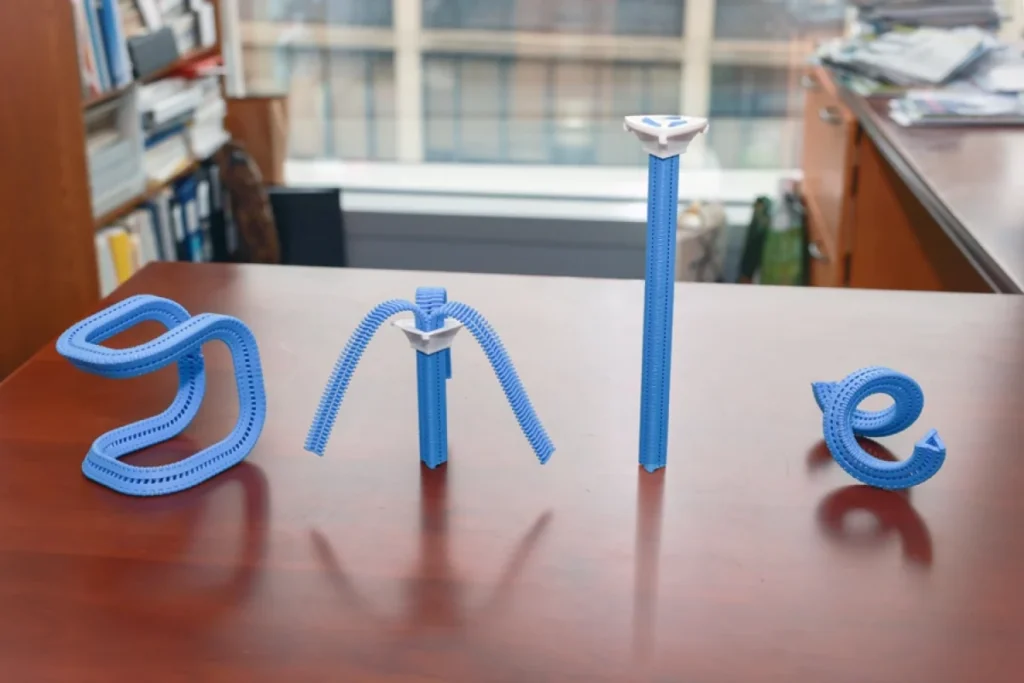
The "why zippers?" question, when applied to this advanced three-sided mechanism, reveals a profound shift in how we can interact with and assemble objects. The CSAIL software provides users with a granular level of control over the Y-zipper’s final form and function. Users can meticulously customize aspects such as the length of each of the three strips, as well as the precise direction and angle at which they will bend when engaged. This level of customization extends to the zipper’s inherent motion primitives, offering four distinct appearances when zipped: straight, bent (forming an arch), coiled (resembling a spring), or twisted (evoking the appearance of screws).
The resulting Y-zipper exhibits a captivating "shape-shifting" capability. In its unzipped state, it can unfurl into a form reminiscent of a squid, with three gracefully extending tentacles. Upon zipping, it compacts into a more rigid structure, such as a slender rod. This inherent flexibility has immediate practical implications, particularly in scenarios where space and ease of deployment are critical.
Streamlining Outdoor Adventures and Enhancing Medical Care
Consider the common task of pitching a tent. What might traditionally take several minutes of fumbling with poles and fabric can be drastically reduced. With the Y-zipper, a process that could normally take up to six minutes can be accomplished in as little as 1 minute and 20 seconds. The principle is straightforward: by attaching each "tentacle" of the Y-zipper to a corresponding edge of the tent canopy, and providing upward support, the zipper’s action can effectively "pop" the structure into place, erecting the tent with remarkable speed and minimal effort.
Beyond recreational applications, the seamless transition between states offered by the Y-zipper holds immense promise for flexible wearables, especially within the medical field. The researchers demonstrated this potential by wrapping a Y-zipper around a wrist cast. This innovation allows a patient to loosen the cast during the day for comfort and then zip it up securely at night to prevent further injury. This adaptability transforms a potentially rigid and uncomfortable medical device into a more personalized and responsive one, directly catering to the fluctuating needs of a patient. The ability to adjust stiffness on demand can significantly improve patient comfort and potentially accelerate recovery times by providing appropriate support when needed.
Empowering Robotics and Dynamic Art
The Y-zipper system also opens doors to the creation of technology that responds dynamically to commands. By attaching a motor to a fabricated Y-zipper, the zipping process can be automated, paving the way for the construction of more sophisticated robotic systems. One compelling example is an adaptive robotic quadruped. Such a robot could dynamically alter the size of its legs, extending them into taller limbs for traversing challenging terrain or retracting them by unzipping when a lower profile is required. This rapid adjustment capability could be instrumental in enabling robots to explore complex environments like canyons or forests, environments that are currently difficult for autonomous systems to navigate.
Furthermore, actuated Y-zippers can be employed to construct dynamic and engaging art installations. The CSAIL team has already showcased this potential by creating a long, winding flower sculpture that "blooms" as a static motor actuates the Y-zipper, demonstrating how mechanical ingenuity can translate into captivating artistic expression. This fusion of engineering and art highlights the broad creative and functional spectrum of the Y-zipper technology.
Mastering the Material: Durability and Future Potential
While the creative and functional possibilities of the Y-zipper are undeniable, a crucial question remained: how durable would these plastic-based fasteners be under sustained, real-world use? To address this, the CSAIL team embarked on a series of rigorous stress tests, meticulously evaluating the strength and flexibility of the plastics commonly employed in 3D printing: polylactic acid (PLA) and thermoplastic polyurethane (TPU).
Their initial experiments involved subjecting the Y-zippers to mechanical bending. These tests revealed that PLA, while capable of handling heavier loads, was less pliable than TPU, which offered greater flexibility. This differential performance suggests that material selection can be tailored to specific application requirements, optimizing for either load-bearing capacity or inherent elasticity.
To assess longevity, the researchers employed an actuator to repeatedly open and close the Y-zipper, simulating continuous use. The results were remarkable: some Y-zippers endured an astonishing 18,000 cycles of zipping and unzipping before eventually failing. Through detailed 3D simulations, the team identified the key factor contributing to this impressive durability: the inherent elastic structure of the Y-zipper. This elasticity plays a critical role in distributing the stress imposed by heavy loads, thereby preventing premature failure.
Despite these encouraging findings, Li and his colleagues are not resting on their laurels. They envision future iterations of the three-sided zipper that leverage even stronger materials, such as metals, to achieve unparalleled durability and load-bearing capabilities. The current 3D printing platform, while advanced, also presents limitations for fabricating significantly larger zippers. Overcoming these constraints could unlock applications for massive-scale projects, further expanding the Y-zipper’s potential.
Unexplored Frontiers and Expert Endorsements
The potential applications for the Y-zipper extend far beyond the immediate demonstrations. Li pointed to intriguing possibilities in space exploration, where the unique "tentacle-like" structure of the Y-zipper could be integrated into spacecraft for grasping and collecting rock samples from celestial bodies. The ability to assemble structures rapidly with Y-zippers could also be a game-changer in disaster relief scenarios. Imagine emergency responders quickly deploying shelters or medical tents in the wake of natural disasters, significantly reducing the time it takes to establish critical infrastructure.
The significance of this work has not gone unnoticed by the broader scientific community. Guanyun Wang, an assistant professor at Zhejiang University who was not involved in the research, offered a strong endorsement. "Reimagining an everyday zipper to tackle 3D morphological transitions is a brilliant approach to dynamic assembly," Wang commented. "More importantly, it effectively bridges the gap between soft and rigid states, offering a highly scalable and innovative fabrication approach that will greatly benefit the future design of embodied intelligence." This expert opinion underscores the Y-zipper’s potential to influence the development of intelligent systems and adaptable robotics.
The research paper detailing the Y-zipper project was co-authored by Jiaji Li and William Freeman, alongside Tianjin University PhD student Xiang Chang. The MIT CSAIL team contributing to this breakthrough included PhD student Maxine Perroni-Scharf, undergraduate Dingning Cao, and recent visiting researchers Mingming Li (Zhejiang University), Jeremy Mrzyglocki (Technical University of Munich), and Takumi Yamamoto (Keio University). The work was further guided by MIT Associate Professor Stefanie Mueller, a CSAIL principal investigator and senior author on the paper. Funding for this innovative research was partially provided by a postdoctoral research fellowship from Zhejiang University and the MIT-GIST Program, highlighting the collaborative international efforts behind this advancement.
This groundbreaking research was formally presented at the ACM’s premier conference, the CHI (Conference on Human Factors in Computing Systems), held in April, where it garnered significant attention for its novelty and practical implications. The journey of the three-sided zipper, from a 1980s visionary concept to a 21st-century engineered reality, exemplifies the enduring power of innovative ideas and the relentless pursuit of technological advancement. The Y-zipper stands as a testament to how revisiting foundational concepts with modern tools can unlock solutions to complex design challenges, promising a future where objects are not just static entities but dynamic participants in our built environment.