Scientific breakthroughs rarely happen all at once. More often, they evolve slowly, as researchers and engineers build on years of steady progress until the extraordinary eventually becomes routine. Now, scientists may be reaching a turning point in that gradual journey. Researchers from the University of Michigan and the Air Force Research Laboratory (AFRL) have demonstrated a way to 3D print intricate tubular structures whose unique internal geometry allows them to suppress vibrations in ways never seen in natural materials. These creations belong to a class known as mechanical metamaterials—engineered substances with properties that come entirely from their design rather than their composition.
The ability to block or reduce vibrations could be valuable across many industries, from transportation and construction to aerospace and sensitive scientific instrumentation. The team’s findings, published in the esteemed journal Physical Review Applied, represent a significant leap from decades of theoretical exploration and computer modeling to the tangible creation of real-world structures capable of passively disrupting the transmission of vibrations.
The Dawn of Practical Vibration Isolation Metamaterials
"That’s where the real novelty is. We have the realization: We can actually make these things," stated James McInerney, a research associate at AFRL, highlighting the tangible achievement of the project. McInerney, who previously served as a postdoctoral fellow at the University of Michigan under Professor Xiaoming Mao of the Department of Physics, emphasized the practical implications of their work. "We’re optimistic these can be applied for good purposes. In this case, it’s vibration isolation."
This groundbreaking research received crucial financial backing from prominent governmental agencies, including partial funding from the Defense Advanced Research Projects Agency (DARPA) and the Office of Naval Research. Additional support was provided by the U.S. National Research Council Research Associateship Program, a prestigious initiative administered by the National Academies of Sciences, Engineering, and Medicine, which fosters scientific advancement through postdoctoral fellowships. The collaborative effort also saw significant contributions from Serife Tol, an associate professor of mechanical engineering at the University of Michigan; Othman Oudghiri-Idrissi from the University of Texas; and Carson Willey and Abigail Juhl of AFRL.
Geometry as the New Chemistry: A Paradigm Shift in Material Science
Professor Xiaoming Mao articulated the fundamental shift in approach underpinning this research: "For centuries, humans have improved materials by altering their chemistry. Our work builds on the field of metamaterials, where it is geometry—rather than chemistry—that gives rise to unusual and useful properties. These geometric principles can apply from the nanoscale to the macroscale, giving us extraordinary robustness." This assertion underscores a paradigm shift in material science, moving beyond elemental composition to the precise arrangement of matter as the primary determinant of material behavior.
McInerney elaborated on the interdisciplinary nature of the study, stating that it "brings together classical structural engineering, modern physics, and cutting-edge manufacturing tools such as 3D printing." This convergence of disciplines has enabled the translation of theoretical concepts into functional prototypes.
From Theory to Tangible: The 3D Printing Revolution
The advent of advanced additive manufacturing techniques, particularly 3D printing, has been instrumental in bringing the theoretical potential of mechanical metamaterials into reality. This technology allows for the fabrication of complex geometries that were previously impossible or prohibitively expensive to produce using traditional manufacturing methods.
"There’s a real probability that we’re going to be able to manufacture materials from the ground up with crazy precision," McInerney envisioned. "The vision is that we’re going to be able to create very specifically architectured materials and the question we’re asking is, ‘What can we do with that? How can we create new materials that are different from what we’re used to using?’"
As Professor Mao pointed out, the innovation lies not in modifying a material’s intrinsic chemical properties but in meticulously controlling its shape and structure at a fine scale. This geometric control can unlock novel and advantageous mechanical properties. Nature itself provides ample evidence of this principle. For instance, the remarkable strength and resilience of human bones and the delicate yet robust shells of plankton are achieved through intricate geometries inherent in their composition from relatively simple materials. With sophisticated tools like 3D printing, scientists can now mimic and even surpass these natural designs, engineering materials with unprecedented capabilities.
"The idea isn’t that we’re going to replace steel and plastics, but use them more effectively," McInerney clarified, emphasizing that metamaterials are poised to augment, rather than supplant, existing material paradigms.
Historical Roots and Topological Innovations
While this work is at the forefront of modern material science, its conceptual foundations are rooted in historical scientific advancements. The research draws inspiration from the work of 19th-century physicist James Clerk Maxwell. Though widely recognized for his contributions to electromagnetism and thermodynamics, Maxwell also delved into mechanics, developing crucial design principles for creating stable structures composed of repeating subunits, known as Maxwell lattices. These lattices, characterized by their specific geometric arrangements, demonstrated inherent stability and load-bearing capabilities.
Another pivotal concept that informs this study emerged in the latter half of the 20th century: the discovery that peculiar and significant material behaviors often manifest at the edges and boundaries of substances. This observation spurred the development of a new field of study, topology, which continues to actively investigate these phenomena and explore their potential for real-world applications.
"About a decade ago, there was a seminal publication that found out that Maxwell lattices can exhibit a topological phase," McInerney noted, referencing a key theoretical development that bridged the gap between abstract mathematical concepts and tangible material properties.
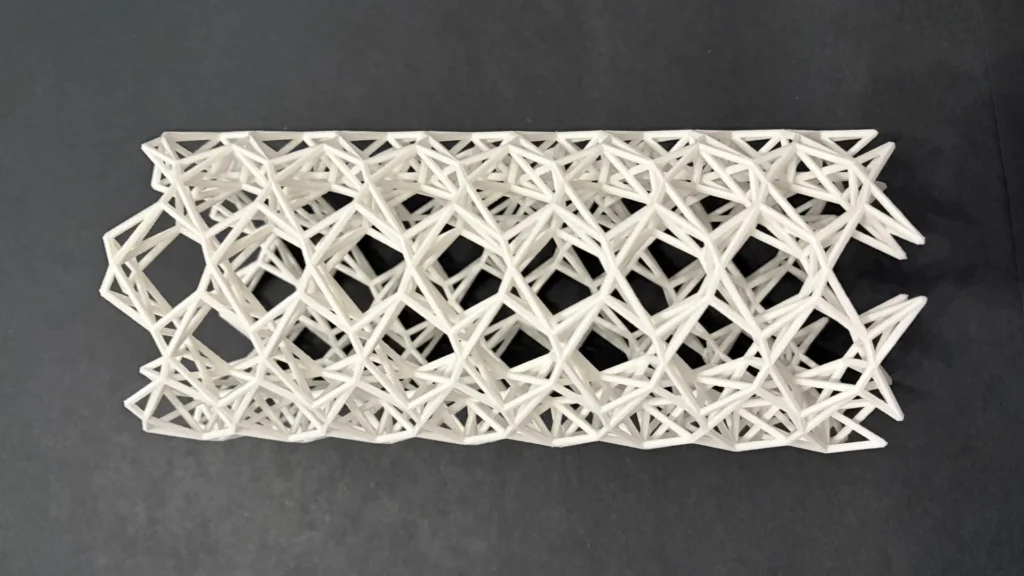
Over the past several years, McInerney and his colleagues have systematically explored the implications of this theoretical breakthrough for vibration isolation. They have successfully developed a comprehensive model that explains this behavior and outlines how to design physical objects that would exhibit it. The culmination of this extensive research is the proof-of-concept demonstration: the successful fabrication of such objects using 3D-printed nylon.
The Kagome Tube: A Geometry for Silence
A cursory examination of the fabricated structures reveals the intricate design that was previously challenging to achieve. These structures resemble a chain-link fence that has been artfully folded and rolled into a tubular form, featuring interconnected inner and outer layers. Physicists have termed these structures "kagome tubes," a nomenclature derived from traditional Japanese basket weaving techniques that employ similar intricate, repeating patterns. This specific geometric configuration is critical to the material’s vibration-dampening properties.
Challenges and Future Directions: Balancing Performance and Practicality
Despite the remarkable achievement, this represents only the initial phase in realizing the full potential of these novel structures. McInerney pointed out a significant trade-off identified in their study: the enhanced vibration suppression capability of a structure directly correlates with a reduction in its load-bearing capacity. This presents a considerable challenge, as a compromise between vibration isolation and structural integrity could be unacceptable for certain applications. However, this trade-off also illuminates fascinating avenues for future research and fundamental scientific inquiry.
As these novel structures move from laboratory prototypes to potential real-world applications, a critical need arises for the development of new standards and methodologies for their testing, characterization, and assessment. This presents an exciting frontier for scientists and engineers.
"Because we have such new behaviors, we’re still uncovering not just the models, but the way that we would test them, the conclusions we would draw from the tests and how we would implement those conclusions into a design process," McInerney explained. "I think those are the questions that honestly need to be answered before we start answering questions about applications." This forward-looking perspective underscores the scientific rigor driving the project, prioritizing foundational understanding and robust validation before widespread deployment.
Broader Implications and Potential Applications
The successful demonstration of 3D-printed tubular metamaterials capable of vibration suppression opens a vast landscape of potential applications across numerous sectors.
In the transportation industry, these materials could revolutionize vehicle design. Imagine quieter, smoother rides in automobiles, trains, and aircraft, achieved not through complex active dampening systems, but through the inherent properties of the vehicle’s structure itself. This could lead to enhanced passenger comfort, reduced material fatigue due to vibration, and improved fuel efficiency by minimizing unnecessary structural mass. For high-speed rail, where vibration is a significant concern affecting both ride quality and track maintenance, these metamaterials could offer a passive and cost-effective solution.
The construction sector stands to benefit significantly. Buildings in earthquake-prone regions could incorporate vibration-isolating foundations or structural elements, providing enhanced seismic resilience. Bridges and other infrastructure could be designed to withstand the constant vibrations from traffic and wind more effectively, leading to increased longevity and reduced maintenance costs. In urban environments, the reduction of noise and vibration transmitted from sources like subways or heavy machinery could dramatically improve the quality of life for residents.
The aerospace and defense industries are particularly well-positioned to leverage these advancements. Sensitive electronic equipment and payloads within spacecraft, satellites, and aircraft are susceptible to damage from vibrations during launch and operation. Metamaterials could provide a lightweight and highly effective means of protecting these critical components. For defense applications, silent operation is paramount; these materials could contribute to stealth technologies by minimizing the acoustic signature of machinery and vehicles. Furthermore, in the realm of precision instruments used in defense and intelligence, such as advanced sensor arrays or targeting systems, vibration isolation is crucial for maintaining accuracy.
In scientific research, laboratories often house delicate and expensive equipment that requires extremely stable environments. The ability to create custom-designed vibration-isolating platforms or enclosures could significantly enhance the precision of experiments in fields ranging from particle physics to advanced microscopy. For example, the sensitivity of gravitational wave detectors like LIGO relies heavily on minimizing external disturbances, a challenge that could be addressed by incorporating such metamaterials.
The development also has implications for the manufacturing sector. High-precision machinery used in manufacturing processes, such as semiconductor fabrication or intricate machining, can be compromised by vibrations. Metamaterials could form the basis of more stable work surfaces and machine components, leading to higher production yields and improved product quality.
Finally, the fundamental research into topology and mechanical metamaterials contributes to our broader understanding of physics and materials science. This deeper knowledge could unlock entirely unforeseen applications in the future, much like the foundational work on electromagnetism eventually led to technologies like radio and the internet. The journey from understanding Maxwell lattices to fabricating vibration-silencing kagome tubes exemplifies the power of building upon established scientific principles with modern tools and interdisciplinary collaboration. This breakthrough signifies not just an engineering feat but a profound step forward in our ability to engineer the physical world at its most fundamental levels.