A subtle, persistent hum of extremely low frequency gravitational waves, recently detected through an intricate network of cosmic beacons known as pulsars, may hold profound clues to some of the most dramatic events that unfolded more than 13 billion years ago. This includes the mysterious emergence of some of the Universe’s earliest supermassive black holes, challenging existing cosmological models and opening an unprecedented window into the epoch of "cosmic dawn."
In a groundbreaking study published as a Letter in the prestigious journal Physical Review D, researchers Sohan Ghodla and Cosmin Ilie from Colgate University have meticulously investigated whether supermassive black holes that originated in the nascent Universe could have evolved to produce a significant portion of the gravitational wave background now being meticulously measured by Pulsar Timing Arrays (PTAs). Their findings forge a remarkable and unexpected link between two seemingly disparate areas of astronomical inquiry: the direct observation of surprisingly massive black holes in the Universe’s infancy and the ripples in spacetime generated billions of years later by the cataclysmic mergers of colossal black hole pairs.
The research suggests a compelling possibility: one particular class of hypothetical early black hole seeds – specifically, the remnants left behind by supermassive Dark Stars – could potentially account for a dominant contribution to the elusive PTA signal. This revelation transforms the narrative around gravitational wave astronomy, suggesting it’s not merely a probe of recent cosmic mergers but a powerful tool for archaeology, capable of unearthing the very foundations of cosmic structures.
"Pulsar timing arrays are traditionally conceived as instruments primarily designed to probe supermassive black hole binaries in the relatively recent cosmic past," stated Dr. Ilie, co-author of the study, emphasizing the paradigm shift. "What our work profoundly demonstrates is that this signal, observed today, may also contain invaluable information about the formation mechanisms and conditions of the ancestors of those black holes, specifically how they formed during the Universe’s cosmic dawn. In essence, these gravitational waves, traveling across billions of years, could provide an entirely new and unparalleled window onto the birth of the first supermassive black holes."
Pulsars: Cosmic Clocks and Gravitational Wave Detectors
At the heart of these discoveries are Pulsar Timing Arrays, a global network of some of the Universe’s most extraordinary objects: rapidly spinning neutron stars known as pulsars. These celestial bodies are the remnants of massive stars that have undergone supernova explosions, leaving behind incredibly dense, rotating cores that emit beams of radio waves from their magnetic poles. As these beams sweep across Earth, they are detected as highly regular, precise pulses, effectively transforming pulsars into extraordinarily accurate cosmic clocks.
The principle behind PTA detection is elegant yet complex. As gravitational waves – ripples in the fabric of spacetime predicted by Albert Einstein’s theory of general relativity – traverse the vast cosmic distances between a pulsar and Earth, they subtly stretch and squeeze spacetime. These distortions cause minuscule, yet measurable, changes in the arrival times of the radio pulses at our planet. By meticulously tracking hundreds of pulsars across the Milky Way over extended periods, international collaborations of astronomers have collectively found compelling evidence for a stochastic (random, background) gravitational wave background at nanohertz frequencies. This detection marks a new era in astronomy, providing the first glimpse into a cosmic symphony of gravitational waves that permeate the Universe.
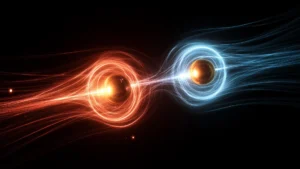
The most widely accepted astrophysical explanation for this pervasive background is a vast, unresolved population of supermassive black hole binaries, each pair slowly but inexorably spiraling inward towards a catastrophic merger. These colossal systems, often found at the centers of merging galaxies, whose combined black hole masses exceed approximately a billion times that of our Sun, are predicted to make especially significant contributions at the incredibly low nanohertz frequencies detectable by PTAs. This frequency range corresponds to gravitational waves with periods ranging from months to years, indicative of the extremely large scales and immense masses involved in these cosmic dance partners.
The Enduring Mystery of Early Supermassive Black Holes
While the existence of supermassive black hole binaries provides a compelling source for the observed gravitational wave background, it simultaneously raises a more fundamental and profound question: how did their original "seeds" form? The conventional understanding of black hole growth often struggles to explain the sheer size and early appearance of some of the Universe’s most massive black holes. Observatories like the venerable Chandra X-ray Observatory and, more recently, the revolutionary James Webb Space Telescope (JWST) have made astonishing discoveries, detecting supermassive black holes that were already surprisingly massive at unexpectedly early stages of cosmic history – often within the first billion years after the Big Bang, at high redshifts (z > 6-7). These observations have intensified scientific interest in formation mechanisms capable of producing large black hole seeds very quickly, challenging the notion that black holes grow predominantly through slow accretion and mergers over cosmic time.
Ghodla and Ilie’s investigation squarely addresses this enigma. They modeled whether the descendants of such ancient, rapidly formed black hole seeds could persist through cosmic time, growing in tandem with their host galaxies, eventually pairing up as galaxies merge, and ultimately generating the distinct gravitational wave background that PTAs are detecting billions of years later. This framework connects the very earliest moments of structure formation to the gravitational wave signals we observe in the present day, offering a unique observational test for theoretical models of early Universe astrophysics.
Could Dark Stars Seed Giant Black Holes? Exploring Formation Pathways
The researchers delved into two leading theoretical pathways for producing massive black hole seeds in the early Universe, each with distinct implications for the observed gravitational wave background.
The first pathway involves direct collapse black holes (DCBHs). This scenario posits that under specific, rare conditions in the early Universe – typically in pristine gas clouds free of heavy elements and exposed to intense ultraviolet radiation – massive gas clouds could bypass the normal stellar evolutionary stages and collapse directly into black holes. These DCBHs are predicted to form with initial masses ranging from 10^4 to 10^5 solar masses, providing a substantial head start for growth compared to black holes formed from the collapse of individual massive stars (which are typically tens to hundreds of solar masses).
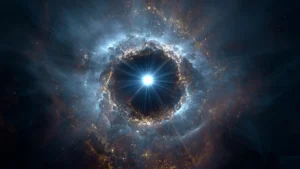
The second, more speculative, yet increasingly compelling pathway explored is the formation of black holes through the collapse of supermassive Dark Stars (SMDS). Dark Stars are a hypothetical class of primordial stars that represent a fascinating intersection of astrophysics and particle physics. Unlike conventional stars, which derive their energy primarily from nuclear fusion in their cores, Dark Stars are theorized to receive much of their internal heating from the annihilation of Weakly Interacting Massive Particles (WIMPs), a leading candidate for dark matter. In the WIMP dark matter scenario considered in the study, dark matter particles accumulate in the centers of early protogalaxies, heating the surrounding hydrogen and helium gas. This heating prevents the gas from cooling sufficiently to fragment and form many smaller stars. Instead, the gas collapses into a single, enormous, diffuse "Dark Star."
These Dark Stars would possess unique characteristics: they would remain relatively cool and extended, powered by dark matter annihilation, allowing them to continue gathering material from their surroundings for prolonged periods. Under the right conditions, they could grow to truly gargantuan sizes – a million times the mass of the Sun or more – before their dark matter fuel is exhausted or they become unstable and eventually collapse into massive black holes. These black holes, stemming from Dark Stars, would also represent a significant initial mass, providing a rapid route to supermassive black hole formation.
Ghodla and Ilie meticulously modeled how black holes produced through both of these pathways – DCBHs and SMDS remnants – would evolve over cosmic history. Their simulations tracked the dark matter halos hosting these nascent black holes, estimated the frequency with which these objects would merge as their host galaxies collided, and subsequently calculated the cumulative gravitational wave background that these mergers would produce across cosmic time, extending all the way to the present day.
Revealing Cosmic Dawn through Gravitational Waves
The results of their sophisticated modeling are highly illuminating. Their analysis indicates that if remnants of supermassive Dark Stars existed at a number density of approximately 10^-3 Mpc^-3 (meaning roughly one such object per thousand cubic megaparsecs, where a megaparsec is about 3.26 million light-years), their descendants could provide a large, and potentially dominant, share of the gravitational wave signal currently measured by PTAs. This suggests a direct and measurable connection between the presence of these exotic primordial objects and the gravitational wave background we observe.
In contrast, the direct collapse black hole population, while a viable formation mechanism, appears to have been much less common in the models considered. With characteristic densities near 10^-6 Mpc^-3 (roughly one per million cubic megaparsecs), these objects would contribute substantially less to the observed PTA signal, making them a less likely dominant source for the measured gravitational wave background. This differentiation is crucial, as it provides a potential observational discriminator between competing theoretical models of early black hole formation.
One of the study’s most profound conclusions is that current PTA measurements are not just detecting gravitational waves; they are simultaneously placing crucial limits on how common the earliest seeds of supermassive black holes could have been. "Produce too many of these massive seeds, and you inevitably end up over-producing the PTA-detected signal, exceeding what our observations allow," explained Ghodla, highlighting the delicate balance. "Conversely, produce too few, and you then require other, exceptionally efficient sources and mechanisms to assemble these supermassive black holes later in the life of the Universe to match the observed PTA signals."
Within the specific models examined by the researchers, seed densities around the 10^-2 to 10^-1 Mpc^-3 range (one per hundred to one per ten cubic megaparsecs) would begin generating more gravitational wave background than current observations permit. The precise upper limit on seed density is strongly dependent on the masses of the dark matter halos where those seeds originally formed, reflecting the complex interplay between black hole formation and the larger cosmic environment.
This critical finding endows PTA observations with an unexpected and powerful ability to probe extremely ancient populations of objects. They may be able to constrain the properties and abundance of objects that existed at redshifts greater than 10 – a period deep within the Universe’s "cosmic dawn" when the first stars and galaxies were forming – even though the mergers of their descendants that generate the detectable gravitational waves happen much later in cosmic history, often billions of years after their formation. This represents a novel and indirect way to peer into an epoch otherwise extremely challenging to observe.
The calculations also lend further support to an earlier finding in gravitational wave astronomy: binary systems with total black hole masses roughly above 10^9 solar masses (a billion Suns) overwhelmingly dominate the predicted PTA signal. Binary systems containing less massive black holes contribute significantly less, underscoring the fact that the nanohertz gravitational wave background is primarily a signature of the Universe’s most massive black hole behemoths.
Connecting Dark Matter, Dark Stars, and Black Holes
The implications of this study ripple across several major questions in modern cosmology, creating a new and exciting observational link between previously disparate fields. It connects the fundamental nature of dark matter – the invisible substance that makes up about 27% of the Universe – to the formation of the first luminous objects (stars and galaxies), to the enigmatic origins of supermassive black holes, and finally, to the gravitational waves that ceaselessly travel through the Universe.
"Dark Stars were originally proposed as exotic objects that might be directly observable at cosmic dawn, perhaps through their unique spectral signatures," Dr. Ilie elaborated. "This work, however, points to a completely different, indirect, yet equally compelling way of testing their possible role in cosmic history. Their colossal descendants, through their gravitational-wave imprint, could leave a detectable signature that persists all the way to the present-day Universe, long after the Dark Stars themselves have vanished."
As Pulsar Timing Array measurements continue to become more precise with longer observation times and improved data analysis techniques, and as astronomers enhance their understanding of distant black holes and the galaxies that hosted them through telescopes like JWST and future observatories, researchers anticipate being able to distinguish more clearly among the competing theoretical explanations for how the Universe’s first supermassive black holes formed. This confluence of gravitational wave astronomy, observational cosmology, and theoretical astrophysics promises to unlock unprecedented insights into the Universe’s earliest moments, potentially revealing a story written in the very fabric of spacetime, a story that began more than 13 billion years ago. The persistent hum of gravitational waves may well be the echo of cosmic genesis.