Scientists investigating the perplexing asymmetry between the Moon’s near and far sides have uncovered compelling new evidence, suggesting that vast, heat-driven movements within the Moon’s ancient magma ocean played a pivotal role in shaping its distinct hemispheres billions of years ago. This groundbreaking research, led by Professor Hejiu Hui of Nanjing University, leverages precious lunar rock samples returned by China’s Chang’e-6 (CE6) mission, offering an unprecedented direct comparison with material previously gathered from the near side.
The analysis focused on three primary types of lunar rocks: anorthosites, Mg-suite rocks, and mare basalts. By meticulously examining their chemical compositions and comparing samples from the CE6 mission’s far-side landing site with those collected during the United States’ Apollo missions and China’s Chang’e-5 (CE5) mission from the near side, the research team has provided strong support for a model where large-scale thermal convection within the Moon’s primordial molten interior, following its tidal locking to Earth, was the driving force behind its contrasting geological personalities.
The Enigma of Lunar Duality: A Long-Standing Scientific Puzzle
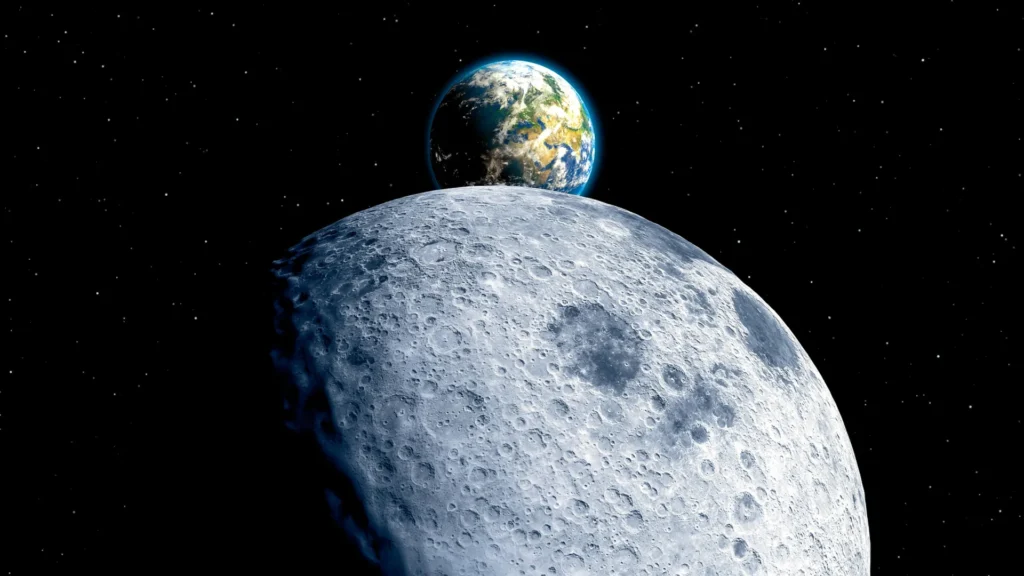
The Moon’s appearance from Earth is characterized by a striking dichotomy. The near side, which perpetually faces our planet, is marked by expansive, dark plains of volcanic basalt, interspersed with regions rich in potassium, rare earth elements, and phosphorus (KREEP). This side also exhibits a thinner crust. In stark contrast, the far side is a rugged expanse of ancient, heavily cratered highlands, boasting a significantly thicker crust and a conspicuous absence of extensive volcanic plains. This uneven distribution of geological features has puzzled lunar scientists for decades, prompting a variety of hypotheses.
Previous explanations have ranged from variations in the circulation patterns of the Moon’s original magma ocean to the aftermath of a colossal impact event, the effects of gravitational tidal heating, and differential development of the lunar crust. However, no single theory has achieved universal consensus, leaving a significant void in our understanding of the Moon’s formative processes. A crucial unanswered question has been whether these visible differences extended deep into the lunar mantle, or if they were primarily confined to the crustal layers.
Chang’e-6: A Quantum Leap in Lunar Sample Analysis
The arrival of the Chang’e-6 mission in 2024 marked a historic moment in lunar exploration. As the first mission ever to successfully return samples from the far side of the Moon, it provided scientists with a unique opportunity to directly compare geological materials from both hemispheres. This capability has proven instrumental in resolving long-standing debates about lunar evolution.
The recent analysis of these CE6 samples has unveiled a surprising degree of uniformity at deeper levels of the lunar interior. Specifically, the mare basalts collected from the far side exhibit chemical signatures that point to an origin from depleted mantle material. This finding mirrors the characteristics of low-titanium basalts brought back by the Apollo astronauts from the near side. The implication is profound: the mineral accumulations, known as cumulates, that formed as the Moon’s magma ocean cooled and solidified, do not appear to exhibit significant compositional differences between the near and far sides of the Moon.
Further corroboration for this conclusion has emerged from the examination of Mg-suite rocks. These rocks are formed through complex interactions between the crust and mantle, particularly when portions of the accumulated mantle material undergo partial melting. The magnesium number (Mg#), a key indicator of the magnesium content relative to other elements like iron, in these Mg-suite rocks provides crucial insights into the composition of the mantle material from which they originated.
The research team found that the Mg# values of Mg-suite samples retrieved by Chang’e-6 from the far side are remarkably similar to those of comparable Apollo samples from the near side. This similarity strongly suggests that the mantle cumulates underlying both hemispheres share broadly comparable chemical characteristics. In essence, the fundamental building blocks that crystallized from the Moon’s ancient magma ocean appear to be chemically consistent across the entire Moon, defying expectations of deep-seated asymmetry.
Crustal Contrasts: Where the Moon’s Duality Takes Shape
While the lunar mantle appears to be a region of remarkable uniformity, the lunar crust presents a decidedly different narrative, showcasing the pronounced contrasts that define the Moon’s two faces.
Anorthosite samples, a key component of the lunar highlands, returned by the Chang’e-6 mission exhibit higher peak Mg# values compared to their Apollo counterparts. This indicates a greater abundance of magnesium-rich material in the far-side crust, a finding consistent with earlier remote sensing observations that suggested a thicker and potentially more mafic crust on this hemisphere.
The researchers also identified significant chemical disparities within the Mg-suite rocks themselves. Samples from the Chang’e-6 mission revealed exceptionally low concentrations of rare earth elements and lower thorium-to-samarium (Th/Sm) ratios than their near-side Apollo counterparts. These chemical signatures point towards distinct evolutionary pathways for these magmas in the two hemispheres.
Two primary explanations have been proposed for these observed differences. One possibility is that the Mg-suite magmas on the far side formed without substantial input from KREEP-rich material, a component known to be concentrated on the near side. Alternatively, the layer or reservoir containing these KREEP elements may have developed unevenly across the Moon, leading to a differential distribution of chemical compositions between the hemispheres.
Earth’s Gravitational Influence: A Catalyst for Lunar Asymmetry
Synthesizing these findings, the research team has formulated a compelling model that elegantly explains the genesis of the Moon’s strikingly different near and far sides. This model centers on the profound influence of Earth’s gravity and the dynamic processes within the Moon’s early molten state.
According to their proposed scenario, the Moon’s primordial magma ocean initially cooled and crystallized in a relatively homogenous manner. This process laid down the initial mantle cumulates and the foundational anorthositic crust. This phase predates the Moon becoming tidally locked to Earth, a crucial milestone in its orbital evolution.
The situation dramatically shifted once the Moon settled into its stable, synchronous orbit, where one hemisphere perpetually faced Earth. During this formative period, the Earth and Moon were significantly closer than they are today. The intense gravitational tidal forces exerted by Earth generated substantially more heat on the lunar near side compared to the far side.
This uneven heating created a significant temperature gradient across the Moon’s still-molten interior, initiating vigorous, large-scale horizontal circulation of magma. Molten material, along with previously formed magnesium-rich anorthosite, was transported from the warmer near side towards the cooler far side.
Over eons, this continuous flow of material led to an accumulation of crustal material on the far side, thereby contributing to the development of its thicker crust and higher magnesium content. Concurrently, the remaining molten material preferentially flowed towards the near side. This differential movement resulted in the far side developing relatively thin layers enriched in KREEP and ilmenite-bearing cumulates (IBCs), while a greater concentration of these late-stage materials became localized on the near side.
This model of heat-driven magma circulation offers a robust explanation for the observed dichotomy: a chemically similar mantle underlying dramatically different crustal compositions. By integrating the newly analyzed Chang’e-6 samples with the Moon’s early thermal history and its tidal interaction with Earth, these findings provide invaluable insights into the complex geological processes that sculpted our closest celestial neighbor.
Broader Implications and Future Research
The implications of this research extend beyond simply solving an ancient lunar mystery. Understanding the processes that led to the Moon’s asymmetrical evolution can provide a valuable analog for studying the formation and differentiation of other rocky bodies in the solar system and beyond. The fact that the mantle appears so uniform while the crust exhibits such dramatic differences highlights the complex interplay of internal dynamics and external influences in planetary evolution.
This research also underscores the immense scientific value of sample return missions. The ability to directly analyze extraterrestrial materials in terrestrial laboratories allows for a level of detail and precision unattainable through remote sensing alone. The success of Chang’e-6 in retrieving samples from the far side opens up a new era of lunar science, promising further revelations about the Moon’s history and its relationship with Earth.
Future research will likely focus on further refining the models of magma ocean circulation, investigating the precise timing and duration of these thermal events, and exploring the role of other potential factors, such as differences in initial composition or the precise nature of impact events. The ongoing analysis of the Chang’e-6 samples, and the potential for future missions to similar regions, will undoubtedly continue to illuminate the intricate geological tapestry of the Moon. This study represents a significant stride towards a comprehensive understanding of how the Moon, and by extension other celestial bodies, acquired their unique geological identities.