Investors poured an unprecedented amount of capital into the drone market in 2025, with total investments reaching just under $4 billion, a record-breaking figure. The momentum shows no signs of abating, as the first two months of 2026 reportedly saw an additional $1.7 billion injected into the industry, signaling a potential for a second consecutive year of record-breaking investment. Against this backdrop of significant market growth, a seemingly modest six-figure angel investment round secured by Austrian startup DropForce Systems warrants close examination. The funding, provided by Austrian firm BarnVentures and Germany’s LNX GmbH, which collectively acquired a 20 percent stake in DropForce, underscores a significant shift in the drone industry’s value proposition.
This investment in DropForce Systems is particularly noteworthy as it embodies the very evolution that is capturing investor attention. The company’s innovative approach to distributed, on-site drone manufacturing reframes these complex machines not as durable, high-value assets, but rather as a more consumable and readily available resource. This paradigm shift, succinctly summarized by the Dealroom database as "Distributed, on-site manufacturing reframes drones as a consumable rather than a durable asset," is a key indicator of the future direction of the drone market and its associated business opportunities.
The Rise of Distributed Manufacturing in the Drone Sector
The concept of distributed manufacturing, particularly when enabled by advanced technologies like additive manufacturing (3D printing), is rapidly gaining traction across various industries. In the drone sector, this approach addresses several critical challenges, including supply chain vulnerabilities, the need for rapid deployment, and the increasing demand for customized or specialized aerial platforms.
Companies like Firestorm Labs have already pioneered containerized systems for drone production, primarily serving the U.S. military. These solutions offer a degree of on-site manufacturing capability, allowing for the assembly and deployment of drones closer to operational theaters. DropForce Systems builds upon this concept, offering not only containerized production systems but also self-driving vans equipped with integrated manufacturing cells. This mobility and flexibility are crucial for military and emergency response operations where rapid deployment and on-demand production are paramount.
DropForce Systems’ Tactical Case: Pushing the Boundaries of On-Site Production
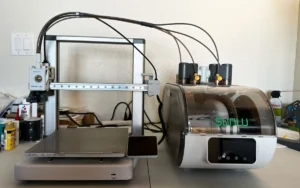
While DropForce Systems’ larger-scale containerized solutions are significant, their "Tactical Case" represents a particularly compelling innovation. This ruggedized, man-portable case is designed to enable a single individual to deploy a drone manufacturing capability virtually anywhere. This represents the logical extreme of AM-enabled distributed production, a direction that appears to be increasingly favored within the industry.
The strategic advantage of such a product is amplified by current geopolitical realities. The company’s founding in Europe, with its founders having direct experience in the aerospace and drone sectors, positions them ideally to address the demand conditions exacerbated by ongoing global conflicts, such as Russia’s war in Ukraine. The ability to produce drones quickly and efficiently in remote or contested areas is a critical capability that DropForce Systems aims to provide.
Jakub Hamdard, CEO, and Christian Mühl, CTO, bring a wealth of experience to DropForce Systems. Their previous roles at Diamond Aircraft, an Austrian manufacturer of gliders, and their broader experience with both satellites and drones, provide a strong foundation for their innovative venture. This background in aviation and unmanned systems likely informed their understanding of the critical need for flexible and resilient drone production capabilities.
Core Business Model: Beyond 3D Printing
While the ability to 3D print drone components is central to DropForce’s model, it is not the sole driver of their business. The company’s primary offering, the FPV (First-Person View) system named the STURM 01, is not entirely 3D printable. This distinction is crucial to understanding DropForce’s revenue generation strategy.

The company plans to offer fully assembled drones, but their core revenue stream is expected to come from the sale of components that cannot be manufactured through additive processes. This includes critical electronic components, which are essential for the functionality of any drone. DropForce acknowledges the global reliance on China for certain electronics and rare earth materials but is actively prioritizing sourcing as many components as possible from within the European Union. This includes the design and manufacturing of their own circuit boards, a move that enhances their control over the supply chain and potentially offers greater reliability and security.
Synergies with Complementary Businesses
The innovative approach of DropForce Systems aligns well with other players in the drone ecosystem. Companies like Unusual Machines, based in Orlando, Florida, which focuses on selling non-3D printable drone components to users who complete their builds using additive manufacturing, represent a potential partnership opportunity. Unusual Machines, as a user of 3D printing technology itself and a supplier of essential components, could benefit from DropForce’s distributed manufacturing capabilities and vice versa.
The CEO of Unusual Machines, Allan Evans, previously highlighted the growing demand signals for additive manufacturing in the drone sector, particularly in response to White House executive orders concerning drone usage. This indicates a broader market trend that DropForce Systems is well-positioned to capitalize on.
The Importance of Firmware in a Distributed Network
The success of an enterprise built around a distributed production network hinges on robust management and maintenance of that network. DropForce Systems is currently developing its own proprietary firmware, which will be a critical factor in achieving this goal. This firmware will likely be responsible for managing production schedules, quality control, inventory of printable materials and non-printable components, and potentially even remote diagnostics and updates for the distributed manufacturing units.
The company’s ambitious selling point of achieving "20 minutes per drone" production time underscores the critical role of efficient firmware and streamlined operational processes. This rapid turnaround time, if realized, would be a significant differentiator in a market where rapid deployment is often a key requirement.
Navigating a Competitive and Evolving Landscape
The drone market, particularly the defense sector, is characterized by intense competition and significant capital investment. Many established players and emerging companies have secured substantially larger funding rounds than DropForce Systems. However, the company’s relatively leaner funding structure could, paradoxically, become an advantage.
This smaller initial investment allows DropForce Systems the agility to adapt to the rapidly changing market landscape without the burden of substantial sunk costs in outdated technologies or strategies. The drone market has undergone dramatic transformations in just the past few years, and companies that are not rigidly tied to previous market assumptions are better positioned to innovate and succeed.
The defense startup space is witnessing unprecedented innovation and disruption. The unique value proposition offered by DropForce Systems, focusing on accessible, on-demand, and distributed drone manufacturing, positions them as a compelling contender. Their ability to leverage additive manufacturing for rapid prototyping and production, combined with a strategic focus on essential non-3D printable components and proprietary firmware, suggests a well-thought-out strategy for navigating this complex and dynamic industry. The success of DropForce Systems will be a significant indicator of the growing viability of decentralized manufacturing models in critical sectors.
This article was compiled using information from various industry sources, including droneii.com, companieshistory.com, trendingtopics.eu, Dealroom.co, and 3dprint.com. The investment figures and market trends cited reflect reported data and analysis from early 2026.