In a landmark development for the field of quantum optics, researchers at the Max Planck Institute for the Science of Light (MPL) in Erlangen, Germany, have successfully demonstrated that individual molecules positioned on a surface can reach the absolute quantum limit of optical coherence. This achievement, recently detailed in the journal Science, effectively resolves a long-standing paradox in quantum physics: how to maintain the delicate, fragile states of a quantum emitter while keeping it accessible on a physical interface. By overcoming the "noise" and contamination typically associated with surfaces, the team has paved the way for a new generation of quantum technologies that combine the precision of scanning probe microscopy with the high-fidelity information processing of quantum optics.
The Quest for the Ideal Quantum Emitter
At the heart of the burgeoning quantum revolution lies the search for the perfect "quantum emitter." These are microscopic systems—typically individual atoms, ions, or molecules—that can interact with light at the level of single photons. These emitters serve as the fundamental building blocks for quantum computers, where they act as qubits, and for quantum communication networks, where they function as nodes that store and transmit quantum information over vast distances.
For decades, the gold standard for studying these systems has involved isolating them from their environment as much as possible. Scientists have traditionally achieved this by trapping atoms in high-vacuum chambers using complex laser configurations or by embedding molecules deep within the crystalline lattice of a solid-state material. While these methods provide the stability required to observe quantum phenomena, they come with a significant drawback: the emitters are "buried" or "caged." They are difficult to manipulate directly and even harder to integrate into complex, multi-layered circuits or to interact with external sensors.
The alternative—placing these emitters directly onto a surface—has long been the "holy grail" of the field. A surface-bound molecule could, in theory, be manipulated with the atomic precision of a Scanning Tunneling Microscope (STM) or an Atomic Force Microscope (AFM). This would allow researchers to build quantum circuits "atom by atom." However, until now, the transition from the bulk interior of a crystal to its surface has resulted in a catastrophic loss of quantum coherence.
The Challenge of the "Noisy" Surface
The primary obstacle to surface-based quantum optics is the inherent instability of physical interfaces. In the macroscopic world, surfaces appear solid and static, but at the nanometer scale, they are chaotic environments. Even in high-quality laboratory settings, surfaces quickly accumulate layers of water molecules, hydrocarbons, and other environmental contaminants.
These contaminants, along with the thermal vibrations of the surface atoms (phonons) and fluctuating electric fields, create a "noisy" environment. For a quantum emitter, this noise leads to decoherence—the process by which a quantum system loses its unique properties and reverts to a classical state. In practical terms, this means the light emitted by the molecule becomes "jittery" or inconsistent, making it useless for quantum information processing.
Before the MPL breakthrough, molecules on surfaces typically exhibited coherence times that were hundreds or even thousands of times shorter than those of their counterparts embedded deep within crystals. This gap was widely considered an unavoidable tax on the accessibility of surface-bound systems.
A Novel Solution: The Sublimation Cleaning Method
The research team, led by Professor Vahid Sandoghdar, Director at the MPL and a pioneer in the field of nano-optics, approached this problem not by attempting to shield the molecule from the surface, but by reimagining the surface itself. The team utilized organic crystals, which are known for their excellent optical properties, but applied a clever thermodynamic trick to ensure their purity.
The process begins with the principle of sublimation—the transition of a substance directly from a solid to a gas phase without passing through a liquid state. At room temperature, many organic crystals undergo sublimation at a slow, steady rate. The MPL researchers realized that this "evaporating" surface acts as a self-cleaning mechanism. As the outermost layers of the crystal turn into gas, they carry away any dust, water, or chemical contaminants that may have settled on the surface.
To capture this pristine state, the researchers placed the crystal inside a cryostat—a specialized vacuum chamber designed to reach extreme temperatures. Once the sublimation process had "peeled" the crystal to a clean layer, the team rapidly cooled the system to temperatures just a few degrees above absolute zero (approximately 1.4 Kelvin). This extreme cold effectively "froze" the surface in its ultra-pure state, halting further sublimation and preventing new contaminants from adhering.
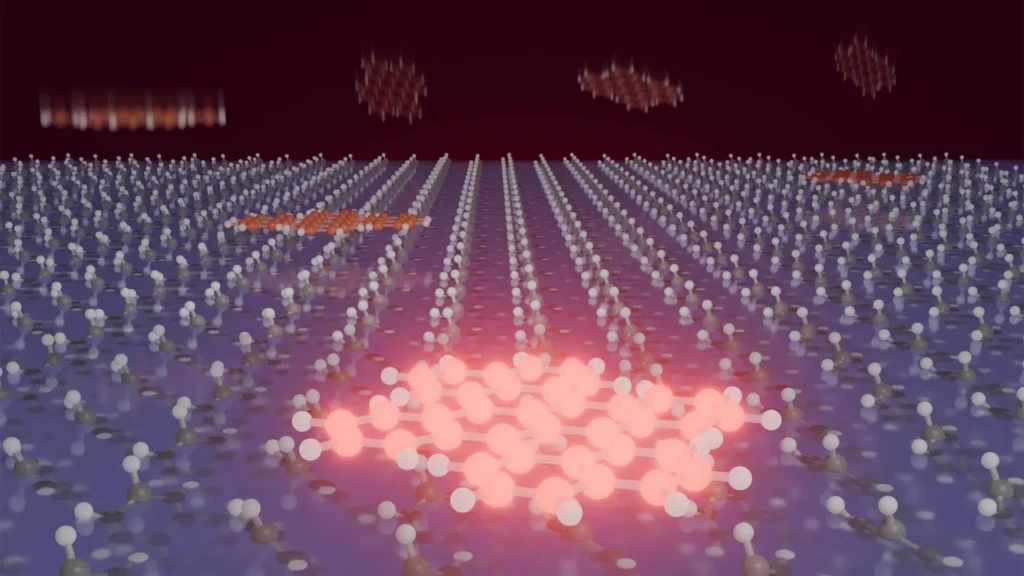
With the surface prepared, the team used a precision-engineered molecular oven to evaporate a small number of target molecules onto the cold crystal. These molecules settled onto the surface like dew on a windowpane, but in an environment so quiet and stable that their quantum signatures remained intact.
Reaching the Fourier Limit: The Ultimate Benchmark
The success of the experiment was measured against a fundamental physical boundary known as the Fourier limit. In quantum optics, the quality of a photon source is defined by its coherence time ($T_2$). There is a theoretical maximum for this value, dictated by the excited-state lifetime of the molecule ($T_1$). According to the laws of physics, the coherence time can never exceed twice the lifetime ($T_2 leq 2T_1$).
When a system reaches this $T_2 = 2T_1$ ratio, it is said to be "Fourier-limited." This state represents the pinnacle of quantum stability; it means that the only thing causing the molecule to lose its quantum state is the inevitable release of energy as it emits a photon. There is no additional "noise" from the environment interfering with the process.
Through rigorous spectroscopic analysis, Dr. Alexey Shkarin and his colleagues at the MPL Nano-Optics Division demonstrated that the molecules on their self-cleaned surfaces consistently reached this Fourier limit. This was a historic first. By showing that surface-bound molecules could perform as well as those protected in a vacuum or deep inside a solid, the team proved that the "surface tax" on quantum coherence could be eliminated.
Experimental Chronology and Technical Milestones
The path to this discovery was built on several years of incremental progress in the Nano-Optics Division at MPL. The chronology of the project highlights the interdisciplinary nature of the work:
- Phase I: Material Selection (2020-2021): The team identified specific organic host-guest systems (such as dibenzoterrylene molecules in anthracene or p-terphenyl crystals) that were known for high photostability at cryogenic temperatures.
- Phase II: Cryogenic Engineering (2021-2022): Development of a custom cryostat setup that allowed for in-situ surface preparation. This was critical, as moving a sample from a cleaning chamber to a measurement chamber would have introduced immediate contamination.
- Phase III: The Sublimation Protocol (2022-2023): Fine-tuning the temperature and timing of the sublimation process. The researchers had to balance the rate of surface renewal with the need to maintain the structural integrity of the crystal.
- Phase IV: Spectroscopic Validation (2023-2024): Using high-resolution laser spectroscopy to measure the linewidths of the emitted photons. The narrowing of these lines until they hit the Fourier limit provided the definitive proof of their success.
Deeper Insights: How Surfaces Mold Molecular Behavior
Beyond achieving the coherence limit, the MPL team used their new platform to observe how the surface environment subtly influences molecular properties. This is a field known as surface science, but conducted with a level of precision previously impossible for quantum emitters.
The researchers observed that the orientation of the molecules on the surface was not random; rather, the crystal lattice of the host material forced the molecules to align in specific directions. Furthermore, they detected minute shifts in the energy levels of the molecules and changes in their vibrational modes. These observations suggest that the surface acts as a "template" that can be used to tune the optical properties of the emitter.
"Our findings show that the surface is not just a platform, but an active participant that can be understood and eventually controlled," noted Dr. Shkarin. "We can see how the proximity to the interface alters the way the molecule breathes and vibrates."
Broader Impact and Future Implications
The implications of this research extend far beyond the laboratory. By demonstrating that high-quality quantum emitters can exist on a surface, the Max Planck Institute has opened the door to several transformative technologies:
1. Hybrid Quantum-Nano Systems:
The most immediate application is the integration of these emitters with scanning probe technologies. Prof. Sandoghdar’s vision involves using an AFM or STM tip to move individual molecules on the surface, creating "quantum circuits" on demand. This would allow for the study of collective quantum effects, such as superradiance, where multiple molecules interact to emit light in a synchronized, ultra-bright burst.
2. Quantum Sensing:
Because these molecules are on the surface, they are incredibly sensitive to their immediate environment. They could function as "quantum microphones" or "nanoscale thermometers," capable of detecting the tiniest fluctuations in electric or magnetic fields at the atomic level. This has potential applications in biological imaging and material science.
3. Scalable Quantum Networking:
Current quantum networks often rely on bulky equipment to interface light with matter. Surface-bound molecules could be integrated into on-chip photonic circuits—tiny "highways" for light—allowing for more compact and scalable quantum communication devices.
4. Fundamental Physics:
This platform provides a new window into the transition between quantum and classical physics. By slowly introducing "noise" or contaminants back onto the clean surface, researchers can study exactly how and why decoherence occurs, providing data that could refine our understanding of quantum mechanics.
Expert Analysis and Scientific Reaction
The scientific community has reacted to the Science publication with significant interest. Independent analysts suggest that the "self-cleaning crystal" method solves a bottleneck that has existed since the early days of single-molecule spectroscopy in the 1980s.
"The ability to reach the Fourier limit on a surface is a watershed moment," says one senior researcher in the field of solid-state physics. "It moves us away from the ‘black box’ approach where we hope the emitter is stable, and toward an ‘engineering’ approach where we can see and touch the quantum system we are measuring."
Professor Sandoghdar emphasizes that this is only the beginning. The next phase of research at the Max Planck Institute for the Science of Light will focus on achieving "local nanometer control." By combining their ultra-clean surface technique with advanced microscopy, the team aims to manipulate individual quantum emitters with billionth-of-a-meter precision, essentially playing "quantum billiards" with molecules to forge the next generation of light-based technology.
As quantum technology moves from theoretical models to practical hardware, the ability to bridge the gap between the fragile quantum world and the tangible physical surfaces of our devices will be the defining challenge of the next decade. The work at MPL suggests that, with enough ingenuity and a bit of "clever cleaning," that gap is finally closing.