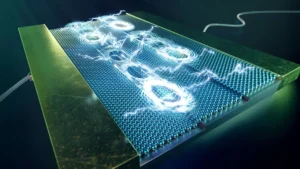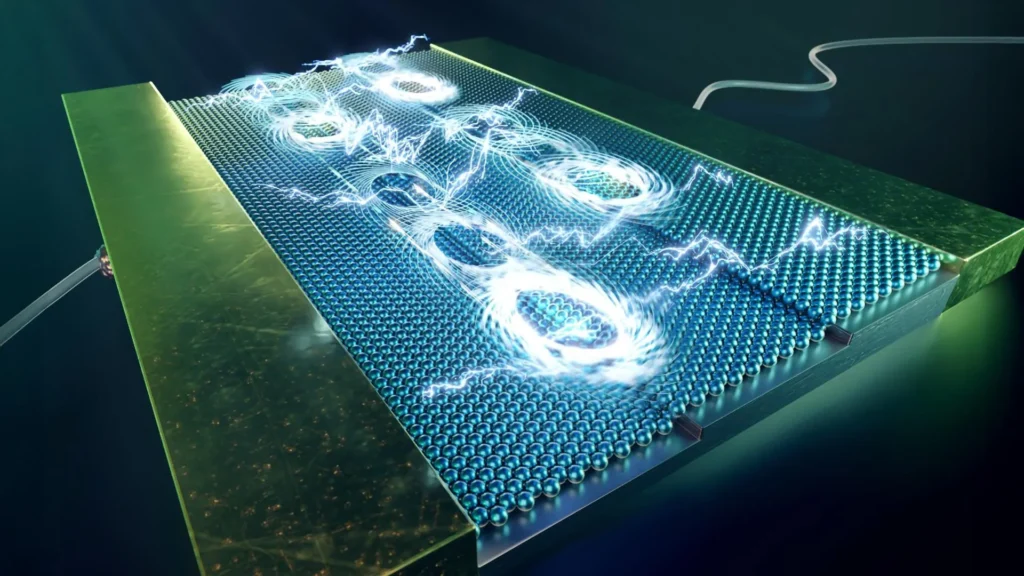
Scientists in Japan have made a groundbreaking discovery, revealing that atomic-scale steps, mere fractions of a nanometer in height, can function as microscopic guiding rails for quantum vortices within an ultrathin superconductor. This remarkable phenomenon, observed by researchers at the Research Center for Materials Nanoarchitectonics (MANA), part of Japan’s National Institute for Materials Science (NIMS), demonstrates that these one-atom-high surface features can dramatically influence quantum behavior, enabling vortices to move more than 1,000 times more easily along these steps than across them under specific conditions. Furthermore, the team found that this guiding effect is highly tunable, capable of being adjusted simply by altering the ambient temperature or the strength of the applied magnetic field, opening new avenues for controlling quantum systems.
The implications of this finding are substantial, offering a promising new approach to manipulating quantum phenomena at an atomic scale. Such precision control over quantum vortices is critical for advancing superconducting technologies, potentially leading to the development of next-generation electronics that operate with vastly improved energy efficiency and computational power. The research, published in the esteemed journal Physical Review B, marks a significant step forward in materials science and quantum physics, bridging fundamental understanding with tangible technological potential.
Understanding the Quantum Realm: Superconductors and Vortices
To fully appreciate the significance of this discovery, it is essential to understand the unique properties of superconductors and the quantum entities known as vortices. Superconductors are a class of materials that exhibit zero electrical resistance when cooled below a specific critical temperature. This extraordinary property means that an electrical current, once initiated, can flow indefinitely without any energy loss, making them highly attractive for a myriad of advanced technological applications. From high-field magnets used in medical imaging (MRI) and particle accelerators to lossless power transmission lines and advanced computing, superconductors hold the promise of revolutionizing many sectors by dramatically reducing energy waste.
However, the perfect conductivity of superconductors can be compromised by the presence of magnetic fields. When an external magnetic field penetrates a superconducting material, it creates tiny, quantized regions known as quantum vortices, or fluxons. These vortices are essentially microscopic tubes of magnetic flux, each carrying a fundamental quantum of magnetic flux (Φ₀ = h/2e, where h is Planck’s constant and e is the elementary charge). Within these vortex cores, the material momentarily reverts to a normal (non-superconducting) state, surrounded by circulating superconducting currents.
The movement of these quantum vortices is a critical factor in the performance of superconducting devices. When vortices move, they dissipate energy, generating electrical resistance and undermining the very advantage that superconductors offer. This phenomenon, known as "vortex motion" or "flux flow," is a major challenge in developing practical superconducting technologies. Preventing or precisely controlling vortex movement is therefore paramount for maintaining the zero-resistance state and ensuring the optimal performance of superconducting components. In particular, directing their movement in ultrathin, two-dimensional superconductors, which are increasingly relevant for miniaturized electronics, has proven exceptionally difficult due to their delicate nature and sensitivity to atomic-scale imperfections.
The MANA/NIMS Investigation: Unveiling Atomic-Scale Control
The groundbreaking investigation was spearheaded by a team led by Dr. Takashi Uchihashi at the Research Center for Materials Nanoarchitectonics (MANA), a distinguished part of Japan’s National Institute for Materials Science (NIMS). NIMS is renowned globally for its cutting-edge research in materials science, focusing on creating innovative materials that address critical societal challenges, including energy, environment, and information technology.
The researchers focused their study on an ultrathin superconducting material whose surface was meticulously engineered or naturally formed with a series of regularly spaced atomic steps. These steps, effectively terraces on the material’s surface, are only one atom high, representing the ultimate limit of surface engineering. To visualize these minute features and the quantum vortices themselves, the team employed Scanning Tunneling Microscopy (STM). STM is a powerful imaging technique capable of resolving individual atoms on a surface, allowing scientists to obtain direct, atomic-scale images of the material’s topography and the precise locations of the vortices. Through STM, the researchers visually confirmed that the atomic steps ran parallel to one another and, crucially, observed vortices preferentially positioned along these steps, hinting at their guiding role.
To quantitatively assess the impact of these atomic steps on vortex movement, the team utilized four-terminal resistance measurements. This precise electrical measurement technique allows researchers to accurately determine the electrical resistance across a material under various conditions, including the presence of moving vortices. By applying magnetic fields and measuring the resulting resistance, they could infer how easily the vortices traversed the material in different directions relative to the atomic steps.
A Thousandfold Advantage: The Guiding Mechanism
The experimental results revealed an extraordinary anisotropy in vortex mobility, meaning a directional dependence on their movement. Under intermediate magnetic fields, the team discovered that quantum vortices traveled more than 1,000 times more easily along the atomic steps than they did across them. This dramatic difference in mobility highlights the profound influence of these nanoscale topographical features. In essence, the atomic steps acted as highly effective, predefined "rails," creating preferred pathways that significantly reduced the energy required for the vortices to move. This "railroad track" analogy perfectly captures the essence of the discovery: just as a train follows tracks with minimal effort, quantum vortices are guided along these atomic steps with vastly reduced resistance compared to navigating the flat, unimpeded surface or crossing the steps.
A particularly intriguing aspect of this discovery is the tunability of this guiding effect. Dr. Uchihashi emphasized this point, stating, "Our study shows that atomic-scale steps can act as effective rails that guide superconducting vortices, and that this guiding effect can be tuned simply by changing the temperature or magnetic field." This tunability is immensely important for practical applications, as it provides an external mechanism to dynamically control vortex flow. By adjusting these macroscopic parameters, engineers could potentially switch the guiding effect on or off, or modify its strength, offering unparalleled flexibility in designing and operating superconducting devices.
The researchers also identified a specific magnetic field range, approximately 0.10 to 0.20 Tesla (T), where a unique behavior emerged. Within this range, vortices could flow freely along the atomic steps without becoming trapped by other imperfections or "pinning sites" in the material. This phenomenon is termed "one-dimensional pinning-free vortex flow." In conventional superconductors, vortices often get "pinned" by material defects, which can hinder their movement and still lead to energy dissipation when they eventually break free. The observation of pinning-free flow along the atomic steps suggests that these steps not only guide but also effectively eliminate common obstacles, allowing for exceptionally smooth and energy-efficient vortex transport along a defined path.
At the lowest experimental temperatures, another fascinating quantum phenomenon came into play: quantum tunneling. Under these extreme conditions, vortex motion was observed to be governed by quantum tunneling, a counter-intuitive effect where quantum objects can pass through energy barriers that would normally be insurmountable according to classical physics. This observation underscores the fundamental quantum nature of the vortices themselves and the sophisticated quantum mechanics at play in these ultrathin systems, further enriching our understanding of quantum transport phenomena.
Expert Insight and Broader Scientific Context
The findings from MANA/NIMS resonate deeply within the scientific community, particularly among those working in condensed matter physics and materials science. The ability to precisely control quantum phenomena at the atomic scale has long been a holy grail in these fields. Dr. Uchihashi’s concise summary encapsulates the profound nature of this achievement: the realization of atomic-scale engineering to dictate the movement of macroscopic quantum entities.
This research represents a significant advancement in the burgeoning field of quantum materials. For decades, scientists have grappled with the challenge of harnessing the unique properties of quantum mechanics for technological gain. While the intrinsic quantum nature of superconductivity has been known for over a century, the ability to sculpt materials at the atomic level to direct these quantum phenomena with such high precision is relatively new. The publication in Physical Review B, a highly respected peer-reviewed journal, attests to the rigor and originality of the research, solidifying its place as a notable breakthrough. This work not only provides a novel mechanism for vortex control but also pushes the boundaries of what is possible in materials design and fabrication. It demonstrates that even features as subtle as a single atomic step can wield immense power over quantum transport, highlighting the critical role of surface morphology in the performance of advanced materials.
Pathways to a Quantum Future: Implications and Applications
The implications of this discovery are far-reaching, paving the way for advancements across several technological frontiers. The most immediate and impactful application lies in the realm of energy-efficient electronics. By precisely controlling the movement of quantum vortices, or even preventing their undesirable motion, engineers can design superconducting circuits and devices that operate with significantly reduced, or even zero, resistive losses. This would translate directly into lower power consumption for a wide array of electronic systems, from high-speed processors to superconducting quantum interference devices (SQUIDs) used in highly sensitive magnetometers.
In the context of superconducting electronics, this atomic-scale approach could be transformative. Future generations of superconducting logic gates and interconnects could be designed with integrated atomic steps, ensuring that any stray magnetic fields or current fluctuations do not lead to energy dissipation from uncontrolled vortex motion. This capability is particularly relevant for quantum computing, where maintaining the delicate quantum states of qubits often requires extremely low temperatures and carefully managed electromagnetic environments. While directly applicable to classical superconducting electronics, the principles of precisely guiding quantum entities could inspire new designs for robust quantum bits or components that interact with them.
Beyond electronics, the ability to manage both vortex movement and heat flow through such precise guidance could benefit other superconducting applications. For instance, in high-field magnets, effective vortex pinning and control are crucial for preventing "flux jumps" and ensuring stable operation. While this research focuses on ultrathin films, the underlying principles could inform the design of bulk superconducting materials with improved pinning landscapes.
However, translating these fundamental findings into practical, large-scale applications will require further development. The challenges include scaling up the precise fabrication of atomic steps over larger areas, integrating these materials into complex device architectures, and exploring the robustness of this effect across a wider range of superconducting materials. Researchers will need to investigate whether similar guiding mechanisms can be engineered in other superconductors and whether more complex, three-dimensional guiding structures can be developed. The potential to combine this vortex control with other properties, such as thermal management, also presents an exciting avenue for future research.
In conclusion, the discovery by the MANA/NIMS team represents a profound step forward in our quest to harness quantum phenomena. By demonstrating that surface features as subtle as a single atomic step can act as highly effective, tunable "railroad tracks" for quantum vortices, they have unveiled a powerful new tool for atomic-scale engineering. This breakthrough not only deepens our fundamental understanding of quantum materials but also lays a critical foundation for developing incredibly energy-efficient and high-performance superconducting technologies that could define the next era of electronics and beyond.