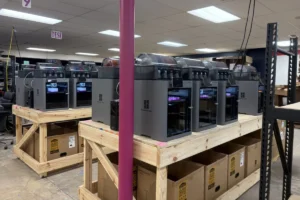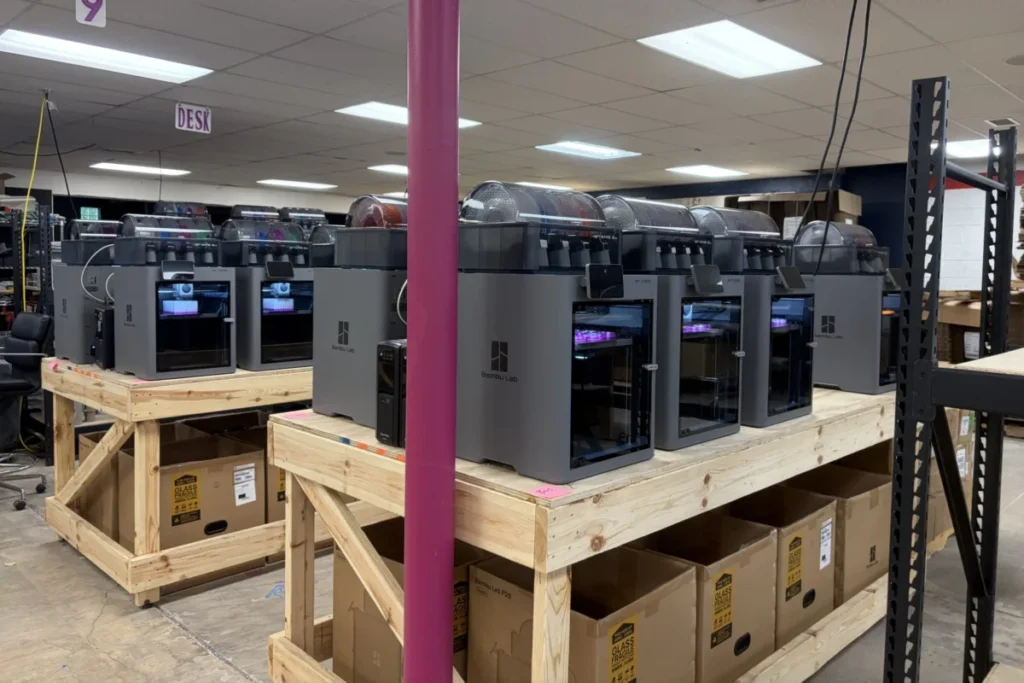
Amy Mucha, owner of Daisy Makes, a Kent, Ohio-based manufacturer of cake pop tools, operates a facility that is home to over 200 3D printers, with 173 currently operational and 60 undergoing installation. This impressive print farm is the engine behind a business that has rapidly evolved from a home-based cake pop venture to a leading supplier of specialized baking tools, embodying a remarkable journey of innovation and entrepreneurial spirit. The company’s philosophy, as stated by Mucha, is simple yet powerful: "We go from print farm to table."
The genesis of Daisy Makes can be traced back to Mucha’s burgeoning cake pop business, Daisy Pops. What began in 2016 as a passion project, baking and decorating cake pops from her home kitchen, soon outgrew its humble origins. Mucha, a former high school math teacher with a natural aptitude for baking, initially sold her creations to friends, neighbors, and students. The growing demand within her local community led to the formal establishment of Daisy Pops in 2018. To meet the increasing volume of orders for schools, parties, and holidays, Mucha enlisted the help of friends, family, and former students, building a dedicated team.
The year 2021 marked a significant turning point for Daisy Pops as its reach expanded nationwide. Mucha transitioned to pursuing the business full-time, leaving her teaching career behind. Her ambition extended to attending baking conferences with the dream of one day opening her own bakery. As nationwide orders surged, the need to streamline the production process became paramount. It was during this period that Mucha’s husband, Nate Mucha, a keen 3D printing hobbyist, conceived of a revolutionary idea: to create cookie cutter-style molds using his personal Bambu Lab 3D printer.

Leveraging his technical expertise, Nate Mucha designed the initial molds based on hand-drawn sketches, employing Autodesk Fusion for the design process and Bambu Studio Slicer software for 3D printing. The filament of choice was food-grade PLA+. The impact of these 3D-printed molds was immediate and transformative. Instead of painstakingly rolling and shaping dough by hand, the Daisy Pops team could now achieve precise, consistent shapes in a fraction of the time. This efficiency gain was crucial for managing large-scale production.
Complementing the molds, Amy and Nate Mucha further innovated by designing and 3D printing specialized "poppers." These tools were ingeniously crafted to assist in pushing stubborn, sticky dough from the circular molds, ensuring the structural integrity of each cake pop. The team also began producing other essential production aids, such as custom trays designed to store cake pops upright after cutting and shaping, and stands for product display.
From Bakery to Tool Manufacturer: A Natural Evolution
The year 2023 witnessed another milestone with the opening of the first Daisy Pops bakery in Kent, further solidifying its presence and expanding its customer base. Recognizing the broader market potential for her innovative tools, Mucha began selling starter kits of her 3D-printed molds online. These kits, typically including four molds in varying sizes, a miniature rolling pin, and a four-sided tray, met with immediate success. It became clear that a significant demand existed for specialized cake pop molds within the baking community.
Drawing upon her background as a geometry teacher, Mucha applied her understanding of spatial design and measurement to create a diverse range of unique molds. These included seasonal designs, such as Halloween ghosts and Thanksgiving turkeys, which resonated exceptionally well with her audience. The demand for these molds soon began to outpace the demand for cake pops themselves. This trend prompted a strategic business decision: to separate the mold manufacturing operation from the cake pop business. In 2024, Daisy Makes was officially established as a dedicated cake pop tool manufacturer. By 2025, the company had moved into its own specialized production facility, a testament to its rapid growth and evolving focus.

A State-of-the-Art 3D Printing Facility
The current Daisy Makes facility in Kent, while significantly larger and more equipped than Mucha’s original home setup, retains the core principles that have driven its success. The business continues to operate on an all-online model, with in-house packaging and a consistent 7-8 day shipping timeframe. Designs still originate from initial paper-and-pencil sketches, which are then digitized and transformed into 3D-printable files. The cornerstone of production remains fused filament fabrication (FFF), utilizing an impressive fleet of over 200 Bambu Lab PS2 and H2D 3D printers.
A key feature of this extensive printer farm is the integration of AMS 2 Pro automatic material systems. These systems are crucial for enabling seamless switching between different colored filaments. This capability is directly linked to the product line, as standard molds are now offered in four distinct sizes, each color-coded for easy identification: orange, purple, blue, and green. Importantly, all molds within a given size category are designed to hold the exact same volume, ensuring consistency for bakers.
The 3D printing technology at Daisy Makes is not only used for mass production but also enables the company to fulfill custom, or "print-to-order," mold requests for individual customers. While standard mold sizes are printed in bulk batches, custom molds are printed using white filament, reflecting their bespoke nature.
The design pipeline at Daisy Makes is a well-orchestrated process. Designs typically emerge from collaborations with other cake pop businesses or from the creative sketches of Nate Mucha, who now serves as the lead designer. These initial 2D designs are meticulously digitized using Adobe Illustrator before being imported into Autodesk Fusion for conversion into detailed 3D models. Subsequently, the Bambu Studio Slicer software is employed to translate these 3D models into precise print presets, which also provide estimates for printing time and filament consumption per run. The facility currently manages 1 to 2 printing runs per day, with each run typically lasting between 8 to 10 hours. A single build plate can accommodate approximately eight molds and six to seven trays, leading to an estimated daily output of around 720 molds.

Maintenance of this extensive printer fleet is handled entirely in-house. A dedicated team of employees is responsible for the consistent repair and refurbishment of the 3D printers. Amy Mucha also maintains a personal setup of 54 Bambu Lab printers at her home, which are actively used for new product development and special projects, fostering continuous innovation.
Following the printing process, all cake pop tools undergo a thorough manual inspection and cleaning within the facility. Daisy Makes has established distinct areas for filament storage, individual packaging (also a manual process), and shipping, in collaboration with UPS. The facility is also equipped with two large refrigerators stocked with Daisy Makes’ own dough, chocolate, and other baking ingredients, a product line that was introduced on their website in 2025, reinforcing their "one-stop pop shop" mantra. "Everything you need, you can get from us," Mucha proudly states.
A Trajectory of Sustained Growth and Future Aspirations
As of August 2026, Daisy Makes achieved a significant milestone by fulfilling its 100,000th order. This accomplishment underscores a consistent and robust growth trajectory since the business’s inception in 2024. Looking ahead, Mucha harbors ambitious plans for Daisy Makes, including the aspiration to become a filament distributor in its own right. To this end, the company is actively engaging in discussions with local filament suppliers and additive manufacturers. Further strategic goals include expanding the current facility and exploring opportunities to sell cake pop tools physically in home and appliance stores, broadening their retail presence beyond the online marketplace.
Mucha remains committed to sustaining the company’s strong online presence and nurturing its various collaborations with other bakeries and social media influencers. Concurrently, she continues to champion her third venture, the annual "What’s Popping Con." This event is specifically curated for cake pop artists, both beginners and established small business owners, providing a platform for knowledge sharing, idea exchange, and the development of specialized skills in baking, decoration, social media marketing, and other relevant areas. The success of Daisy Makes serves as a compelling case study in how innovative application of 3D printing technology can revolutionize traditional industries, empowering artisans and entrepreneurs alike.