Physicists at TU Dortmund University have achieved a groundbreaking feat, demonstrating that multiple continuous time crystals can spontaneously emerge within the same semiconductor material and subsequently synchronize their electron-nuclear spin oscillations. This builds upon their earlier announcement in January 2024, which revealed the existence of a continuous time crystal capable of persisting inside a semiconductor with oscillations stable for hours. The new study, published in Nature Communications by Professor Alex Greilich and his team, not only confirms the robustness of these exotic states of matter but also unveils a previously unobserved mechanism of non-local coupling between spatially separated spin systems, opening novel avenues for future spin-based technologies and a deeper understanding of non-equilibrium physics.
The Enigma of Time Crystals: A Background
Time crystals represent a revolutionary concept in condensed matter physics, challenging traditional notions of matter. Unlike conventional crystals, which exhibit a repeating structure in space (like atoms arranged in a lattice), time crystals display a repeating pattern in time, akin to a perpetually ticking clock, even in their lowest energy state and without any external periodic driving force. This spontaneous breaking of time-translation symmetry was first theoretically proposed by Nobel laureate Frank Wilczek in 2012. He posited that a system could exhibit a persistent, periodic motion in its ground state, a concept initially met with skepticism as it seemed to contradict the laws of thermodynamics.
The initial theoretical proposals focused on discrete time crystals (DTCs), which require a periodic drive but respond at a sub-harmonic frequency, effectively "breaking" the driving period. Experimental breakthroughs in 2016 and 2017 by research groups at the University of Maryland and Harvard University, respectively, provided the first concrete evidence for DTCs using chains of trapped ions and nitrogen-vacancy centers in diamonds. These early demonstrations, while significant, still relied on external periodic driving. The grander challenge remained: to create a continuous time crystal (CTC) that oscillates spontaneously without any external periodic kick, existing in a true non-equilibrium steady state. Such a system would truly break continuous time-translation symmetry.
TU Dortmund’s Pioneering Work: From Stability to Synchronization
The journey towards continuous time crystals has been a complex one, involving intricate quantum mechanical interactions. The January 2024 announcement from TU Dortmund University marked a pivotal moment. Researchers there successfully created a continuous time crystal within a semiconductor, a gallium arsenide material doped with small amounts of indium and silicon. This material choice is crucial because the added elements create localized electrons within the semiconductor lattice. At extremely low temperatures, close to absolute zero (-270 °C or 3 Kelvin), these localized electrons engage in profound interactions with the nuclei of the surrounding atoms. Each electron, in essence, becomes entangled with the spins of approximately one million nearby atomic nuclei, forming a localized quantum system.
The core mechanism involves the manipulation of spins. Spins are a fundamental quantum property of particles, analogous to tiny magnets. To initiate the time crystal’s formation, the TU Dortmund team employed a pump laser. This laser light, tuned to specific frequencies, aligns the spins of the localized electrons within the semiconductor. Once the electron spins are polarized, they transfer this polarization to the surrounding nuclear spins through a process known as hyperfine interaction. This electron-nuclear spin coupling is a critical component, allowing for the creation of a collective, coherent spin state.
Upon the application of a weak external magnetic field, the polarization of these nuclear spins begins a synchronized rotation. What sustains these oscillations, preventing them from decaying, is a remarkable feedback loop between the electron spins and nuclear spins. The precessing nuclear spins, in turn, influence the electron spins, which are continuously repolarized by the pump laser. This continuous exchange of angular momentum and energy sustains the coherent oscillations, allowing the time crystal to "tick" stably for hours – an unprecedented duration for such a delicate quantum phenomenon. A second, weaker laser is then used to non-invasively monitor the evolution of these oscillations, providing real-time data on the time crystal’s behavior.
The latest study, however, takes this discovery a significant step further. Instead of focusing on a single time crystal, the researchers investigated what happens when multiple such systems coexist within the same material. Due to inherent microscopic variations in the semiconductor’s composition and local strain fields, time crystals forming in different regions would naturally oscillate at slightly different, independent frequencies. This is akin to having multiple clocks, each running at its own unique, slightly off pace.
The Dance of Synchronization: Multiple Oscillators Lock In
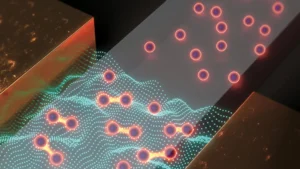
The breakthrough came when the researchers illuminated many regions of the semiconductor simultaneously with a broad laser beam. Under these specific experimental conditions, a fascinating collective phenomenon emerged: the individual time crystals, initially oscillating independently, began to lock together. Their disparate frequencies converged, and they started operating at precisely the same frequency, demonstrating a remarkable act of synchronization. This spontaneous self-organization of multiple, distinct quantum oscillators into a unified rhythm is a hallmark of complex systems and has profound implications.
To illustrate this effect, the researchers drew a parallel to a historical scientific observation made by Christiaan Huygens in 1665. Huygens, the inventor of the pendulum clock, famously noted that two pendulum clocks, when hung from the same support beam, would gradually synchronize their swings. This occurred due to weak mechanical vibrations transmitted through the shared support structure. While the analogy highlights the concept of distant synchronization, the mechanism in the semiconductor is fundamentally different. Instead of mechanical vibrations, the time crystals become coupled through the movement of spin-polarized electrons. These mobile electrons, carrying spin information, act as an intermediary, transmitting the oscillatory phase information between spatially separated time crystals, allowing them to communicate and synchronize their internal rhythms.
Spanning Distances: Non-Local Interaction Unveiled
A particularly astonishing finding of the study was the distance over which this synchronization could occur. The team observed that time crystals located as far as 40 micrometers (µm) apart could still lock together and oscillate in perfect unison. To put this into perspective, 40 micrometers is more than one thousand times greater than the characteristic size of a single localized electron-nuclear spin oscillator. This "non-local coupling" across such substantial distances for quantum phenomena is highly unusual and suggests a robust, long-range interaction mediated by the collective behavior of spin-polarized electrons.
However, there are limits to this synchronized dance. Once the physical separation between the individual time crystals exceeded approximately 40 micrometers, the coupling mechanism became too weak to sustain synchronization. Beyond this critical distance, the individual time crystals reverted to their independent oscillations, each ticking to its own rhythm, oblivious to its neighbors. This establishes a critical range for the observed non-local coupling, providing valuable data for theoretical models seeking to describe these complex interactions. The precise mechanisms governing this distance-dependent coupling, particularly the role of electron diffusion and spin coherence lengths within the semiconductor, will be a focal point for future investigations.
Chronology of a Quantum Marvel
The journey from theoretical conjecture to experimental verification and, now, to collective behavior, highlights a rapid progression in the field of time crystals:
- 2012: Nobel laureate Frank Wilczek proposes the concept of time crystals, envisioning systems that spontaneously break time-translation symmetry.
- 2016-2017: First experimental realizations of discrete time crystals (DTCs) are achieved by groups at the University of Maryland (using trapped ions) and Harvard University (using nitrogen-vacancy centers in diamonds). These require periodic driving.
- Early 2020s: Theoretical work continues to explore the properties and potential realizations of continuous time crystals (CTCs), which do not require external periodic driving.
- January 2024: Researchers at TU Dortmund University announce the successful creation of a stable continuous time crystal in a semiconductor, demonstrating oscillations lasting for hours. This marks a major step forward, showing continuous time-translation symmetry breaking.
- Present Study (Published in Nature Communications): The same TU Dortmund team, led by Prof. Alex Greilich, reveals that multiple continuous time crystals can emerge within the same semiconductor and, critically, synchronize their oscillations over surprising distances, unveiling non-local coupling.
Implications for Future Technologies and Fundamental Science
The findings from TU Dortmund University hold profound implications across several domains, from fundamental physics to the development of next-generation technologies.
1. Fundamental Physics: New States of Matter and Non-Equilibrium Dynamics
This research pushes the boundaries of our understanding of matter. Time crystals represent a new phase of matter, existing in a non-equilibrium steady state. The ability to create, sustain, and now synchronize multiple such states offers an unprecedented laboratory for studying complex emergent phenomena, collective behavior, and the dynamics of open quantum systems far from equilibrium. It provides empirical data to validate or refine theoretical models of quantum many-body systems and non-equilibrium thermodynamics. The non-local coupling mechanism itself is a new phenomenon to be explored, potentially revealing new types of quantum entanglement or correlation.
2. Spintronics: Beyond Conventional Electronics
The field of spintronics aims to leverage the electron’s spin, in addition to its charge, for information processing and storage. Current electronics primarily rely on electron charge. Spin-based devices promise greater energy efficiency, faster processing speeds, and smaller footprints. The synchronized time crystals, essentially arrays of controllable spin oscillators, lay crucial groundwork for realizing complex spintronic architectures. The ability to synchronize these oscillators over relatively long distances suggests a mechanism for transmitting and processing spin information across a material without relying on traditional charge currents. This could lead to novel memory devices, logic gates, and sensors.
3. Quantum Computing and Quantum Information Science
Controllable and addressable quantum oscillators are foundational components for quantum computing. While time crystals themselves are not directly qubits (which require superposition and entanglement for computation), the ability to generate and synchronize stable, coherent spin oscillations could be leveraged in quantum technologies. For instance, these synchronized oscillators could act as highly stable quantum clocks for other quantum systems, or potentially form the basis for novel types of quantum simulators or specialized quantum sensors. The non-local coupling mechanism could also inspire new approaches to creating entangled states or mediating interactions between qubits.
4. Precision Metrology and Timekeeping
Although not an immediate application, highly stable, synchronized oscillators have long been the backbone of precision timekeeping. While atomic clocks operate on different principles, the exploration of new forms of stable, self-sustaining oscillations, particularly in solid-state systems, could theoretically contribute to future advancements in metrology, offering new benchmarks or complementary approaches for ultra-precise timing, navigation, and fundamental constant measurements.
The Road Ahead: Challenges and Opportunities
While this breakthrough is monumental, the journey is far from over. Future research will likely focus on several key areas:
- Mechanism of Coupling: A deeper theoretical understanding of the exact mechanism by which spin-polarized electrons mediate synchronization over 40 micrometers is crucial. This will involve detailed modeling of electron diffusion, spin coherence, and hyperfine interactions within the semiconductor.
- Controllability: Exploring methods to precisely control the synchronization process, including tuning the coupling strength, the number of synchronized crystals, and their collective phase.
- Material Science: Investigating other semiconductor materials or quantum systems that could host continuous time crystals, potentially at higher temperatures, to make them more practically viable.
- Device Integration: Conceptualizing and demonstrating how these synchronized time crystals could be integrated into functional spintronic or quantum devices.
- Scalability: Understanding the limits of scalability for these synchronized networks and exploring how larger, more complex arrays of time crystals could be formed and controlled.
The work by Professor Greilich and his colleagues at TU Dortmund University represents a significant leap forward in our understanding of quantum matter. By demonstrating the synchronization of multiple continuous time crystals, they have not only revealed a fascinating collective phenomenon but also illuminated a path toward harnessing these exotic states for future technological innovations, fundamentally reshaping our interaction with the quantum world.