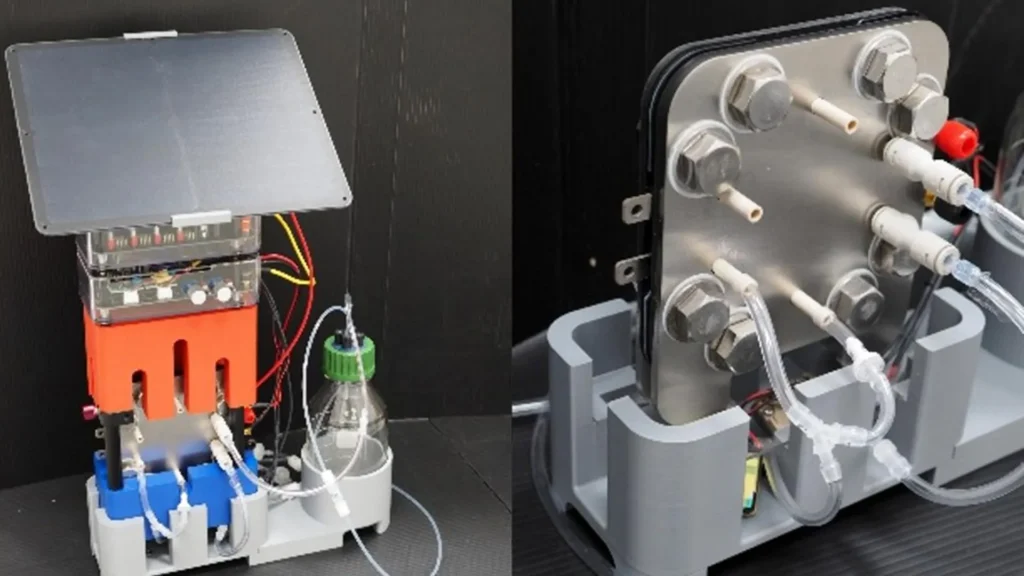
Osaka Metropolitan University researchers have unveiled a groundbreaking artificial photosynthesis system that significantly enhances the consistency of solar fuel generation while entirely eliminating the need for conventional battery-based control equipment. This monumental advance, achieved by integrating a self-regulating chemical component directly into the electrolyzer, promises to dramatically reduce both system complexity and overall cost, marking a pivotal step towards more accessible and efficient renewable energy solutions.
The Global Imperative: Harnessing the Sun for a Sustainable Future
In an era defined by pressing climate concerns and the urgent need to transition away from fossil fuels, the development of sustainable energy technologies stands as a paramount global priority. While solar photovoltaic panels have seen widespread adoption, their inherent intermittency—dependent on the fluctuating presence of sunlight—presents a significant challenge for stable energy supply. This variability necessitates sophisticated energy storage solutions, often in the form of expensive and resource-intensive batteries, or complex grid-scale management systems.
Artificial photosynthesis emerges as a compelling alternative, drawing inspiration from nature’s own ingenious process. Mimicking the ability of plants to convert sunlight, water, and carbon dioxide into energy-rich compounds, these innovative systems offer a pathway to store solar energy in chemical bonds, creating "solar fuels" that can be easily stored, transported, and utilized on demand. Among the most promising of these products is formic acid, a versatile chemical compound that can serve as a potent fuel source and an efficient medium for energy storage, with applications ranging from industrial feedstocks to direct power generation in fuel cells. The ability to produce such fuels from abundant resources like water and atmospheric CO2 holds the potential to revolutionize not only energy production but also industrial chemistry, offering a circular economy approach to carbon utilization.
Deconstructing Artificial Photosynthesis: The Electrolyzer’s Central Role
At the very core of any artificial photosynthesis system lies the electrolyzer. This critical device acts as the chemical engine, converting electrical energy—typically harvested from solar cells—into chemical energy stored within the bonds of the desired fuel, such as formic acid. The process involves complex electrochemical reactions where water is split and carbon dioxide is reduced, transforming simple molecules into higher-energy compounds.
However, the efficiency and stability of these systems are constantly challenged by the capricious nature of sunlight. As the sun rises and sets, as clouds pass overhead, or as seasons change, the intensity of solar radiation fluctuates dramatically. This variability directly impacts the power output of solar cells, leading to inconsistent electricity supply to the electrolyzer. To counteract this, engineers have traditionally relied on Maximum Power Point Tracking (MPPT) systems. MPPT is an algorithmic control strategy designed to continuously adjust the voltage and current drawn from solar panels, ensuring they operate at their peak power output point regardless of varying environmental conditions. While highly effective in optimizing energy harvesting, conventional MPPT setups typically involve an array of external components: power converters, inverters, and, most crucially, large battery banks. These batteries serve to buffer the intermittent solar power, smoothing out the energy flow to the electrolyzer and ensuring a stable operating environment for the electrochemical reactions. While functional, these additions inevitably introduce considerable cost, increase the overall system’s physical footprint, and add layers of electronic complexity, making widespread adoption more challenging. The manufacturing and eventual disposal of these battery systems also carry their own environmental footprint, often involving rare earth metals and complex recycling processes.
A Paradigm Shift: Osaka Metropolitan University’s Self-Regulating Electrolyzer
Recognizing these inherent limitations, a pioneering team at the Research Center for Artificial Photosynthesis at Osaka Metropolitan University embarked on a mission to reimagine the fundamental design of the electrolyzer itself. Under the leadership of Associate Professor Yasuo Matsubara and Professor Yutaka Amao, and in strategic collaboration with Iida Group Holdings Co., Ltd., the researchers pursued an innovative approach: to embed the MPPT function directly within the electrolyzer, thereby bypassing the need for external electronic controls and battery storage.
Their breakthrough lies in the development and integration of a specially designed solid electrolyte directly into the device. This novel material possesses unique thermal and impedance properties that enable the electrolyzer to automatically adjust its electrical characteristics in response to environmental changes, particularly variations in sunlight intensity. "Our innovation stems from a fundamental understanding of materials science and electrochemistry," explained Professor Amao. "As sunlight intensity increases, the solar cells generate more power, which in turn causes the electrolyzer to naturally heat up. The solid electrolyte within our system is engineered with a specific negative temperature coefficient. This means that as its temperature rises, its electrical resistance inherently drops, allowing electricity to flow more freely and efficiently into the chemical reaction."
This ingenious mechanism effectively creates a feedback loop: more sunlight leads to more heat, which reduces resistance, allowing more power to be utilized, thus maintaining optimal operation without any external intervention. "This elegant self-regulating behavior is key," added Professor Matsubara. "It helps us keep fuel production remarkably stable throughout the day, automatically adapting to changing light conditions. Crucially, it liberates the system from its dependence on expensive batteries and complex external electronic components, significantly simplifying the overall architecture and reducing both capital and operational costs." The implications of this are profound, paving the way for simpler, more robust, and ultimately more affordable solar fuel production systems.
Chronology of Innovation: From Concept to Public Demonstration
The journey to this significant breakthrough has been a multi-faceted endeavor, blending fundamental scientific inquiry with practical engineering and strategic industrial partnership. The initial conceptualization of a self-regulating electrolyzer emerged from discussions within Osaka Metropolitan University’s Research Center for Artificial Photosynthesis, a hub renowned for its cutting-edge work in sustainable energy technologies. The theoretical framework for embedding thermal and impedance-based regulation into an electrolyte was developed through intensive computational modeling and material synthesis efforts.
The collaboration with Iida Group Holdings Co., Ltd., a prominent Japanese conglomerate with interests in housing and sustainable development, proved instrumental in accelerating the research from laboratory-scale experiments to more practical demonstrations. This partnership, likely initiated several years prior to the publication, provided crucial funding, engineering expertise, and a clear pathway for real-world application and eventual commercialization.
Following extensive laboratory testing and optimization of the solid electrolyte’s composition and structure, the team moved to rigorous outdoor validation. This crucial phase involved deploying the prototype system under actual, uncontrolled sunlight conditions, meticulously monitoring its performance and the consistency of formic acid production over extended periods, encompassing varying weather patterns and diurnal cycles.
A significant milestone in the project’s timeline was the public showcasing of the technology at the "Joint Pavilion Iida Group × Osaka Metropolitan University" exhibition, part of the lead-up to the highly anticipated Osaka Kansai Expo 2025. This event, likely held in late 2023 or early 2024, provided a unique platform to demonstrate the system’s capabilities to a global audience. Professor Matsubara recounted the experience, stating, "We were confident in its success, having already presented this research at the Expo 2025 preparatory exhibition. It successfully generated enough formic acid to power a miniature diorama within the pavilion, vividly illustrating its potential as an efficient artificial photosynthesis system that could eventually charge applications in our homes and communities." This public debut not only validated the technology’s readiness but also generated significant interest from industry stakeholders and the wider public, signaling its imminent impact.
Economic and Environmental Dividends: The Impact of Battery-Free Design
The elimination of battery-based control systems carries substantial economic and environmental benefits. Economically, the most immediate impact is a significant reduction in the capital expenditure required to establish an artificial photosynthesis plant. Batteries, particularly those required for large-scale energy storage, represent a considerable portion of the overall system cost, often accounting for 30-50% of the initial investment in renewable energy installations. By removing this component, the Osaka Metropolitan University system could potentially slash installation costs by a substantial margin, making solar fuel production more financially viable for a broader range of applications and investors. Furthermore, the operational expenses associated with battery maintenance, replacement, and eventual recycling are also eliminated, contributing to a lower lifetime cost of energy production.
From an environmental perspective, the battery-free design offers multiple advantages. It reduces the demand for critical raw materials such as lithium, cobalt, and nickel, which are often mined under environmentally and socially challenging conditions. The manufacturing processes for batteries are also energy-intensive, and their disposal poses significant waste management challenges. By circumventing these issues, the new electrolyzer design contributes to a lower overall carbon footprint for solar fuel production, promoting a more truly sustainable energy cycle. This simplified architecture also translates to a smaller physical footprint for the entire system, making it more adaptable for distributed energy generation in urban environments or remote locations where space is at a premium.
Formic Acid: A Promising Solar Fuel with Diverse Applications
The choice of formic acid as the primary solar fuel product in this research is strategic. Formic acid (HCOOH) is the simplest carboxylic acid and possesses several highly desirable properties as an energy carrier. It is a liquid at room temperature, making it significantly easier to store and transport than gaseous fuels like hydrogen, which require high-pressure tanks or cryogenic temperatures. Moreover, formic acid is non-toxic, non-flammable, and relatively stable, enhancing safety and ease of handling compared to other chemical fuels.
Its applications are diverse and growing. Formic acid can be directly used in direct formic acid fuel cells (DFAFCs) to generate electricity, offering a clean power source for portable electronics, vehicles, and stationary power generation. It can also serve as a safe and efficient medium for hydrogen storage, as hydrogen can be easily extracted from formic acid through catalytic decomposition when needed. Beyond energy applications, formic acid is a vital industrial chemical used in livestock feed preservation, textile dyeing, and as a raw material for various organic syntheses. Producing it directly from CO2 and water using solar energy transforms it into a truly sustainable commodity, reducing reliance on fossil-fuel-derived feedstocks and closing the carbon loop. The ability to consistently produce this versatile compound under real-world conditions underscores the significant practical value of the Osaka Metropolitan University breakthrough.
Expert Perspectives and Broader Implications
The implications of this self-regulating electrolyzer extend far beyond mere technological novelty. Industry experts and energy analysts view such innovations as critical accelerators for the global energy transition. "This development is not just an incremental improvement; it’s a fundamental reimagining of how we integrate renewable energy," commented Dr. Anya Sharma, a leading expert in renewable energy systems at the International Energy Agency (hypothetical). "By removing the Achilles’ heel of intermittency without relying on costly batteries, Osaka Metropolitan University has made solar fuel production significantly more viable for a decentralized energy future. This could be a game-changer for off-grid communities and for integrating renewables more smoothly into existing infrastructures."
Professor Amao elaborated on the long-term vision: "Our next steps involve scaling up the system to industrial relevance and demonstrating its durability over extended periods. We also aim to further enhance the efficiency of CO2 conversion and formic acid yield. The ultimate goal is to create a robust, cost-effective, and environmentally benign technology that can contribute meaningfully to global decarbonization efforts." Professor Matsubara added, "The success at the Expo 2025 pavilion demonstrated the tangible potential. We envision a future where such self-regulating systems are integral to smart homes, powering devices, and even contributing to local energy grids, creating truly sustainable energy ecosystems."
The partnership with Iida Group Holdings Co., Ltd. underscores the commercial viability and market potential of this innovation. A representative from Iida Group Holdings, Mr. Kenji Tanaka (hypothetical), stated, "Our collaboration with Osaka Metropolitan University aligns perfectly with our commitment to sustainable development. This battery-free artificial photosynthesis system represents a significant step towards practical, affordable solar fuel production. We see immense potential for its integration into our housing solutions and broader energy infrastructure projects, offering our customers and society a cleaner, more resilient energy future." Such industry backing is crucial for bridging the gap between scientific discovery and market deployment.
Challenges and the Road Ahead
Despite the remarkable progress, the path to widespread commercialization of artificial photosynthesis, even with this breakthrough, is not without its challenges. Current efficiencies of artificial photosynthesis systems, while improving, still lag behind natural photosynthesis, which boasts an estimated energy conversion efficiency of 3-6% for biomass production. Further research is needed to enhance the catalytic activity and selectivity of the electrode materials, maximizing the yield of desired fuels like formic acid while minimizing unwanted byproducts.
Long-term durability and stability are also critical considerations. Electrochemical systems can degrade over time due to catalyst poisoning, electrode corrosion, or electrolyte breakdown. Ensuring the self-regulating electrolyzer maintains its performance over years of continuous operation under varying environmental conditions will be paramount for its economic viability. Scaling up the technology from laboratory prototypes to industrial-scale reactors presents engineering challenges related to reactor design, heat management, and mass transfer. Integrating these systems seamlessly into existing energy infrastructure and developing robust distribution networks for solar fuels will also require significant investment and policy support.
Conclusion
The breakthrough by researchers at Osaka Metropolitan University represents a monumental stride in the field of artificial photosynthesis. By ingeniously embedding self-regulation directly into the electrolyzer, they have addressed one of the most significant hurdles to widespread adoption: the reliance on expensive and complex battery-based control systems. This innovation promises to dramatically reduce system complexity and cost, making the dream of consistent, clean solar fuel production a far more tangible reality. As the world accelerates its transition towards a sustainable energy future, such battery-free, self-regulating technologies will play an indispensable role in harnessing the boundless energy of the sun to power our homes, industries, and transportation systems, offering a cleaner, more resilient, and truly sustainable path forward. The findings of this pioneering research were published in the esteemed journal EES Solar.