The city of Brno, often characterized as the smaller cousin to Prague, is currently experiencing a significant cultural and technological surge driven by a robust community of creators, engineers, and hobbyists. Despite a local running joke that the city is merely a "large village," its demographic reality tells a different story. With a population of nearly 400,000 and a student body of 80,000 across its various universities, Brno has become a premier European hub for creative energy and technical experimentation. This momentum culminates annually in the Maker Faire Brno, an event that has evolved from its 2019 debut into a cornerstone of the Central European maker movement. The eighth edition of the festival, scheduled for October 17–18, 2026, is set to return to the historic Brno Exhibition Halls, signaling a new chapter in the city’s industrial and digital evolution.

A Strategic Hub for the Maker Movement
The growth of Maker Faire Brno is not an isolated phenomenon but the result of a deliberate ecosystem built by local stakeholders. Since its inception, the event has expanded to accommodate approximately 7,500 visitors and hundreds of individual makers from across the Czech Republic and neighboring countries. Central to this success is the collaboration between the Make More team—the organizers responsible for the national circuit of Maker Faires—and Fab Lab Brno. As one of the most active digital fabrication laboratories in the region, Fab Lab Brno provides the year-round infrastructure necessary for enthusiasts to transition from conceptual ideas to physical prototypes.

The choice of the Brno Exhibition Halls (Brněnské výstaviště) as the venue adds a layer of architectural and historical significance to the event. Known for its soaring functionalist ceilings and abundant natural light, the venue also features a planetarium and a sprawling main hall that facilitates large-scale engineering demonstrations. The environment serves as a metaphor for the event itself: a bridge between the industrial heritage of "Moravian Manchester"—a nickname Brno earned in the 19th century for its textile prowess—and the modern era of high-tech manufacturing and coding.

Institutional Support and the Role of Prusa Research
A defining feature of the Czech maker scene is the involvement of Prusa Research, a global leader in the 3D printing industry founded by Josef Průša. The company’s presence in Brno is more than a mere exhibition; it represents a successful model of how "making" can be scaled into a world-class business. Prusa Research has been a primary catalyst for the explosion of Maker Faires across the Czech Republic, advocating for an integrated, in-house approach to manufacturing that mirrors the DIY ethos of the maker community.

For the 2026 event, Prusa Research is hosting the "Maker Challenge," a competition designed to encourage circular economy principles. Participants are tasked with using 3D printing technology to transform discarded or broken items into functional tools. This initiative highlights a broader trend within the festival: the shift from purely aesthetic creation to utilitarian problem-solving. By offering high-end 3D printers as prizes, the challenge ensures that the tools of innovation remain accessible to the next generation of creators.

Showcasing Interdisciplinary Innovation
The 2026 lineup demonstrates a blurring of boundaries between art, science, and mechanical engineering. Ten featured projects illustrate the diversity of the current maker landscape:

- Acoustika 3D: Developed by SIMPLIXITY, this project explores the intersection of audio engineering and additive manufacturing. The exhibit features a custom-designed, 3D-printed loudspeaker that can be disassembled, allowing visitors to examine how internal enclosure geometries affect sound waves and acoustic output.
- Sublisica: Maker Jan Grygerek has combined chemistry and photography to create a unique glass engraving process. Utilizing tiny frozen soap-bubble crystals as a visual template, Grygerek designed a custom engraving machine to etch these transient patterns onto permanent glass surfaces.
- Biouhel (Biochar): Addressing environmental sustainability, this project demonstrates how garden waste and pruned branches can be converted into biochar. This porous, carbon-rich material is presented as a solution for soil health and long-term carbon sequestration, moving the maker movement into the realm of climate action.
- Masaryk University Computer Science Labs: Academic research is made tangible through interactive robotics. The university’s presentation includes a drawing robot and a marionette controlled via motion-capture sensors, showcasing the practical application of complex algorithms.
- 3Dfil.cz: This exhibit serves as a comprehensive playground for additive manufacturing materials. It provides a comparative analysis of FDM (Fused Deposition Modeling) and resin printing, focusing on high-strength engineering polymers for specialized industrial use.
- Mechanical Bearings in Action: An interactive workshop focused on the "unsung heroes" of transportation. Visitors engage in the hands-on removal and installation of bearings in skateboards and bicycles, emphasizing the importance of mechanical literacy and maintenance.
- KAMaRAD Radar Systems: Developed by the Brno University of Technology (BUT), this project utilizes millimeter-wave radar to enhance road safety. The prototype is designed to detect hazards in low-visibility conditions, specifically aimed at protecting cyclists and pedestrians.
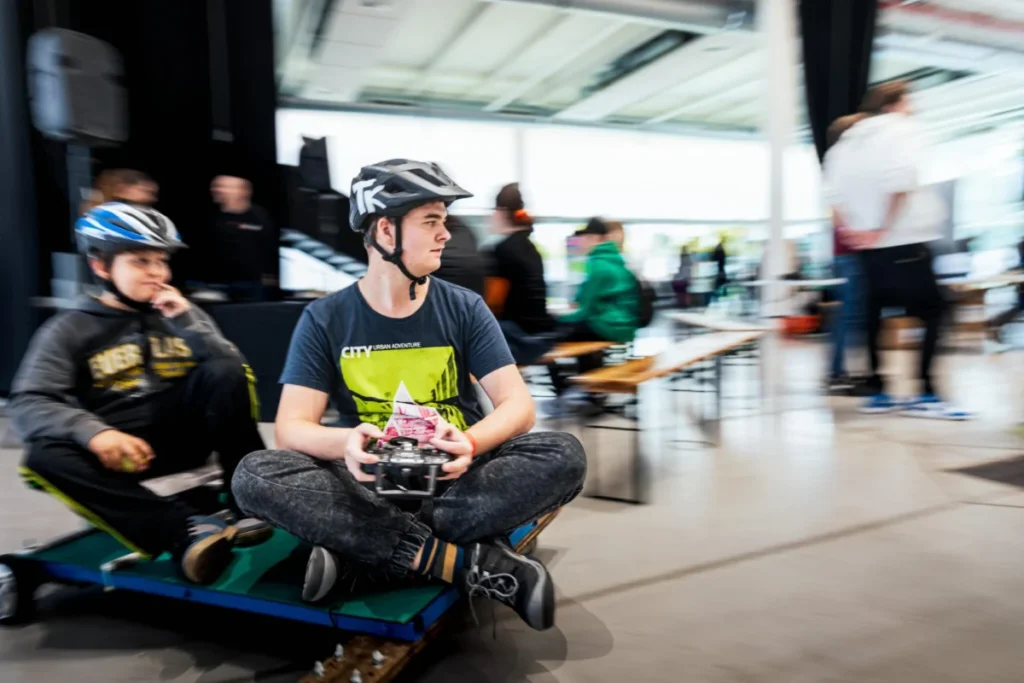
- Baťa Customs: This mobile workshop focuses on traditional woodworking and gravity-based physics. Participants assemble and customize wooden racers, learning the fundamentals of friction and aerodynamics without the need for electronic components.
- RaveBOX Synthesizers: An exploration of electronic music and circuit design. The RaveBOX is a DIY synthesizer and sequencer that encourages users to experiment with rhythmic patterns and sound synthesis, illustrating the democratization of musical instrument production.
- High-Performance RC Jet Boat: A technical highlight from BUT, this project features a 3D-printed boat powered by a water jet pump. It integrates an ESP32 chip for real-time telemetry, transmitting data on GPS speed, battery voltage, and component temperature to a shore-based receiver.
The Pedagogical Impact: Learning by Doing
Maker Faire Brno 2026 places a heavy emphasis on "active learning" through its extensive workshop program. These sessions are categorized by complexity and duration, ranging from 30-minute introductory lessons to 90-minute deep dives. The curriculum is designed to be inclusive, catering to children, teenagers, and professional engineers alike.

In the aerospace sector, student teams such as YSpace and SoRC (Student Organization for Rocketry and CanSat) lead workshops on CubeSat modeling and rocket design. For younger attendees, water rockets powered by compressed air provide an immediate and engaging introduction to the laws of physics and propulsion. Meanwhile, the Nitlab workshop bridges the gap between historical computing and textiles by teaching participants how to use punch cards to control vintage knitting machines, producing patterned scarves through logic-based crafting.

The "Smart Devices" track, led by LaskaKit, focuses on the Internet of Things (IoT). Participants build Wi-Fi-connected e-paper displays, gaining experience in soldering, firmware flashing, and API integration. This hands-on approach is intended to demystify modern technology, transforming consumers into creators who can customize their digital environments.

The Right to Repair and Collaborative Stages
A critical component of the 2026 event is the "Repair Zone," a dedicated space where visitors can bring broken household items to be fixed by expert tinkerers. This initiative aligns with the growing global "Right to Repair" movement, which advocates for consumer access to parts, tools, and manuals. By fostering a culture of repairability, the event challenges the "planned obsolescence" model of modern manufacturing and promotes a more sustainable relationship with technology.

The Maker Faire stage serves as the festival’s intellectual hub. The 2026 schedule includes a 24-hour Student Hardware Hackathon, where teams compete to solve specific engineering challenges under tight deadlines. Other stage highlights include presentations on the science of the aurora borealis, the ethics of Artificial Intelligence in student projects, and "Open Mic" sessions where independent makers can pitch their inventions to the community and potential investors.

Chronology of the Maker Faire Brno Evolution
- 2019: The inaugural Maker Faire Brno launches, establishing the city as a key node in the international Maker Media network.
- 2020–2021: Despite global disruptions, the community maintains momentum through virtual workshops and smaller, decentralized "micro-faires."
- 2022–2023: Attendance surges as the event moves to the Exhibition Halls, integrating more academic partnerships with Masaryk University and BUT.
- 2024–2025: The introduction of the "Maker Challenge" and the expansion of the "Repair Zone" solidify the event’s focus on sustainability.
- 2026: The 8th edition reaches a record number of exhibitors, with a specific focus on aerospace technology and AI-driven hardware.
Broader Implications and Regional Analysis
The success of Maker Faire Brno has significant implications for the regional economy. Brno is currently responsible for approximately one-third of the world’s production of electron microscopes, a testament to its high-precision engineering capabilities. The Maker Faire acts as a "feeder system" for this industry, sparking interest in STEM (Science, Technology, Engineering, and Mathematics) careers among the city’s large student population.

Furthermore, the event serves as a platform for "stealth innovation"—projects developed in garages and basements that have the potential to become viable startups. By providing a low-stakes environment for prototyping and public feedback, the Faire accelerates the R&D cycle for local inventors.

In a broader European context, Brno’s maker movement represents a shift toward localized, small-batch manufacturing. As global supply chains face increasing volatility, the ability to design, iterate, and produce components locally using 3D printing and CNC machining becomes a strategic advantage. Maker Faire Brno is not just a festival; it is a demonstration of a resilient, decentralized industrial future.

As the gates open on October 17, 2026, the "village" of Brno will once again prove that its creative boundaries are limitless. Whether through the lens of a 3D-printed jet boat, a DIY synthesizer, or a repaired toaster, the event underscores a fundamental truth: in an increasingly automated world, the human drive to tinker, build, and understand remains the most powerful engine of progress.