Researchers in Austria are pioneering a groundbreaking approach that aims to fundamentally transform electron microscopy by integrating it with quantum computing. This innovative method promises to extract significantly more information from each electron, potentially allowing scientists to visualize structures with unprecedented clarity while drastically reducing the electron dose required for imaging delicate samples. The collaborative effort, spearheaded by TU Wien in partnership with the University of Vienna, JKU Linz, and the University of Innsbruck, represents a significant leap forward from conventional electron microscopes, which are believed to leave valuable quantum information untapped. A prototype of this quantum computer electron microscope is currently under construction at TU Wien, marking a pivotal step from theoretical concept to experimental reality.
The Evolution and Limitations of Electron Microscopy
Since its inception in the 1930s by Ernst Ruska and Max Knoll, the electron microscope has been an indispensable tool for scientific discovery, enabling humanity to peer into a realm far beyond the capabilities of optical light. By utilizing beams of electrons, which have much shorter wavelengths than photons, electron microscopes can resolve structures down to the atomic scale. This capability has been instrumental in fields ranging from materials science to cell biology, revealing the intricate architecture of viruses, proteins, and advanced materials.
Conventional electron microscopes, such as Transmission Electron Microscopes (TEM) and Scanning Electron Microscopes (SEM), operate by firing a beam of electrons at a sample. As these electrons interact with the sample, they are scattered, absorbed, or transmitted, carrying information about the sample’s internal structure and composition. Detectors then capture these interacting electrons, and their signals are processed to construct an image. In essence, these systems primarily count electrons to build a picture, relying on statistical averages of numerous electron interactions to achieve high resolution and signal-to-noise ratio.
Despite their extraordinary resolution capabilities, conventional electron microscopes face inherent limitations, particularly when imaging biological specimens. "Today, we can image tiny details on the atomic scale," explains Philipp Haslinger from the Institute of Atomic and Subatomic Physics at TU Wien. "However, this requires a large number of electrons. And not every sample can be exposed to so many electrons without being damaged. This is often a problem, particularly when imaging biological samples such as individual proteins." The high-energy electron beam can cause radiation damage, altering the sample’s structure or even destroying it before sufficient data can be collected. This challenge has historically limited the study of dynamic biological processes or highly sensitive materials, often necessitating techniques like cryo-electron microscopy (cryo-EM) where samples are flash-frozen to mitigate damage. While cryo-EM earned its developers the Nobel Prize in Chemistry in 2017 for revolutionizing structural biology, even this advanced technique still contends with the fundamental trade-off between resolution and sample preservation. The underlying problem remains: a high electron dose is typically required to achieve the desired clarity, yet this dose invariably inflicts damage.
The Quantum Solution: Harnessing Unused Information
The Austrian research consortium proposes a radical solution to this dilemma: to learn more from each electron by tapping into its inherent quantum information, which traditionally goes unused. In standard electron microscopy, the quantum properties of individual electrons—beyond their mere presence or absence—are largely ignored. Each electron, however, carries a wealth of quantum information, such as its spin or entanglement potential, that could provide richer insights into its interaction with the sample.
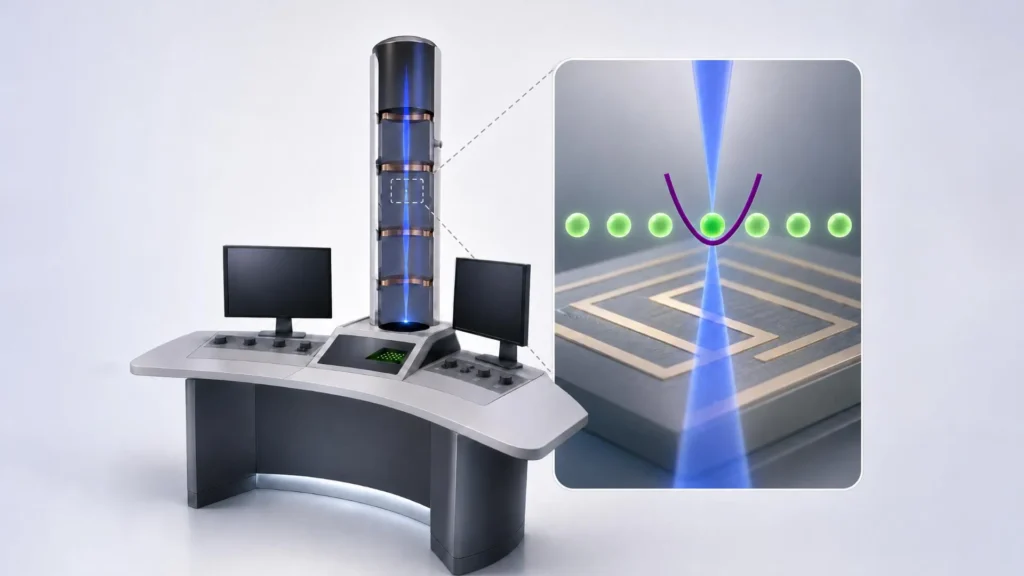
The core innovation lies in connecting an electron microscope to a quantum computer. "Our idea is to combine the electrons with a quantum computer. We let them interact with ions that are held in place along the path of the electron beam," elaborates Elias Pescoller, first author of the publication and a doctoral student at the Institute for Theoretical Physics and the Institute of Atomic and Subatomic Physics at TU Wien. This interaction is designed to create quantum entanglement between the electron and the quantum computer.
Quantum entanglement is a phenomenon unique to quantum mechanics, where two or more particles become linked in such a way that they share a joint quantum state, regardless of the distance separating them. A measurement on one entangled particle instantaneously influences the state of the other. In this setup, as an electron passes through the microscope and interacts with the sample, it then encounters a trapped ion within the quantum computer’s system. This interaction entangles the electron with the ion, effectively transferring and storing crucial quantum information about the electron’s state—and thus its interaction with the sample—into the ion.
Turning Weak Signals into Powerful Insights
The process extends beyond a single electron. After one electron interacts and becomes entangled with a trapped ion, another electron can follow suit, also becoming entangled with the quantum computer. By repeatedly performing carefully designed quantum operations, the system can combine and process information from multiple electrons in a way that is impossible with classical computing.
"If we perform very specific quantum-computing operations each time, we can optimally combine the information from several electrons so that we obtain a signal of maximum strength even though we use only a relatively small number of electrons," states Dennis Rätzel from the Institute of Atomic and Subatomic Physics at TU Wien. These sophisticated algorithms, crucial for processing the entangled quantum states, were developed in collaboration with Johannes Kofler’s team at JKU Linz.
The fundamental imaging mechanism still relies on electrons to probe the sample, mirroring conventional electron microscopy. The transformative difference, however, lies in the quantum computer’s ability to process the subtle quantum information carried by these electrons that would otherwise be lost or indistinguishable from background noise. "The electrons themselves are used to image small objects, just as in any other electron microscope. But by processing the quantum information carried by these electrons in a quantum computer, we can extract significantly more information from the process," explains Iva BÅ™ezinová from the Institute for Theoretical Physics at TU Wien. "What would previously have been indistinguishable from random noise can thus become a clear signal." This enhanced signal processing capability allows researchers to recover useful details that would be impossible to identify using ordinary electron counting alone, effectively overcoming the statistical limits that constrain conventional electron microscopes.
From Mathematical Proof to Experimental Reality
The journey from a groundbreaking theoretical concept to a fully operational instrument is often long and arduous, but the Austrian team has already made significant strides. The researchers have rigorously demonstrated through mathematical proofs that their novel method should offer substantial advantages over existing technologies. The immediate and exciting next step is to validate these theoretical benefits experimentally.
This crucial phase is currently underway at TU Wien’s University Service Center for Transmission Electron Microscopy (USTEM). Researchers are actively preparing to integrate an ion-based quantum computer directly into an electron microscope. The specialized quantum computer, a key component of this ambitious project, was developed by Philipp Schindler’s team at the University of Innsbruck, highlighting the interdisciplinary nature and collaborative spirit of the initiative. The integration of such a sophisticated quantum system with the highly sensitive environment of an electron microscope presents significant engineering challenges, requiring meticulous control over vacuum conditions, electromagnetic interference, and precise alignment of electron and ion beams.
A Collaborative Vision and Broader Implications
The development of this quantum-enhanced electron microscope is a testament to the power of collaborative research, bringing together expertise from across Austria’s leading academic institutions. The consortium is a major component of the Cluster of Excellence quantA, a multi-university initiative coordinated by the University of Vienna, which receives significant funding from the Austrian Science Fund (FWF) and the prestigious Gordon and Betty Moore Foundation.
Thomas Juffmann from the University of Vienna emphasizes the synergy: "It is really exciting that, within the quantA Cluster of Excellence, we can combine the expertise in quantum information, quantum computing and electron microscopy available at the different universities in Austria. This allows us to launch a unique project." This integrated approach leverages diverse specializations—from theoretical physics and quantum information science to experimental quantum computing and advanced electron microscopy—to tackle a problem of fundamental scientific importance.
If the system performs as expected, the implications for scientific research are profound and far-reaching:
- Structural Biology and Medicine: The ability to image delicate biological materials with fewer electrons could revolutionize structural biology. Scientists could obtain high-resolution images of individual proteins, DNA, RNA, and even entire cells in their near-native states, without the confounding effects of radiation damage. This would accelerate drug discovery, vaccine development, and our fundamental understanding of disease mechanisms, potentially leading to new therapeutic strategies. Imaging dynamic biological processes in real-time with minimal perturbation could become a reality.
- Materials Science: The technology could provide unprecedented insights into the properties of novel materials, particularly those sensitive to electron beams. Researchers could characterize quantum materials, nanomaterials, and catalysts at the atomic scale with enhanced fidelity, accelerating the design and synthesis of next-generation materials for electronics, energy storage, and environmental applications. Understanding defects and interfaces with greater precision would be a game-changer for materials engineering.
- Fundamental Physics: Beyond practical applications, this project pushes the boundaries of quantum measurement and control. It explores the practical utility of quantum entanglement in a complex experimental setup, providing a robust platform for investigating fundamental quantum phenomena in new contexts. The ability to manipulate and extract information from individual electrons using quantum computation opens new avenues for quantum metrology and sensing.
- Technological Advancement: The successful integration of an ion-trap quantum computer with an electron microscope would represent a significant engineering feat, driving innovation in both quantum computing hardware and electron microscope design. The development of robust interfaces between classical and quantum systems in a highly controlled environment could pave the way for other hybrid quantum technologies.
While still in the experimental validation phase, this pioneering work by the Austrian consortium represents a bold vision for the future of microscopy. By moving beyond classical electron counting and embracing the principles of quantum information science, researchers are poised to unlock a new era of discovery, offering a clearer, less destructive window into the nanoscale world that governs our universe. The construction of the prototype at TU Wien is not just an engineering challenge; it is a promise of a future where the hidden quantum secrets of matter are finally brought into sharp focus.