Founded in 2015 with a mission to revolutionize propulsion systems, Ursa Major has emerged as a significant player in the aerospace and defense sector. Initially focused on developing cutting-edge engines for launch vehicles, hypersonics, solid fuel motors, and in-space maneuvering, the company, with facilities in Ohio and Colorado, now employs over 300 individuals dedicated to crafting critical components. However, Ursa Major’s ambition extends beyond propulsion; it is actively reshaping the landscape of additive manufacturing (AM), transforming it from a rapid prototyping tool into a robust, scalable production solution. This strategic pivot is driven by a vision to democratize and optimize the complex world of 3D printing, making it more accessible, efficient, and reliable for high-stakes applications.

From Rocketry to Revolutionizing AM: The Ursa Major Journey
The genesis of Ursa Major was firmly rooted in providing propulsion for space launches. Additive manufacturing was, from the outset, recognized as a powerful enabler for achieving this goal. Nick Doucette, Vice President of Operations at Ursa Major, articulates the company’s initial imperative: "The only way to attract investor dollars was to go out and prove that we could build a really advanced-stage combustion rocket engine. In 12 to 18 months, we needed to go from clean sheet to this thing working, or we would not be able to raise the required capital to scale. So we printed as much as we could, because it was the fastest way to get complicated hardware." This urgency propelled Ursa Major to leverage external additive suppliers, leading to the rapid development of its first commercial product, the Hadley engine – a 5,000-pound-thrust liquid rocket engine.
The Hadley engine, a testament to Ursa Major’s rapid development capabilities, quickly transitioned from a proof-of-concept to a commercially viable product. It found its initial application in launch vehicles and subsequently in hypersonic systems, with numerous units currently in active service. A key innovation of the Hadley engine is its use of liquid oxygen as an oxidizer for its liquid kerosene fuel, operating at extremely low temperatures. In 2017, Ursa Major achieved a significant milestone by becoming the first U.S. company to successfully hot-fire an oxygen-rich staged combustion (ORSC) engine. This early success laid the foundation for scaling production and integrating the Hadley engine and its variants into critical aerospace and defense missions.

The Additive Advantage: Beyond Speed
While speed of development was the initial driver for adopting 3D printing, Ursa Major soon discovered additional, compelling advantages for production. Doucette explains, "It became evident that we could start to combine what would be individual pieces of hardware into one." This consolidation is exemplified in the Hadley engine’s turbine manifold, where traditionally, multiple machined and welded components like bellows and vanes would be required. Additive manufacturing allows for the creation of this complex assembly as a single, integrated part, significantly reducing manufacturing complexity and cost. "Additive is combining what would be a pretty expensive manufacturing process into one part, so then you’re getting some cost benefit," Doucette notes.
Beyond cost efficiencies, Ursa Major has harnessed AM to achieve substantial performance enhancements. The design freedoms offered by 3D printing enable the creation of geometries impossible to manufacture through conventional means, allowing engineers to "take the performance knob from 8 to 11," as Doucette puts it. This capability has not only benefited the Hadley engine but has also informed the development of Ursa Major’s broader product line. The Draper engine, designed for hypersonic applications both within and beyond Earth’s atmosphere, also incorporates significant 3D-printed components, utilizing hydrogen peroxide as its oxidizer. Even Ursa Major’s solid rocket motor production, under the "Lynx" manufacturing process, integrates 3D-printed metal parts alongside advanced flexible manufacturing techniques. It’s worth noting that Ursa Major strategically deploys AM where it provides the most benefit, acknowledging that for some products, like their in-space mobility systems, traditional machining remains the optimal production method. As Savanah Bray, Ursa Major’s Director of Marketing and Communications, aptly states, "Because we’re experts in additive, we also know when not to use it."

Scaling Production: The Strategic Insourcing of Additive Manufacturing
As Ursa Major’s product portfolio expanded and production volumes increased, relying on external additive suppliers presented logistical and quality control challenges. This realization prompted a strategic decision to insource its AM capabilities. In October 2021, the company established its Advanced Manufacturing Lab at the Youngstown Business Incubator in Youngstown, Ohio, equipped with two EOS metal 3D printers. "We were challenged with finding suppliers who could print the crazy stuff," Doucette recalls. "So we decided to stand up additive out here. That really set us on a trajectory to insource all of it."
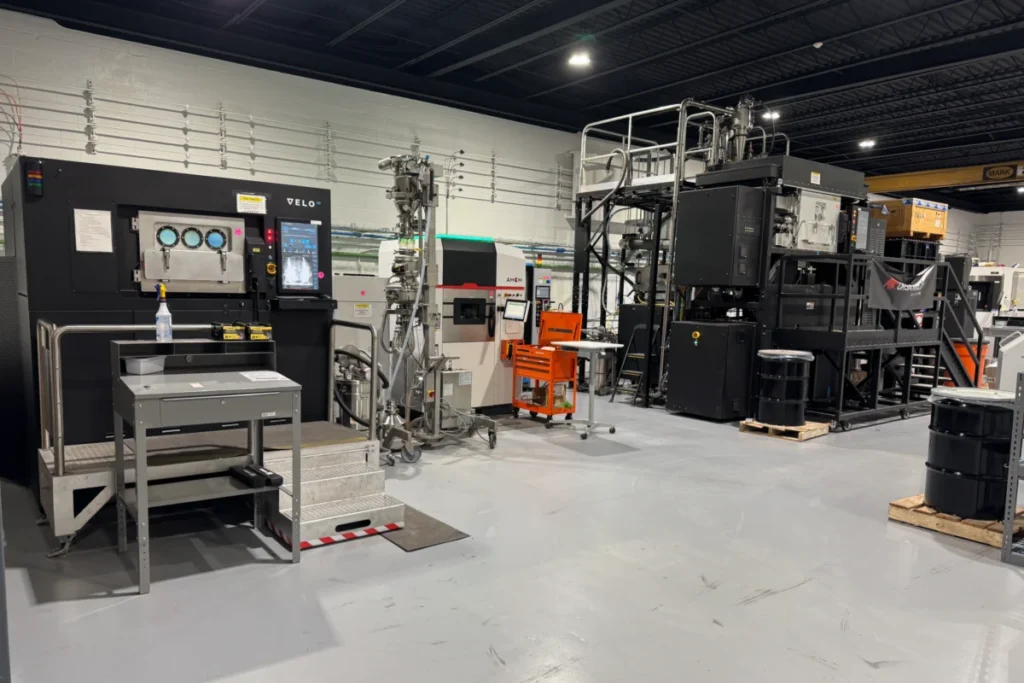
This initial investment proved to be a catalyst for further expansion. In 2024, Ursa Major significantly bolstered its Ohio presence with a new R&D facility in nearby Boardman, which has since evolved into a dedicated production hub for additive parts. This facility now houses an impressive array of nine metal 3D printers from EOS and its custom machine brand, AMCM, alongside printers from Velo3D. The integration of on-site CNC milling and wire EDM capabilities completes a comprehensive in-house AM workflow. While engine design, assembly, and testing remain centralized at the Berthoud, Colorado, facility, Ohio has emerged as a strategic advantage for additive production. Doucette highlights Youngstown as "one of the easiest places to hire for us," citing the region’s robust industrial talent pool. The facility’s proximity to essential post-processing services like heat treatment and hot isostatic pressing (HIP) further streamlines production timelines.

Navigating the Complexities of Qualification and Digitalization
Despite the tangible benefits of AM, Ursa Major, like many in the industry, faces persistent challenges, particularly concerning qualification and adoption within the Department of Defense (DOD). Thomas Pomorski, Director of Additive Manufacturing, explains, "One of the biggest challenges we face is qualification and adoption within the DOD. Right now, every additive part is qualified using a very boutique process, where individual machine serial numbers are qualified. That is very difficult, slash impossible, to scale. How do we define what that next generation of qualification looks like for advanced aerospace and defense hardware?"
This current qualification paradigm, which ties the approval of a part to the specific serial number of the machine that printed it, presents a significant bottleneck to scaling production. To address this, Ursa Major is championing a shift towards a more standardized and digital approach to qualification. Pomorski envisions a future where qualification is based on defined "acceptable process windows" rather than static machine serial numbers. This involves leveraging qualified algorithms to meticulously control the printing process on characterized machines.

The Digital Thread: Data, Algorithms, and Collaborative Innovation
Ursa Major’s vision for the future of additive manufacturing centers on treating it as a truly digital technology, optimized by code rather than solely by human expertise. This approach involves extensive data capture, sophisticated algorithm development, and strategic collaboration. The company is actively working to de-mystify and simplify the intricate functionalities of AM machines, which are often tied to proprietary and opaque interfaces.
A cornerstone of this initiative is Ursa Major’s collaboration with software company Dyndrite. Together, they are developing a custom slicer designed to bypass OEM build preparation software and communicate directly with any additive machine. This innovative slicer acts as a crucial bridge between design intent and the physical printing process. It automatically adapts to the unique characteristics of each printing platform, such as recoat direction and gas flow, while gaining granular control over malleable parameters like laser path and power.

This advanced slicer functions akin to a postprocessor for CNC machines. By inputting machine capabilities, users can generate print code tailored for specific machines with a single command. "I can generate code for seven different machines with one button click," Pomorski states, highlighting the dramatic simplification this offers. The software’s ability to dynamically adjust laser power and speed allows for advanced techniques like "keyhole remelting." This process optimizes overhangs by remelting underlying layers to achieve superior surface finishes, even on challenging downskin surfaces.
The development of these sophisticated print strategies is made possible by the flexibility of Python and the potential integration of Large Language Models (LLMs). This allows for the rapid creation and refinement of algorithms that can intelligently analyze designs, identify complex features like overhangs, and implement optimal printing parameters. Crucially, these AI-enabled algorithms operate behind the scenes, automating complex processes and making advanced AM capabilities accessible to users without deep expertise in laser mechanics or metallurgy.

Democratizing AM: Towards Scalable Qualification and Broader Adoption
The implications of Ursa Major’s work extend far beyond their internal operations. By developing tools that enable greater control and standardization in additive manufacturing, the company aims to empower a broader user base. A significant objective is to facilitate a shift in the qualification process from machine-centric to process-centric. This involves converting print vector data into mathematical models, which can then be validated against machine performance data. This approach promises to accelerate part qualification, reduce reliance on destructive testing, and enable more responsive manufacturing.
Furthermore, the ability to easily transfer designs and print parameters between different machines drastically simplifies production workflows and ensures repeatability. This is particularly vital for defense applications, where rapid deployment and flexible manufacturing capabilities are paramount. Doucette emphasizes the strategic importance of this advancement: "We know for a fact that China has essentially industrialized their entire printing base to do defense-related applications. The U.S. has thousands of 3D printers across the country. If we can figure out a way to get this to work, it’s a light switch that can make the U.S. capable of using all those printers to do defense-related things."

This push towards a more software-driven approach to AM is also reshaping the workforce requirements. Ursa Major recognizes the growing need for software developers to collaborate with AM experts, fostering a new breed of engineers proficient in both technical manufacturing and digital programming. As this technology matures and its benefits become more widely understood, Ursa Major is committed to sharing its learnings with other U.S. manufacturers. "We need broad adoption. It does not benefit us if we’re selfish about it," Doucette asserts, underscoring a commitment to collective advancement in additive manufacturing capabilities.
The company’s ongoing efforts, from optimizing the Hadley engine’s performance through additive design to pioneering a digital thread for AM production, position Ursa Major not just as a propulsion innovator, but as a key architect of the future of advanced manufacturing. Their work promises to unlock new levels of efficiency, reliability, and scalability in additive manufacturing, critical for the continued advancement of aerospace and defense technologies.