MIT researchers have unveiled a groundbreaking methodology that leverages existing urban infrastructure, including traffic cameras and mobile phone data, to generate near real-time, high-resolution maps of vehicular emissions in New York City. This innovative approach promises to revolutionize the way cities understand and address transportation-related pollution, offering granular insights that can directly inform the development of effective local transportation and decarbonization policies. The study, published in the prestigious journal Nature Sustainability, signifies a significant leap forward from traditional methods of emissions assessment, which often rely on less frequent and more generalized data sampling.
The newly developed method stands out for its unparalleled detail and practicality. Unlike current common approaches that often depend on intermittent samples of vehicle emissions, this MIT-developed system can provide emissions data at the street and hourly level. This level of granularity was previously unattainable without extensive and costly dedicated monitoring equipment or highly focused, resource-intensive studies on small fleets of vehicles. The researchers have effectively bridged the chasm between broad, citywide emissions inventories, which offer a macro-level view, and hyper-detailed analyses that focus on individual vehicles, a balance that has long eluded urban planners and environmental scientists.
"Our model, by combining real-time traffic cameras with multiple data sources, allows extrapolating very detailed emission maps, down to a single road and hour of the day," stated Paolo Santi, a principal research scientist at the MIT Senseable City Lab and a co-author of the paper. "Such detailed information can prove very helpful to support decision-making and understand effects of traffic and mobility interventions." This capability empowers policymakers with an unprecedented understanding of pollution hotspots and the dynamic nature of emissions influenced by traffic flow, time of day, and even the specific configuration of traffic signals.
Carlo Ratti, director of the MIT Senseable City Lab, emphasized the broader significance of this research within the lab’s ongoing commitment to hyperlocal environmental monitoring. "This is part of our lab’s ongoing quest into hyperlocal measurements of air quality and other environmental factors," Ratti explained. "By integrating multiple streams of data, we can reach a level of precision that was unthinkable just a few years ago – giving policymakers powerful new tools to understand and protect human health." The integration of diverse data streams, a hallmark of modern data science, is proving to be instrumental in unlocking new insights into complex urban systems.
A crucial aspect of this new methodology is its inherent privacy-preserving design. The system employs advanced computer vision techniques to accurately identify and categorize different types of vehicles. However, it does so without the need to record or compile license plate numbers, thereby safeguarding individual privacy. This ethical consideration is paramount in the deployment of urban sensing technologies, ensuring that technological advancements serve the public good without compromising civil liberties. The research ingeniously leverages existing technologies, many of which are already integrated into urban intersections, to extract richer, more actionable data regarding vehicle movement and associated pollution.
"The very basic idea is just to estimate traffic emissions using existing data sources in a cost-effective way," remarked Songhua Hu, a former postdoc in the Senseable City Lab and now an assistant professor at the City University of Hong Kong. Hu was the lead author of the paper titled "Ubiquitous Data-driven Framework for Traffic Emission Estimation and Policy Evaluation." The study’s publication in Nature Sustainability underscores its scientific rigor and potential impact on global efforts to combat climate change and improve urban air quality.
Manhattan Measurements: A Real-World Testbed
To validate their innovative framework, the MIT researchers conducted their study in the dense urban environment of Manhattan, New York City. The selection of Manhattan as a testbed was strategic, given its complex traffic patterns, extensive sensor network, and high volume of vehicular activity. The team harnessed data from 331 traffic cameras strategically positioned at intersections across Manhattan. These cameras provided a visual feed of vehicle movements and traffic dynamics.
Complementing the visual data, the researchers incorporated anonymized location records from an staggering 1.75 million mobile phones. This vast dataset offered insights into the broader movement patterns of vehicles and individuals throughout the city, providing a comprehensive picture of mobility. The core of the methodology involved applying sophisticated vehicle-recognition programs to the camera footage. These programs were trained to identify and categorize 12 broad classes of automobiles, ranging from passenger cars and trucks to motorcycles. The study reported a remarkable 93 percent accuracy rate in correctly assigning vehicles to their respective categories.
Beyond vehicle classification, the imaging data provided critical information about the intricate ways traffic signals influence traffic flow. This detail is particularly significant because traffic signals are a primary driver of stop-and-go driving patterns. These intermittent braking and acceleration cycles are known to substantially increase urban emissions, yet they are frequently overlooked or oversimplified in conventional emissions inventories. By capturing the nuances of signal timing and vehicle response, the MIT model offers a more accurate representation of real-world driving conditions.
The anonymized mobile phone data then served to enrich the understanding of overall traffic patterns and the movement trajectories of individual vehicles across the city. The scholars masterfully integrated this wealth of camera and phone data with established emission rate information for different vehicle types. This synthesis allowed them to generate their own, highly detailed emissions estimates for New York City, providing a granular view of pollution generation across the urban landscape.
"We just need to input all emission-related information based on existing urban data sources, and we can estimate the traffic emissions," Hu explained, highlighting the model’s reliance on readily available urban data. This approach democratizes emissions monitoring, making it accessible to a wider range of cities and municipalities.
Simulating Policy Interventions: A Glimpse into the Future
A particularly powerful aspect of the MIT researchers’ framework is its ability to evaluate the potential impact of various policy interventions on traffic emissions. The model allows for the simulation of different scenarios, altering parameters such as traffic patterns, vehicle types, and modal shifts, to forecast resulting changes in emissions. This predictive capability is invaluable for policymakers seeking to anticipate the environmental consequences of their decisions.
For instance, the researchers modeled the hypothetical shift of a certain percentage of travel demand from private vehicles to public buses. This scenario would likely lead to a reduction in the total number of vehicles on the road, potentially decreasing congestion and, consequently, emissions. Another scenario examined the effect of spreading out morning and evening rush hour times. A more extended rush hour period would mean fewer vehicles concentrated on the road at any given moment, potentially smoothing traffic flow and mitigating the intense emissions often associated with peak congestion.
Furthermore, the study explored the impact of replacing fine-grained, real-time emissions inputs with citywide averages. The findings were stark: such simplifications could lead to significant discrepancies in emissions estimates, with variations ranging from a 49 percent underestimation to a 25 percent overestimation compared to the more refined results. This highlights the critical importance of granular data in accurately assessing environmental impacts and underscores how seemingly minor simplifications in data aggregation can introduce substantial errors into emissions calculations.
Congestion Pricing in Action: Real-World Impact Quantified
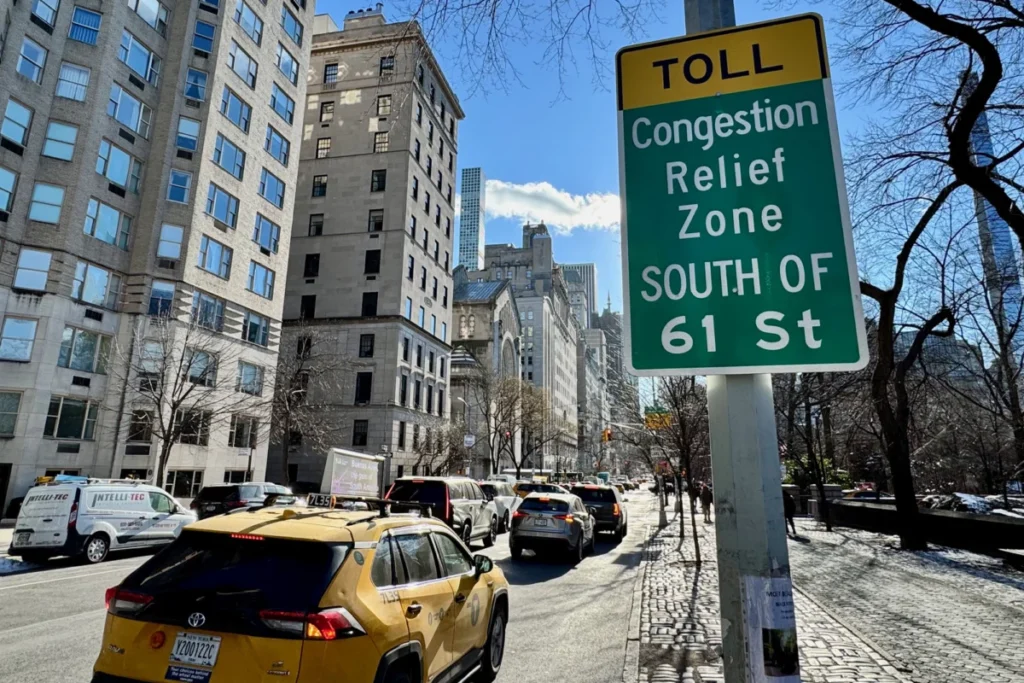
The researchers applied their model to a significant real-world policy change: the implementation of congestion pricing in Manhattan. Beginning in January 2025, a fee was introduced for vehicles entering the busiest parts of Manhattan, specifically south of 60th Street. The MIT team analyzed vehicle traffic data at two, four, six, and eight-week intervals following the program’s inception.
Their analysis revealed a notable decrease in overall traffic volume by approximately 10 percent within the congestion pricing zone. More significantly, this reduction in traffic was accompanied by a corresponding drop in emissions, ranging from 16 to 22 percent. This finding strongly aligns with independent research, such as a previous study by Cornell University researchers, which reported a substantial 22 percent reduction in fine particulate matter (PM2.5) levels within the same pricing zone.
The MIT team’s granular analysis further indicated that these emission reductions were not uniformly distributed across the entire road network. They observed larger declines on some major arteries within the zone, while areas outside the immediate pricing zone exhibited more mixed effects. This nuanced understanding of spatial impact is crucial for refining policy implementation and identifying areas that may require additional interventions or support.
"We see these kinds of huge changes after the congestion pricing began," Hu remarked. "I think that’s a demonstration that our model can be very helpful if a government really wants to know if a new policy converts into real-world impact." The ability to quantify the direct, real-world impact of a policy intervention in near real-time provides an unprecedented level of accountability and transparency for urban governance.
Expanding the Framework: Future Data Streams and Applications
The researchers envision that their framework is adaptable and can be further enhanced by incorporating additional data sources. They point to related work in Amsterdam, where their team successfully utilized dashboard cameras from vehicles to gather rich information about vehicle movement. This suggests that the potential for data integration is vast, extending to various forms of ubiquitous sensing technologies already present in urban environments.
"With our model, we can make any camera used in cities, from the hundreds of traffic cameras to the thousands of dash cams, a powerful device to estimate traffic emissions in real-time," said Fabio Duarte, the associate director of research and design at the MIT Senseable City Lab, who has been involved in numerous related studies. This vision paints a picture of a future where virtually any camera equipped with the appropriate analytics software can contribute to a city’s understanding of its environmental footprint.
The implications of this research are far-reaching. By providing highly detailed, real-time data on vehicular emissions, the MIT framework empowers cities to:
- Targeted Policy Development: Identify pollution hotspots and specific emission sources to design more effective and targeted interventions.
- Evidence-Based Decision Making: Quantify the impact of new policies, such as congestion pricing, low-emission zones, or public transit investments, with greater accuracy.
- Optimized Traffic Management: Understand how traffic signal timing and flow management strategies influence emissions, leading to more sustainable urban mobility.
- Public Health Improvements: Provide crucial data for assessing the correlation between vehicular emissions and public health outcomes, enabling proactive health interventions.
- Climate Action Acceleration: Track progress towards decarbonization goals and identify areas where emissions reduction strategies need to be intensified.
The research was generously supported by various entities, including the city of Amsterdam, the AMS Institute, and the Abu Dhabi Department of Municipalities and Transport. Further support was provided by the MIT Senseable City Consortium, a collaborative network comprising Atlas University, the city of Laval, the city of Rio de Janeiro, Consiglio per la Ricerca in Agricoltura e l’Analisi dell’Economia Agraria, the Dubai Future Foundation, FAE Technology, KAIST Center for Advanced Urban Systems, Sondotecnica, Toyota, and Volkswagen Group America. This broad base of support underscores the international recognition of the importance and potential of this transformative research.