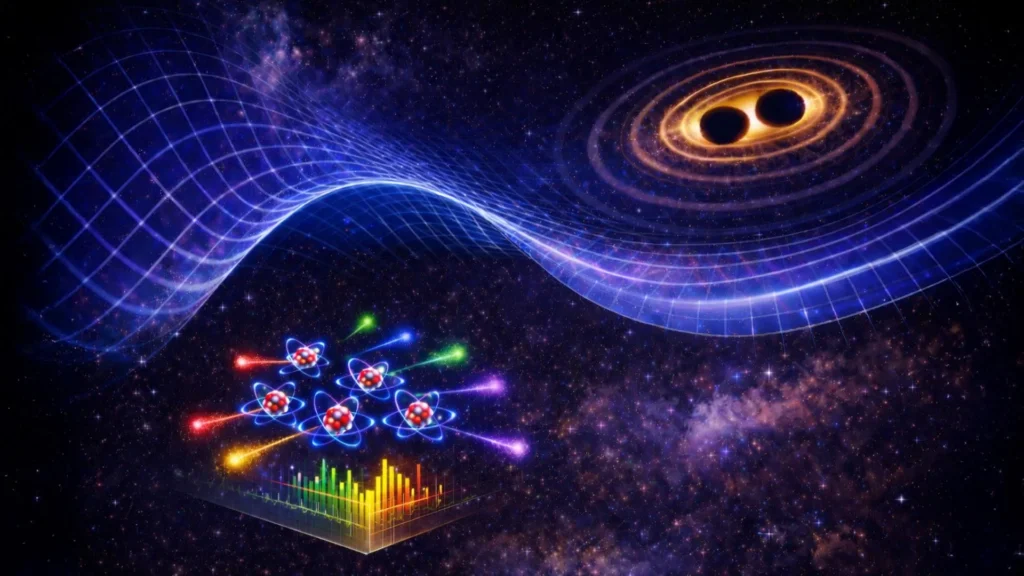
The landscape of modern astrophysics is on the verge of a potential paradigm shift as a new theoretical framework suggests that gravitational waves—the elusive ripples in the fabric of spacetime—could be detected using the subtle light-emitting behaviors of atoms rather than the massive, kilometer-scale interferometers currently in use. A collaborative research effort involving physicists from Stockholm University, Nordita, and the University of Tübingen has proposed a method that leverages the interaction between gravitational waves and the quantum electromagnetic field to observe changes in how atoms release energy. This study, recently accepted for publication in the prestigious journal Physical Review Letters, introduces the possibility of "compact" gravitational-wave sensing, potentially shrinking the required hardware from the scale of a city to the scale of a laboratory benchtop.
The Evolution of Gravitational Wave Astronomy
To understand the significance of this proposal, it is necessary to examine the history and current state of gravitational wave detection. First predicted by Albert Einstein in 1916 as a consequence of his General Theory of Relativity, gravitational waves are perturbations in spacetime caused by the acceleration of massive cosmic objects. For a century, these waves remained purely theoretical because gravity is the weakest of the four fundamental forces, and the ripples it creates are unimaginably faint.
It was not until 2015 that the Laser Interferometer Gravitational-Wave Observatory (LIGO) made the first direct detection of gravitational waves, originating from the merger of two black holes 1.3 billion light-years away. This achievement, which earned the Nobel Prize in Physics, relied on two L-shaped detectors in Washington and Louisiana. Each detector uses vacuum tunnels four kilometers long. By bouncing laser beams between mirrors at the ends of these tunnels, scientists can measure changes in distance smaller than one-thousandth the diameter of a proton.
While LIGO and its counterparts, such as Virgo in Italy and KAGRA in Japan, have opened a new window into the "audio" of the universe, they are limited by their sheer size and the frequency ranges they can monitor. They are primarily sensitive to high-frequency waves from stellar-mass black hole collisions. Lower frequency waves, such as those produced by supermassive black hole binaries or the early universe’s expansion, require even larger scales, leading to the development of the Laser Interferometer Space Antenna (LISA), a planned space-based mission with arms stretching millions of kilometers. The Stockholm-led proposal offers a radically different alternative: looking inward at the quantum behavior of matter rather than outward at the displacement of macroscopic mirrors.
The Mechanism: Spontaneous Emission and the Quantum Vacuum
The core of the new theory lies in the phenomenon of spontaneous emission. In quantum mechanics, an atom in an excited state does not remain there indefinitely. Eventually, it drops to a lower energy state, releasing a photon in the process. Conventional physics teaches that this happens because the atom interacts with the "quantum vacuum"—a field of fluctuating energy that exists even in empty space.
Jerzy Paczos, a PhD student at Stockholm University and a lead author of the study, explains that gravitational waves do not merely move objects; they modulate the very fields that permeate space. "Gravitational waves modulate the quantum field, which in turn affects spontaneous emission," Paczos stated. According to the research, as a gravitational wave passes through a cloud of atoms, it stretches and squeezes the underlying electromagnetic field. This distortion changes the environment in which the atom releases its photon.
Crucially, the researchers found that while the gravitational wave does not change the total number of photons emitted over time—the emission rate remains constant—it does change the energy, or frequency, of those photons. This shift is highly dependent on the direction in which the photon is emitted relative to the orientation of the gravitational wave.
Hidden Signals in the Light Spectrum
The reason this effect has remained undiscovered in previous theoretical models is its subtle nature. Because the total light output of an atomic ensemble remains unchanged, a simple light-intensity sensor would see nothing unusual. However, the Stockholm team’s mathematical models show that a gravitational wave creates a distinct "directional pattern" in the light’s spectrum.
In this scenario, photons traveling in one direction might be slightly blueshifted (increased in frequency), while those traveling in another direction are redshifted (decreased in frequency). This creates a signature that is unique to the gravitational wave’s polarization and its direction of travel through the universe. By analyzing the spectral distribution of light from a group of atoms, researchers could theoretically "see" the gravitational wave passing through the laboratory.
This directional sensitivity is a significant advantage. One of the greatest challenges in gravitational wave detection is distinguishing a cosmic signal from local noise, such as seismic vibrations or thermal fluctuations. A signal that possesses a specific, predictable directional geometry is much easier to isolate from the chaotic, isotropic noise of the environment.
Leveraging Cold Atoms and Precision Timing
The feasibility of this method rests on the use of "cold atoms"—atoms cooled to temperatures near absolute zero. At these temperatures, atoms move very slowly, allowing for extremely precise measurements of their energy transitions. The researchers point to atomic clocks as a potential platform for this technology. Modern atomic clocks are the most precise instruments ever built, capable of keeping time to within one second over billions of years by monitoring the vibrations of atoms.
"Our findings may open a route toward compact gravitational-wave sensing, where the relevant atomic ensemble is millimeter-scale," said Navdeep Arya, a postdoctoral researcher at Stockholm University. The shift from kilometers to millimeters represents a million-fold reduction in scale. Such a device would not replace LIGO but would complement it, potentially targeting different frequency bands and providing a portable means of detection that could be deployed in various environments, including space-based platforms that are much smaller than the proposed LISA mission.
The use of optical transitions in these atomic systems allows for "long interaction times." This means the atoms remain in a state where they are sensitive to the passing gravitational wave for a sufficient duration to allow the frequency shift to be recorded.
Comparative Analysis: Traditional vs. Quantum Detection
The researchers use a musical analogy to describe the difference between current methods and their proposed approach. Current detectors like LIGO are like measuring the physical movement of a guitar string as it is plucked. The new method is more akin to listening to a steady musical tone and detecting the tiniest change in pitch as the listener moves relative to the source.
| Feature | Current Interferometry (LIGO/Virgo) | Proposed Atomic Sensing |
|---|---|---|
| Primary Measurement | Physical displacement of mirrors | Frequency shift in emitted photons |
| Physical Scale | 3 km to 4 km arms | Millimeter-scale atomic clouds |
| Frequency Range | High frequency (10 Hz – several kHz) | Potential for low-frequency sensitivity |
| Mechanism | Laser phase shift | Quantum field modulation |
| Environment | Massive terrestrial/space vacuum tubes | Cold-atom traps / Atomic clocks |
Challenges and Path to Experimental Validation
Despite the mathematical elegance of the theory, the researchers are careful to note that experimental realization is the next major hurdle. The primary obstacle is the signal-to-noise ratio. The frequency shifts predicted are incredibly small, and even the slightest thermal noise or electromagnetic interference could drown out the gravitational wave’s signature.
The next phase of research will involve a thorough "noise analysis" to determine if current laser and cooling technologies are stable enough to detect these quantum shifts. "A thorough noise analysis is necessary to assess practical feasibility, but our first estimates are promising," Arya noted.
Independent experts in the field of quantum optics have reacted with cautious optimism. While the theoretical link between gravity and quantum field modulation is well-supported by the equations of General Relativity and Quantum Field Theory, the practical application requires a level of sensitivity that pushes the boundaries of current experimental physics. If the noise can be managed, the implications for multi-messenger astronomy—the study of the universe using both light and gravitational waves simultaneously—would be profound.
Broader Implications for Science and Technology
If confirmed by experiment, this "compact" approach to gravitational wave detection could democratize the field of gravitational astronomy. Currently, only a few nations have the resources and geography to host kilometer-scale detectors. A millimeter-scale sensor could potentially be integrated into standard laboratory settings or small-scale satellite missions.
Furthermore, this research contributes to the ongoing effort to unify General Relativity (the physics of the very large) with Quantum Mechanics (the physics of the very small). By observing how a gravitational wave—a purely relativistic phenomenon—alters the quantum process of spontaneous emission, scientists are probing the intersection of these two pillars of modern physics.
The ability to detect low-frequency gravitational waves with compact devices would also allow us to study the "background" of the universe. This includes the stochastic gravitational wave background, a hum of ripples left over from the Big Bang. Understanding this background is essential for answering fundamental questions about the birth of the universe and the nature of dark matter and dark energy.
Conclusion
The study from Stockholm University, Nordita, and the University of Tübingen marks a creative departure from the status quo of "bigger is better" in gravitational wave detection. By looking at the directional frequency shifts in the light of atoms, the team has provided a theoretical roadmap for a new generation of sensors. While the transition from a theoretical paper in Physical Review Letters to a functioning laboratory device may take years, the prospect of capturing the most powerful events in the universe within a millimeter-scale ensemble of atoms represents one of the most exciting frontiers in contemporary physics. The universe’s most dramatic events—the collisions of giant black holes and the echoes of the Big Bang—may soon be measured not by the movement of giant mirrors, but by the subtle changing colors of a few cold atoms.