The intricate dance of subatomic particles—specifically the coordinated movement of electrons and protons—serves as the foundational engine for life on Earth and the backbone of modern energy technology. For decades, scientists have scrutinized Proton-Coupled Electron Transfer (PCET), a fundamental process where the movement of an electron is linked to the relocation of a proton. This mechanism is the heartbeat of biological powerhouses, driving cellular respiration, the nitrogen fixation necessary for agriculture, and the conversion of sunlight into chemical energy via photosynthesis. While PCET and its more recent cousin, Proton-Coupled Singlet Energy Transfer (PCEnT), have been well-documented, a significant gap remained in understanding how these movements influence triplet energy states.
In a landmark study published in the journal Nature Materials, a research team led by Professor Kaifeng Wu at the Dalian Institute of Chemical Physics (DICP) of the Chinese Academy of Sciences has unveiled a previously unknown mechanism: Proton Shuttle-Assisted Triplet Energy Transfer (PS-TET). This discovery identifies a sophisticated pathway through which energy can be moved between materials with unprecedented efficiency by utilizing a "shuttle" to facilitate the transition. By bridging the gap between proton dynamics and triplet energy states, the team has provided a new blueprint for controlling energy flow at the molecular level, promising significant advancements in solar energy, catalysis, and laser technology.
The Evolution of Proton-Coupled Energy Dynamics
To understand the significance of PS-TET, one must first look at the historical trajectory of energy transfer research. The study of Proton-Coupled Electron Transfer (PCET) began in earnest during the mid-20th century as chemists sought to explain how enzymes move charges across long distances with minimal energy loss. In the 1990s and 2000s, this research expanded into artificial systems, leading to the development of better fuel cells and water-splitting catalysts.
However, energy transfer isn’t just about moving electrons; it is about the "spin" states of those electrons. Singlet states, where electron spins are paired, were the primary focus of earlier proton-coupled energy transfer studies (PCEnT). Triplet states, where electron spins are parallel, are generally more stable and long-lived, making them highly desirable for certain types of chemical reactions but notoriously difficult to manipulate and transfer efficiently.
Professor Wu’s team recognized that while triplet energy transfer is a staple of both natural and synthetic chemistry, the role of proton movement within this process remained an "uncharted territory." Their research was designed to test whether a proton could act as a catalyst or a "shuttle" to lower the energy barriers that typically slow down triplet transfer.
Decoding the PS-TET Mechanism: The Proton Shuttle in Action
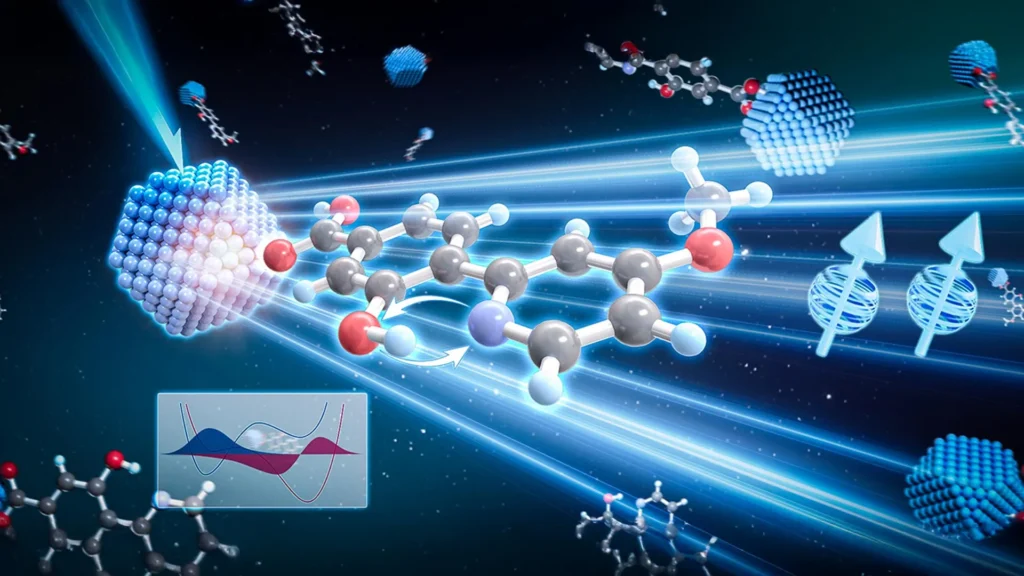
The experimental setup utilized by the DICP researchers involved a sophisticated hybrid system: Zinc Selenide (ZnSe) colloidal quantum dots (QDs) paired with phenol-pyridine dyadic acceptors. Quantum dots are semiconductor nanocrystals known for their unique optical properties, while the phenol-pyridine dyads acted as the receiving "docks" for the energy.
The PS-TET process occurs in a rapid, multi-step sequence that begins when the ZnSe quantum dots absorb a photon and enter an excited state. The mechanism then unfolds as follows:
- Initial Hole and Proton Shift: A "hole" (the absence of an electron) moves from the ZnSe quantum dot to the phenol component of the dyad. Simultaneously, a proton shifts from the phenol to the pyridine. This coordinated move prevents the build-up of excessive charge, which would otherwise halt the process.
- Electron Transfer and Proton Return: Following the hole transfer, an electron moves from the ZnSe quantum dot to the phenoxyl radical created in the first step. At the exact same moment, the proton that had moved to the pyridine "shuttles" back to its original location on the phenol.
- Completion of Triplet Transfer: The net result of these synchronized movements is the transfer of spin-triplet energy from the quantum dot to the dyad. Crucially, the proton ends the cycle exactly where it started, having acted as a temporary facilitator—a shuttle—that enabled the energy to bypass traditional resistance.
To verify that the proton was indeed the driving force, the researchers compared this system to a methylated analog. In the methylated version, the "shuttle" is effectively blocked because the transferable proton is replaced by a methyl group. The results were stark: the system with the active proton shuttle exhibited significantly higher speed and efficiency in triplet energy transfer compared to the version without it.
Quantum Tunneling: Energy Movement Beyond Heat
One of the most striking findings of the study was the behavior of the proton at varying temperatures. In classical chemistry, the rate of a reaction typically increases as temperature rises because thermal energy helps particles overcome physical barriers. However, the researchers observed that the rate of PS-TET remained almost constant regardless of temperature changes.
This phenomenon is a hallmark of quantum mechanical tunneling. In the quantum world, particles like protons can "tunnel" through energy barriers that they technically do not have enough energy to climb over. By analyzing the proton vibrational wavefunction overlap integrals—mathematical models that describe the probability of a particle’s location—the team confirmed that the system was being steered toward efficient energy migration through these quantum effects.
This discovery is particularly relevant for the development of room-temperature quantum technologies. It proves that even in complex, multi-component materials, quantum tunneling can be harnessed to drive energy transfer with high precision without the need for extreme cooling.
Technical Data and Experimental Observations
The research utilized ultrafast transient absorption spectroscopy to monitor the movement of charges and energy on a femtosecond (one-quadrillionth of a second) timescale. This allowed the team to "film" the movement of the proton and electron in real-time.
Key data points from the study included:
- Kinetic Enhancement: The PS-TET pathway was found to be orders of magnitude faster than the non-proton-coupled triplet transfer in similar semiconductor-molecule interfaces.
- Substituent Effects: By adding a trifluoromethyl group—a strongly electron-withdrawing substituent—to the pyridine, the researchers found they could actually reverse or reorder the sequence of the hole and electron transfer steps. This suggests that the PS-TET mechanism is highly "tunable" based on the chemical structure of the materials involved.
- Efficiency Metrics: The efficiency of triplet generation in the ZnSe-phenol-pyridine system approached near-unity under optimized conditions, a significant improvement over traditional heavy-atom-free organic systems.
Implications for Solar Energy and Optoelectronics
The discovery of PS-TET has immediate and profound implications for a variety of industrial and scientific fields. According to Professor Wu, the ability to control triplet states through proton movement provides a new "knob" for scientists to turn when designing advanced materials.
1. Enhancing Photochemical Catalysis:
Many chemical reactions, including those used for environmental remediation and the production of solar fuels (like hydrogen), rely on triplet excited states to drive long-lived redox reactions. By using the PS-TET mechanism, engineers can design catalysts that generate these triplet states more efficiently, leading to faster and cheaper chemical manufacturing.
2. Optimizing Solar Cells and Lasers:
In the world of organic electronics, triplet states are often a double-edged sword. In some photovoltaic cells, triplets can lead to energy loss through recombination. In organic lasers, the accumulation of triplet states can "quench" the laser action, preventing continuous operation. The PS-TET research suggests that by removing or "turning off" a proton shuttle, designers can suppress unwanted triplet formation, thereby increasing the lifespan and efficiency of these devices.
3. Environmental Impact:
The research team’s use of ZnSe quantum dots is also notable. Unlike CdSe (Cadmium Selenide) quantum dots, which contain toxic heavy metals, ZnSe is considered a more environmentally friendly "green" semiconductor. Demonstrating high-efficiency energy transfer in these materials paves the way for more sustainable optoelectronic technologies.
Chronology of Discovery and Future Directions
The journey to the discovery of PS-TET followed a systematic path of inquiry at the Dalian Institute:
- Phase 1 (Early 2020s): Initial studies focused on the interaction between quantum dots and organic molecules, refining the use of ultrafast spectroscopy to track energy flow.
- Phase 2 (2022-2023): The team explored PCEnT (singlet transfer) and began theorizing that a similar mechanism could exist for triplets.
- Phase 3 (Late 2023): Successful synthesis of the phenol-pyridine dyad and integration with ZnSe QDs led to the first observations of the "shuttle" effect.
- Phase 4 (2024): Publication in Nature Materials and the commencement of follow-up studies to apply PS-TET to specific catalytic reactions.
Looking forward, the scientific community is likely to expand upon this work by investigating whether PS-TET occurs in natural biological systems. If a similar proton-shuttle triplet transfer is found in proteins or light-harvesting complexes, it could rewrite our understanding of how certain organisms protect themselves from light-induced damage or how they maximize energy capture in low-light environments.
Conclusion: A New Frontier in Molecular Engineering
The discovery of Proton Shuttle-Assisted Triplet Energy Transfer represents a major leap in our ability to manipulate the fundamental building blocks of matter. By showing that a simple proton can act as a sophisticated gatekeeper for energy flow, Professor Wu and his team have opened a new frontier in molecular engineering.
The study confirms that the future of energy technology lies not just in the materials we use, but in the precision with which we can orchestrate the movement of the smallest particles within those materials. As researchers begin to apply the principles of PS-TET to real-world devices, the transition toward more efficient, tunable, and sustainable energy systems appears more attainable than ever. The "shuttle" has arrived, and it is carrying the future of quantum energy transfer with it.