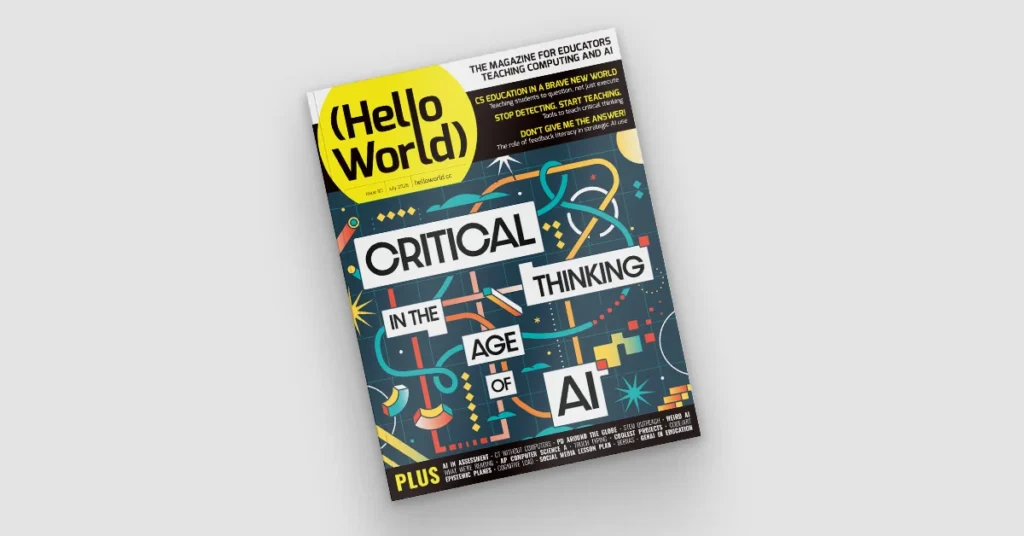
The Raspberry Pi Foundation, in collaboration with the Computer Science Teachers Association (CSTA), has announced the release of the 30th issue of Hello World magazine, a publication dedicated to the intersection of computing education and modern pedagogy. This milestone edition, titled "Critical Thinking in the Age of AI," arrives at a pivotal moment in the history of education, as the rapid proliferation of generative artificial intelligence (AI) tools reshapes the cognitive landscape for students and educators alike. The issue, accompanied by a new podcast mini-series, serves as a comprehensive resource for navigating the complexities of a world where data-driven tools increasingly manage personal decisions, creative choices, and intellectual processes.
The Paradigm Shift in Cognitive Engagement
The central thesis of the latest Hello World issue explores a phenomenon described as the "outsourcing of thinking." In the contemporary digital environment, predictive text features, algorithmic music recommendations, and AI-driven navigation tools have moved from being peripheral conveniences to central architects of daily life. While these tools offer significant efficiency gains, they present a fundamental challenge to the development of critical thinking. By relying on predictive models to choose words, evaluate entertainment, or provide instant answers to complex queries, individuals risk bypassing the internal processes of analysis and reflection that are essential for intellectual growth.
The Raspberry Pi Foundation’s latest research highlights that while older generations may have developed critical thinking skills through manual tasks—such as navigating without GPS or independently researching insurance options—today’s youth are maturing in an environment where these "accidental delights" of exploration and independent decision-making are often replaced by optimized, automated solutions. The educational community is now tasked with reintroducing these cognitive stressors in a controlled, pedagogical environment to ensure that students do not become passive recipients of AI-generated outputs.
A Chronology of AI Integration in Educational Standards
The release of Issue 30 marks a significant point in the timeline of digital literacy education. To understand the current state of critical thinking in schools, it is necessary to examine the trajectory of AI development and its subsequent adoption in the classroom:
- 2012–2017: The Rise of Narrow AI. During this period, AI was largely invisible to the average student, operating behind the scenes in search engine algorithms and social media feeds. Education focused primarily on "digital citizenship" and basic coding.
- 2018–2021: Adaptive Learning Systems. AI began to enter the classroom through personalized learning platforms that adjusted curriculum difficulty based on student performance. The focus remained on the teacher as the primary source of knowledge.
- November 2022: The Generative AI Explosion. The public release of Large Language Models (LLMs) like ChatGPT fundamentally altered the educational landscape. For the first time, students had access to tools that could generate essays, solve complex mathematical proofs, and write code with minimal human intervention.
- 2023: The Crisis of Academic Integrity. Schools globally grappled with the implications of AI on assessment, leading to temporary bans in some districts and a realization that traditional homework models were no longer viable.
- 2024: The Shift to Critical AI Literacy. Publications like Hello World and organizations like the CSTA began advocating for a shift from "how to use AI" to "how to evaluate AI." This period is defined by the integration of AI ethics and critical thinking into core computer science standards.
The CSTA K–12 Standards and the "Supersonic" Future
A cornerstone of the new issue is the contribution from the Computer Science Teachers Association (CSTA) in the United States regarding their newly rewritten K–12 Standards. These standards are research-backed frameworks designed to prepare students for a technological landscape that is evolving at what experts describe as "supersonic speed."
Amanda O’Mara, Smita Kolhatkar, and Tiffany Jones, contributors to the issue, argue that while AI can generate answers instantly, the capacity to understand, evaluate, and verify those answers remains a uniquely human responsibility. The updated standards emphasize a "new balance" in computer science education. The goal is no longer just to produce proficient coders, but to cultivate "AI-fluent" citizens who can direct AI systems rather than being directed by them. This involves understanding the biases inherent in training data, the limitations of probabilistic logic, and the ethical implications of automated decision-making.
Supporting Data: The Impact of AI on the Learning Experience
Recent data from the educational sector underscores the urgency of the themes explored in Hello World Issue 30. According to a 2023 survey by the Pew Research Center, approximately 19% of teenagers who have heard of ChatGPT reported using it to help with schoolwork. Furthermore, a report from the Walton Family Foundation found that nearly half of all teachers are using AI in their professional lives, yet many express concern about their ability to teach students how to use these tools critically.
The "cognitive load" theory, a major focus of Issue 30, suggests that when AI handles the lower-level tasks of information retrieval and formatting, students should theoretically be free to engage in higher-order thinking. However, research suggests that without explicit instruction, the "path of least resistance" often leads to a decrease in deep processing. Educators are now exploring "productive struggle," where AI is used not as a solution-provider, but as a scaffold that is gradually removed as the student gains mastery.
Key Themes and Research Insights from Issue 30
The magazine provides a deep dive into several critical areas that are currently defining the frontier of computing education:
Managing Cognitive Load for Deeper Thinking
This feature examines how educators can prevent students from becoming overwhelmed by the technical complexities of AI while still ensuring they are intellectually challenged. By managing the "extraneous" cognitive load of software interfaces, teachers can focus student attention on the "germane" load of problem-solving and critical analysis.
Whose Knowledge Shapes AI?
A critical sociological question addressed in the issue is the origin of the data that trains AI models. Educators are encouraged to teach students about the cultural and linguistic biases present in LLMs, which often reflect Western-centric viewpoints. Understanding "whose knowledge" is being amplified is a vital component of modern critical thinking.
AI Systems in Assessment
The issue explores how schools are moving away from "AI-proof" assignments toward "AI-integrated" assessments. This includes oral examinations, process-based grading where students must document their prompts and iterations, and tasks that require the critique of AI-generated content.
Flatgames and Predictive Classroom Systems
Beyond AI, the issue explores creative computing through "Flatgames"—a genre of simple, artistic video games—and the use of predictive systems to track student progress. These articles highlight the diversity of the computing curriculum, balancing high-tech AI discussions with accessible, creative projects.
Official Responses and Professional Development
The Raspberry Pi Foundation has emphasized that professional development for teachers must move beyond mere tool-based confidence. "Why AI professional learning should build teachers’ critical thinking, not just their confidence in using tools" is a recurring theme. The foundation posits that if teachers do not understand the underlying mechanisms and potential pitfalls of AI, they cannot effectively guide students through the ethical minefield of the digital age.
Industry leaders have also weighed in on the importance of this educational pivot. Oracle, the sponsor of Issue 30, has long advocated for a workforce that is not only technically skilled but also capable of complex decision-making. The consensus among tech stakeholders is that the future economy will value "human-in-the-loop" systems, where AI augments rather than replaces human judgement.
Broader Impact and Global Implications
The implications of the work being done by the Hello World team extend far beyond the classroom. In a democratic society, the ability to think critically about information is a foundational requirement for informed citizenship. As AI-generated deepfakes and misinformation become more sophisticated, the skills taught in computer science classrooms become essential survival skills for the 21st century.
Furthermore, the focus on "Promoting Human Decision-Making" addresses a growing concern in the field of ergonomics and psychology: the erosion of human agency. By teaching students to interrogate the recommendations of an algorithm—whether it is an insurance quote, a news article, or a line of code—educators are helping to preserve the autonomy of the next generation.
The release of Hello World Issue 30, available for free download, represents a call to action for the global education community. It suggests that while the age of AI may be characterized by automation, the future of education must be defined by an intensified focus on the one thing machines cannot yet replicate: the nuanced, ethical, and critical human mind. Through research, practical resources, and a commitment to rigorous inquiry, the Raspberry Pi Foundation and its partners are providing the roadmap for a future where humans remain the masters of their technological tools.