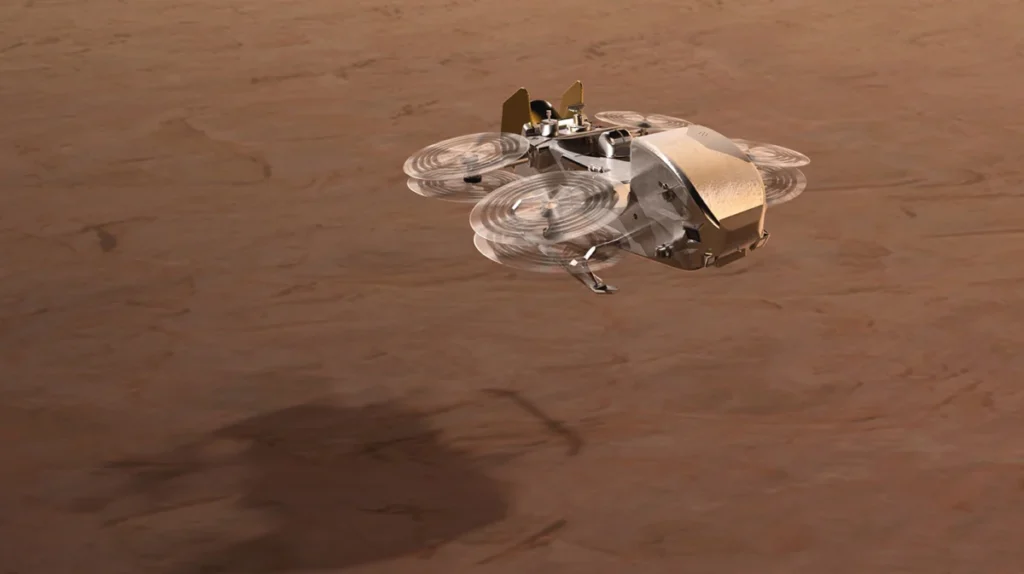
Technicians at Johns Hopkins Applied Physics Laboratory (APL) in Maryland are diligently installing the intricate electronics within NASA’s groundbreaking Dragonfly rotorcraft, a pivotal step in its ambitious 2028 mission to explore Saturn’s largest moon, Titan. This significant progress was recently highlighted in a livestreamed update, offering the public a rare glimpse into the sterile clean room environment where the spacecraft’s core systems are being meticulously assembled.
The visual evidence showcased engineers and technicians working with precision inside the rotorcraft’s body, carefully connecting a complex web of wiring to various electronics boxes. This phase of assembly is critical, laying the foundation for the sophisticated systems that will enable Dragonfly to conduct its unprecedented exploration of Titan’s alien landscape. The spacecraft’s journey, set to commence in 2028, is anticipated to reach its destination in 2035, marking a significant return to the Saturnian system for detailed surface investigation.
Structural Integrity Verified for Extreme Environments
Prior to the current electronics integration, a crucial milestone was achieved: the successful completion of the spacecraft structure qualification. Simmie Berman, APL’s thermal-mechanical subsystem lead for Dragonfly, explained the significance of this testing during the broadcast. "We just finished the spacecraft structure qualification here," Berman stated. This comprehensive testing regimen involved subjecting the entire structure to rigorous simulations designed to replicate the extreme stresses of launch, the challenging landing on Titan, and the subsequent operational demands of flying on another planetary body. The successful qualification of the structure ensures that Dragonfly is robust enough to withstand these formidable environmental pressures, a testament to the advanced engineering and design principles employed in its construction.
Titan: A World of Intriguing Possibilities
Dragonfly’s destination, Titan, presents a unique and scientifically compelling target for exploration. This icy moon, approximately 1.2 billion kilometers (760 million miles) from Earth, is renowned for its dense atmosphere, which is primarily composed of nitrogen, and its unique methane-based hydrological cycle. Unlike any other moon in our solar system, Titan possesses liquid on its surface in the form of methane and ethane lakes, rivers, and seas. Furthermore, evidence suggests the presence of a subsurface ocean of liquid water, potentially harboring conditions suitable for life as we know it. The moon also exhibits a dynamic weather system, including rain, clouds, and sand dunes sculpted by atmospheric winds.
The last spacecraft to visit Titan was the European Space Agency’s Huygens probe in 2005, which detached from the Cassini orbiter and descended through Titan’s thick atmosphere. While Huygens provided invaluable data during its descent and returned stunning images shortly after landing, its operational design did not facilitate extensive surface exploration or prolonged operation on Titan’s frigid surface. Dragonfly, by contrast, is engineered for mobility and extended surface operations, promising a far more comprehensive understanding of this enigmatic world.
A Leapfrog Approach to Exploration
Dragonfly’s mission profile is designed to capitalize on Titan’s unique environment. The rotorcraft will undertake a series of short, controlled flights, effectively "leapfrogging" across the moon’s surface. This method of exploration is particularly suited to Titan, allowing the spacecraft to investigate diverse geological terrains and atmospheric phenomena over an extended period. The mission is slated to last at least three years, during which Dragonfly will collect data on Titan’s habitability, its atmospheric composition, and the processes that shape its surface. The scientific objectives are broad, encompassing the study of prebiotic chemistry, the search for organic molecules, and the understanding of Titan’s geological and meteorological evolution.
Advanced Thermal Management: A Crucial Engineering Challenge
One of the most significant engineering challenges for the Dragonfly mission is maintaining the spacecraft’s operational temperature in Titan’s extremely cold environment. Surface temperatures on Titan hover around a frigid minus 185 degrees Celsius (minus 300 degrees Fahrenheit). To combat this, Dragonfly will be equipped with a sophisticated thermal management system.
Following the installation of electronics, a critical phase will commence: the application of a unique solimide-based insulation. This lightweight, fire-resistant polyimide material is crucial for protecting Dragonfly’s sensitive instruments from the extreme cold. Berman described this process as one of the most difficult and complex parts of assembly. "The lander will be covered in approximately 850 tiles of foam, made by hand here at APL," she explained. "The whole thing goes together like a big, giant, three-dimensional jigsaw puzzle." This meticulous installation is expected to continue through the end of the current year, paving the way for comprehensive environmental testing early next year.
Powering and Heating the Rotorcraft
Dragonfly will draw its power from a Multi-Mission Radioisotope Thermoelectric Generator (MMRTG). Similar to those utilized by NASA’s Curiosity and Perseverance Mars rovers, the MMRTG generates electricity from the heat produced by the natural decay of plutonium-238. This device will not only provide the necessary power for Dragonfly’s operations but will also be instrumental in its heating system.
"We actually take the heat that is rejected from the power source, and we use fans to blow it throughout the entire lander to keep it warm," Berman elaborated. "Then we wrap it in foam to make it like a thermos bottle, just to maintain all the heat inside." This ingenious approach ensures that the delicate electronics remain within their operational temperature range. The system also incorporates a self-cooling capability, which Berman likened to the zippers on a parka, allowing for regulation if internal temperatures rise beyond desired levels during operation.
Rigorous Testing in Simulated Titan Conditions
Once the insulation is expertly applied, Dragonfly will undergo further rigorous testing within APL’s specialized Titan Chamber. This facility is engineered to replicate the extreme temperature and pressure conditions of Titan’s surface, providing a crucial environment for validating the spacecraft’s performance under simulated operational scenarios. "Our team is basically working together to make sure that we meet both thermal requirements and maintain the ability to be able to fly around while we’re on Titan," Berman emphasized. This comprehensive testing phase is essential to ensure mission success and the safety of the spacecraft as it embarks on its interplanetary voyage.
Mission Costs and Broader Implications
The Dragonfly mission represents a significant investment by NASA, with an estimated lifecycle cost of $3.35 billion. APL is serving as the prime contractor for this complex endeavor, underscoring the laboratory’s vital role in NASA’s deep space exploration initiatives. The successful development and deployment of Dragonfly will not only expand our scientific understanding of Titan but will also advance our capabilities in robotic exploration of extreme extraterrestrial environments.
The data gathered from Dragonfly’s exploration is expected to have profound implications for astrobiology, planetary science, and our understanding of the potential for life beyond Earth. Titan’s unique chemical and geological conditions offer a compelling natural laboratory for studying the processes that may have led to the origin of life on Earth. By investigating the complex organic chemistry occurring on Titan, scientists hope to gain insights into the fundamental building blocks of life and the conditions under which they can form and evolve.
Furthermore, the technological innovations developed for Dragonfly, particularly in the areas of rotorcraft flight in dense atmospheres, advanced thermal management, and autonomous operation in extreme environments, will likely have broader applications in future space exploration missions and even terrestrial technologies. The mission is a testament to human ingenuity and our enduring drive to explore the unknown, pushing the boundaries of scientific discovery and technological advancement. As the assembly and testing of Dragonfly continue, anticipation builds for its 2028 launch, promising a new era of exploration for one of the solar system’s most fascinating worlds.