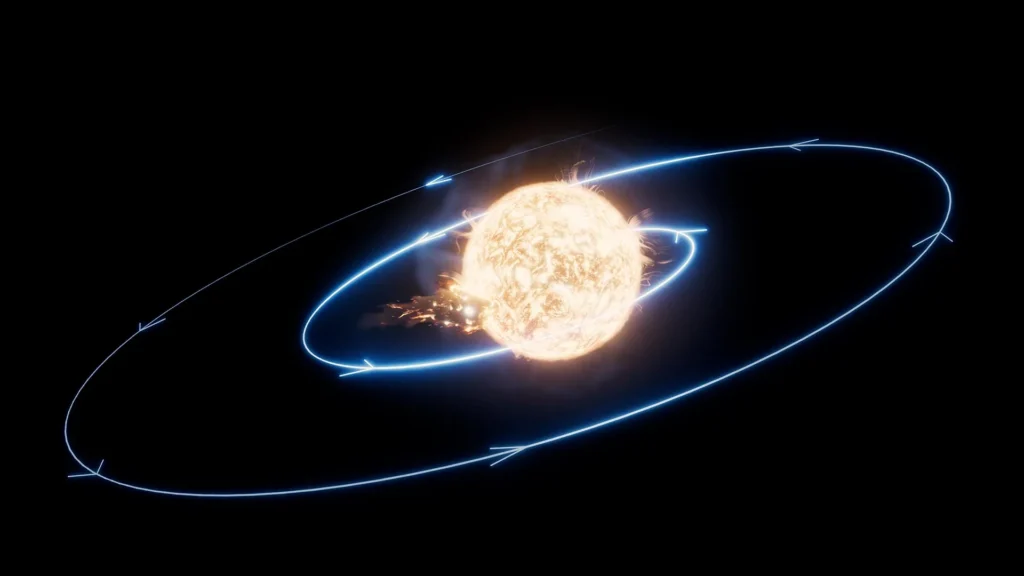
Astronomers have uncovered compelling evidence suggesting that TOI-5882, a sun-like star located approximately 1,300 light-years from Earth, may have consumed one of its own planetary companions. This groundbreaking discovery, led by University of Michigan astronomer Brooke Kotten, hinges on an unusual chemical signature detected within the star’s atmosphere – a significantly higher concentration of lithium than typically observed in stars of its type. The findings, published in the latest issue of The Astrophysical Journal, offer a rare glimpse into the dynamic and often violent evolution of planetary systems.
The unusual abundance of lithium in TOI-5882’s atmosphere acts as a crucial “chemical fingerprint,” pointing towards a past catastrophic event. Lithium, an element relatively rare in stellar cores but abundant in planetary building blocks, is not readily produced in the furnaces of sun-like stars. Therefore, a substantial increase in its presence strongly suggests the incorporation of extraterrestrial material. As lead author Brooke Kotten, a graduate student researcher in the U-M Department of Astronomy, aptly put it, "You are what you eat, right? We know that there’s much more lithium in planetary material than there is in stars. So if a star eats a planet, it’s going to take on a bunch of lithium."
This research, supported in part by federal funding from NASA and the U.S. National Science Foundation, opens a new frontier in our understanding of stellar and planetary evolution. The study highlights the detective work involved in astronomical research, where direct observation of rare events is often impossible.
The Cosmic Enigma: Unraveling Planetary Engulfment
Astronomers refer to the process by which a star consumes a planet as “engulfment.” These events are incredibly rapid on cosmic timescales, often concluding within days or weeks. This brevity makes witnessing such a phenomenon in real-time exceptionally challenging. Instead, scientists must meticulously analyze the aftermath, searching for residual chemical traces and other indirect evidence.
“That’s what makes this field so exciting. You really are solving a mystery,” Kotten explained, recalling her initial involvement with the study as an undergraduate student participating in the Lamat Program at the University of California, Santa Cruz. “We can’t just watch the crime happen, so we have to work with all the clues we’re given to figure out whodunit.” The ability to identify and characterize these engulfment events is vital for determining their frequency across the galaxy and the specific circumstances that precipitate them.
The implications of such discoveries extend to our own solar system. Current models predict that in approximately five billion years, our Sun will enter its red giant phase. As it expands, it is expected to engulf Mercury, Venus, and potentially even Earth, offering a stark, albeit distant, preview of planetary destruction. Understanding how other stars interact with their planets provides valuable context for the future of our own celestial home.
The Curious Case of TOI-5882: A Star with a Secret
The star TOI-5882, while exhibiting a significant lithium excess, has not yet expanded to a size that would naturally explain how it could have swallowed a planet through its own evolutionary process. This anomaly led the research team to consider external factors that might have contributed to the planet’s demise.
A Celestial Accomplice: The Role of a Brown Dwarf
Further investigation revealed that TOI-5882 hosts a massive gaseous object in its orbit, significantly more massive than Jupiter – more than 20 times its mass, in fact. However, this object is not large enough to initiate nuclear fusion, classifying it as a brown dwarf. The presence of this brown dwarf introduces a compelling hypothesis: it may have gravitationally destabilized the orbit of the missing planet, ultimately sending it on a collision course with TOI-5882. This possibility is slated for further investigation in a subsequent study.
Lithium: The Stellar Smoking Gun
The element lithium serves as a particularly potent indicator in the search for planetary engulfment. While stars naturally contain trace amounts of lithium, planets are known to accumulate significantly higher concentrations during their formation. Seth Jacobson, a senior author of the study and assistant professor at Michigan State University, drew an analogy to illustrate this point: "Lithium atoms delivered by planetary engulfment to a star are like sports fans arriving at a stadium. There may already be a few early arriving fans present, representing the initial amount of lithium in the stellar atmosphere, but they are quickly outnumbered."
Based on the detected lithium levels in TOI-5882, the research team estimates that the engulfed planet likely ranged in mass from a couple of Earth masses to that of Neptune. This quantitative assessment underscores the precision of modern astronomical observation and analysis.
Melinda Soares-Furtado, another senior author and assistant professor at the University of Wisconsin, emphasized the remarkable achievement: "The fact that we can look at a star 1,300 light-years away and say with confidence, ‘This star has more lithium than you would expect,’ is a testament to both the precision of modern instrumentation and the hard interpretive work that goes into making sense of that signal."
Rigorous Analysis: Comparing TOI-5882 to Its Peers
The collaborative effort behind this discovery involved 14 researchers from both the United States and Chile. Employing spectroscopy, a technique that analyzes a star’s light to determine its chemical composition, the team meticulously examined TOI-5882 for signs of lithium enrichment.
The initial spectroscopic observations confirmed a substantial presence of lithium. The subsequent and more challenging task was to definitively prove that this lithium level was indeed anomalous, rather than a typical characteristic for stars of similar age, mass, and temperature. To achieve this, the researchers meticulously assembled a comparison group comprising 62 stars with comparable properties. This rigorous comparative analysis allowed them to assess TOI-5882’s lithium content against a statistically relevant baseline.
“And it’s not like you have to cherry-pick the data to make it stand out. It’s robust,” Soares-Furtado asserted. “No matter how you slice it, TOI-5882 is so enriched in lithium it shows up as being at least in the 97th percentile.” This statistically significant deviation leaves little room for doubt regarding the unusual nature of the star’s chemical composition.
A Preserved Cosmic Relic: Why TOI-5882 Holds the Key
This groundbreaking research builds upon earlier theoretical work by Soares-Furtado, which identified specific types of stars most likely to retain observable evidence of planetary engulfment. Many stars, due to their internal mixing processes, quickly disperse or dilute the chemical signatures of ingested planets, rendering them undetectable over time. TOI-5882, however, appears to be a rare stellar environment where these ancient cosmic events have left a remarkably well-preserved imprint.
Interestingly, a few stars within the comparison group also exhibited unexpectedly high lithium levels. This finding introduces a new layer of complexity, suggesting that planetary engulfment might not be the sole mechanism capable of enriching a star with lithium. This opens up new avenues for future research, posing further questions for astronomers to explore.
For Brooke Kotten, the inherent uncertainties and the ongoing quest for answers are precisely what fuels her passion for astrophysics. Reflecting on her career path, she remarked, “When I was growing up, I dreamed about becoming a private investigator. I think that explains a lot about where I ended up. I do feel like a detective.” This sentiment encapsulates the essence of the scientific endeavor – piecing together clues to unravel the universe’s most profound mysteries. The discovery concerning TOI-5882 is a significant step forward in this cosmic investigation, offering tangible evidence of the dramatic evolutionary pathways planets and their host stars can traverse.