In a landmark development for the field of quantum thermodynamics, an international team of physicists has successfully demonstrated a novel method for controlling the rotational dynamics of molecules embedded within superfluid liquid helium. This breakthrough, achieved through the application of a specialized optical centrifuge, allows researchers to manipulate the orientation and angular velocity of molecules with unprecedented precision, opening a new window into the behavior of matter at the intersection of classical mechanics and quantum fluidity. Led by the University of British Columbia (UBC) in collaboration with the University of Freiburg, the research addresses a long-standing challenge in condensed matter physics: the ability to probe and control individual molecular actors within a frictionless, quantum-mechanical solvent.
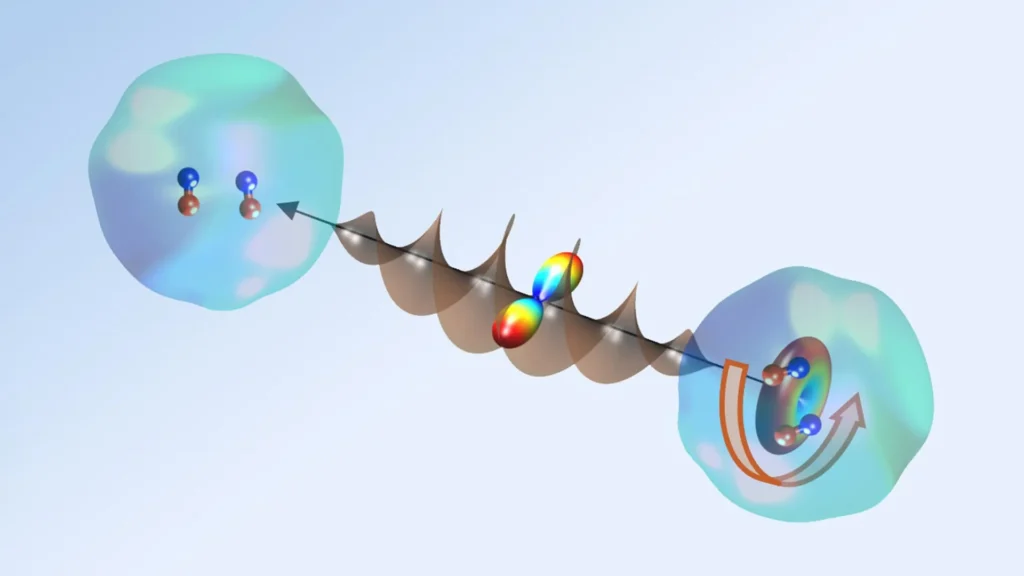
The study, recently published in the prestigious journal Physical Review Letters, provides the first empirical evidence of controlled molecular rotation inside a superfluid environment. By utilizing ultra-fast laser pulses to create a "rotational "knob," the team has bypassed the traditional limitations that have historically hindered the study of molecular dynamics in cryogenic liquids. This achievement is not merely a technical milestone; it is a fundamental advancement that enables scientists to investigate how quantum surroundings influence the movement of matter at the atomic scale, potentially paving the way for innovations in quantum computing and precision chemical engineering.
The Unique Environment of Superfluid Helium
To understand the significance of this achievement, one must first consider the extraordinary nature of the medium involved. Liquid helium, when cooled to temperatures approaching absolute zero (specifically below the "lambda point" of 2.17 Kelvin), transitions into a state of matter known as a superfluid. In this state, the liquid exhibits zero viscosity, meaning it flows without any loss of kinetic energy due to internal friction. A superfluid can climb the walls of containers, leak through microscopic pores that would block normal liquids, and maintain persistent currents indefinitely.
Despite these "frictionless" properties, superfluids are not entirely inert. When a foreign molecule is dissolved within a helium nano-droplet, it interacts with the surrounding helium atoms in a complex quantum dance. These interactions create what physicists call an "effective mass" increase. As a molecule attempts to rotate, it drags a portion of the superfluid density with it, effectively becoming "heavier" and more resistant to changes in motion. This phenomenon is often referred to as the "snowball effect," where the solvated molecule acts as a nucleus for a localized cluster of helium atoms that move in tandem with it.
Until now, the "snowballing" of molecules in superfluids made it exceptionally difficult to exert precise control over their rotation. While scientists have long used liquid helium as a "spectroscopic matrix"—a cold, quiet background to study molecules—they lacked the tools to actively drive and adjust the rotation of those molecules once they were submerged.
The Innovation of the Optical Centrifuge
The primary tool used in this breakthrough is the optical centrifuge, a sophisticated laser system designed to spin molecules to extremely high angular velocities. In a standard gas-phase experiment, an optical centrifuge works by delivering a "chirped" laser pulse. This pulse features an electric field that rotates at an accelerating rate. Molecules with a permanent or induced dipole moment align themselves with this rotating field, much like a compass needle following a spinning magnet, and are "spun up" to trillions of rotations per second.
However, applying this technique to molecules inside a superfluid presented a significant hurdle. The dense, quantum-mechanical environment of the helium nano-droplet tends to dampen the initial "kick" of the laser or causes the molecule to decouple from the field prematurely. To overcome this, Dr. Valery Milner and his colleagues at UBC developed a modified approach involving a dual-pulse interference technique.
By embedding nitric oxide dimers within helium nano-droplets and introducing a calculated delay between successive laser pulses, the researchers were able to create a specific interference pattern in the rotational excitation. This delay allowed the researchers to adjust the "spinnability" of the molecules. Rather than hitting the molecule with a single, overwhelming force, the timed pulses created a steady, controlled acceleration that accounted for the added "weight" of the helium snowball. This method allowed the team to directly tune both the direction and the frequency of the rotation, marking the first time such a "control knob" has existed for molecules in a quantum solvent.
Chronology of Superfluid and Rotational Research
The journey to this discovery spans nearly a century of physics, beginning with the initial discovery of superfluidity and evolving through the development of ultra-fast optics.
- 1937-1938: Pyotr Kapitsa, John Allen, and Don Misener independently discover the superfluidity of Helium-4. This discovery challenges classical thermodynamics and leads to the development of quantum fluid theories by Lev Landau and Richard Feynman.
- 1990s: The development of helium nano-droplet isolation (HENDI) spectroscopy allows scientists to use tiny droplets of helium as a "nanolaboratory." Researchers begin to notice that molecules inside these droplets exhibit different rotational constants than those in a vacuum.
- 1998: The concept of the optical centrifuge is first proposed and later demonstrated in the early 2000s, primarily for gas-phase molecules. It becomes a vital tool for studying "extreme" molecular states.
- 2010s: Theoretical physicists begin to predict that at high enough rotational speeds, the "snowball" effect in superfluids should break down, as the molecule begins to rotate faster than the superfluid can respond.
- 2023-2024: The UBC and Freiburg team successfully merges optical centrifuge technology with helium nano-droplet science, achieving the results published in Physical Review Letters.
Technical Analysis and Supporting Data
The core of the UBC study involved measuring the "rotational wave packet" of nitric oxide (NO) dimers. In a vacuum, a nitric oxide dimer has a well-defined moment of inertia. When placed in a helium droplet, this moment of inertia increases by a factor of nearly three. This change is the direct result of the helium atoms "coating" the molecule.
The data gathered by the UBC team showed that by varying the laser pulse delay, they could observe the transition from "slow" to "fast" rotational regimes. Specifically, they looked for the "revivals" of the rotational wave packet—periodic moments where the rotating molecules align in unison. In the superfluid environment, these revivals are typically suppressed or shifted due to the interaction with the helium.
The UBC researchers found that their new centrifuge technique could "force" the molecule into a specific rotational state, effectively overcoming the environmental decoherence. The significance of this can be quantified by the "degree of alignment," a statistical measure of how well the molecules follow the laser’s lead. In the UBC experiments, the degree of alignment remained remarkably high even within the liquid medium, proving that the optical centrifuge could maintain its grip on the molecule despite the surrounding quantum fluid.
Official Commentary and Scientific Reactions
Dr. Valery Milner, an associate professor at UBC Physics and Astronomy and the lead author of the paper, emphasized the difficulty of the task. "Controlling the rotation of a molecule dissolved in any fluid is a challenge," Dr. Milner noted. He compared the process to moving a snowball that grows as it rolls, making it progressively harder to manipulate. "The question of interest in the science of quantum matter is what changes from the perspective of the dissolved molecule when you make the transition from a normal fluid to this type of quantum superfluid."
While the current research focused on nitric oxide, the implications are much broader. Collaborators from the University of Freiburg noted that this technique could be applied to a wide range of dopant molecules, allowing for a systematic mapping of how different chemical structures interact with superfluids.
Theoretical physicists have reacted to the news with enthusiasm, noting that the ability to spin molecules at specific frequencies provides a way to test the limits of the Landau critical velocity. This is the speed at which a probe moving through a superfluid begins to create excitations (like phonons or rotons), causing the superfluidity to "break" locally. By spinning a molecule faster and faster, researchers can now pinpoint exactly when the frictionless flow collapses at the microscopic scale.
Broader Impact and Future Directions
The implications of this research extend far beyond the laboratory study of liquid helium. One of the most promising areas of impact is in the field of quantum information science. Superfluids are often considered as potential environments for housing qubits—the building blocks of quantum computers—because their cold, stable nature minimizes environmental "noise." Understanding how to control the rotation and orientation of molecules within these fluids is a prerequisite for using them as reliable quantum memory or processing units.
Furthermore, the study of molecular rotation in superfluids has direct relevance to astrophysics. Giant planets like Jupiter and Saturn are thought to contain hydrogen and helium in states that may exhibit superfluid properties. Similarly, the interiors of neutron stars are believed to consist of superfluid neutrons. By studying how molecules rotate in a controlled terrestrial superfluid, scientists can gain insights into the rotational dynamics of celestial bodies and the behavior of matter in extreme cosmic environments.
The UBC team is already looking toward the next phase of their research. Their primary goal is to identify the "critical frequency" where the molecular rotation becomes so fast that the helium atoms can no longer keep up. At this tipping point, the "snowball" is expected to be shed, and the molecule should theoretically begin to rotate as if it were in a vacuum, even though it remains submerged in the liquid. Identifying this transition would provide a definitive map of the transition from quantum to classical behavior at the nano-scale.
Conclusion
The successful demonstration of controlled molecular rotation in liquid helium nano-droplets represents a triumph of precision spectroscopy and ultra-fast laser physics. By turning a laser into a "quantum centrifuge," the researchers at UBC and the University of Freiburg have provided the scientific community with a powerful new tool to probe the mysteries of the subatomic world. As they continue to refine this technique, the "snowball" that once hindered our understanding of superfluids may finally be melted away, revealing the fundamental mechanics of quantum liquids in unprecedented detail.
This research was supported by a coalition of Canadian and international bodies, including the Natural Sciences and Engineering Research Council of Canada (NSERC), the Canada Foundation for Innovation (CFI), and the BC Knowledge Development Fund. As the team moves forward, their work stands as a testament to the power of international collaboration in pushing the boundaries of what is possible in the realm of quantum science.