In the relentless pursuit of precision within modern industrial automation, the focus frequently converges on the tangible elements of a motion control system: the robust mechanics and the powerful motors. While undeniably foundational, these components represent only a part of the intricate ecosystem that defines true performance. The third installment in this essential series delves into the often-underestimated, yet critically vital, role of drives and controls, revealing how these intelligent electronics transform raw mechanical capability into refined, ultra-precise movement. As industries push the boundaries of accuracy, from micron-level to sub-nanometer specifications, the sophisticated designs and features of drives and controls emerge as the linchpins for achieving the exacting demands of contemporary applications.
The evolution of motion control systems mirrors the broader advancement of industrial technology, transitioning from rudimentary electromechanical setups to highly sophisticated, digitally integrated platforms. Initially, electric motors were engaged with a simple application of power, resulting in unmodulated rotation. The advent of drives marked a significant leap, introducing electronic regulation to manage power delivery, thereby enabling smoother operation and enhanced efficiency. This development was crucial for protecting motors from overcurrents and for providing basic speed adjustments. Subsequently, controllers emerged, infusing a new layer of intelligence. These units moved beyond mere power regulation, offering capabilities such as precise acceleration, velocity control, and rudimentary positioning. This progression allowed for more complex motion profiles, laying the groundwork for automated processes.
Today, the landscape of motion control is profoundly shaped by the demands of Industry 4.0, which prioritizes interconnectedness, real-time data analysis, and autonomous operation. This paradigm shift has elevated drives and controls from mere auxiliary components to the central nervous system of any high-performance motion system. According to a report by MarketsandMarkets, the global motion control market size is projected to grow from an estimated USD 14.5 billion in 2023 to USD 19.9 billion by 2028, at a Compound Annual Growth Rate (CAGR) of 6.5%. This growth is primarily fueled by increasing automation across diverse sectors, a trend that is inextricably linked to the continuous innovation in drive and control technologies.
Drives and Controls: The Brains Behind the Motion
Corey Foster, Director of Automation Sales & Application Engineering at Valin Corporation, emphasizes that achieving true precision necessitates a holistic understanding of the entire motion control system. While the first article in this series meticulously examined the mechanical layer—addressing often-overlooked factors like bearing deflection, body stiffness, and structural smoothness—and the second explored the nuances of motor designs, construction, and quality, this current discussion isolates the crucial contributions of drives and controls. Foster’s insights highlight that many critical details, essential for meeting high-performance expectations, often remain absent from standard datasheets, underscoring the need for a deeper engineering perspective.
At their core, drives are the electronic circuits that govern the flow of electrical power to a motor, acting as an interface between the power supply and the motor itself. They modulate voltage and current to control the motor’s speed and torque. Basic drives might simply regulate power for smooth starts and stops, while advanced servo drives offer precise current, velocity, and position control, often operating in closed-loop systems with feedback from encoders.
Controllers, on the other hand, provide the intelligence. They interpret commands, execute motion profiles, and manage sequences of actions. From simple programmable logic controllers (PLCs) handling sequential tasks to sophisticated multi-axis motion controllers capable of complex interpolated movements, these units are responsible for the overall choreography of the system. In high-precision applications, the controller is tasked with maintaining tight synchronization across multiple axes, responding rapidly to external stimuli, and adapting to dynamic environmental conditions.
The synergy between drives and controllers is paramount. The controller issues commands, which the drive then translates into precise electrical signals to move the motor. In modern high-performance systems, these two components are often integrated into a single unit, known as an integrated drive/controller, optimizing communication speed and reducing latency, which are critical for achieving sub-micron or nanometer accuracy.
Navigating the Tiers of Performance
The demands placed on drives and controls vary significantly based on the application’s required performance tier:

-
Basic Applications: For the most fundamental electric motor operations, built-in intelligence in drives and controls might be considered overkill. Here, the primary requirement is simply compatibility to allow the motor to run. Default settings for any available tuning features are often sufficient. Examples include simple conveyor belts or fan systems where exact positioning or dynamic response is not critical. The electronics serve primarily to power the motor reliably and safely.
-
Specification-Level Control: As applications demand tighter control, the specific features of drives and controllers become increasingly important. This tier requires the availability of tuning features, necessitating correct information and parameters to achieve the desired performance. Controllers must be programmed accurately to execute specific motion profiles and sequences. Common issues at this level often stem from simple setup errors, missing settings, or improper tuning by personnel lacking adequate training. An improperly tuned system might exhibit slow, unresponsive motion or, conversely, become overly aggressive and unstable, leading to suboptimal performance. While using a high-performance motor with lower-performance electronics might not be catastrophic in many applications at this tier, it generally prevents the system from reaching its full potential.
-
Pushing Beyond Specifications – The High-Performance Realm: This is where the true capabilities of advanced drives and controls are indispensable. In applications demanding micron-level or nanometer precision, such as semiconductor manufacturing, optical inspection, medical robotics, and advanced material processing, the limitations of basic or mid-range electronics become glaringly apparent. A high-end motor paired with inadequate electronics will struggle to meet its requirements, leading to difficulties in tuning, poor overall performance, and, in worst-case scenarios, the outright impossibility of achieving application goals.
High-performance applications necessitate:
- Advanced Tuning Features: These include dynamic and adaptable gains, allowing the system to adjust its control parameters in real-time based on varying loads, speeds, or environmental conditions. This contrasts sharply with static PID (Proportional-Integral-Derivative) loops, which are often insufficient for highly dynamic systems.
- Multi-Axis Synchronization: For complex mechanics like gantries, Cartesian robots, or multi-axis stages, perfect coordination between multiple motors is crucial. Advanced controllers offer sophisticated interpolation algorithms and synchronization capabilities, ensuring smooth, precise, and coordinated motion across all axes.
- Fast Update Rates: Tight current and voltage control requires extremely rapid sampling and update rates from the drives. This responsiveness minimizes lag and allows for swift, accurate adjustments, directly impacting the system’s ability to track desired trajectories with high fidelity.
- Fast Processors: To prevent lag in logic execution and command processing, controllers must be equipped with powerful, high-speed processors. This ensures that complex algorithms are run efficiently and that the system can react instantaneously to feedback and new commands.
- Environmental Adaptability: Real-world industrial environments are rarely pristine. Electrical noise from arc-welders, mechanical vibrations from heavy machinery, or even human presence can introduce disturbances. High-performance controls must incorporate tools like notch filters to suppress specific resonant frequencies and dynamic tuning parameters to adapt to changing environmental conditions, ensuring consistent performance despite external interference. Corey Foster recounts a scenario where an OEM’s tool performed flawlessly in an isolated lab but failed in a noisy production environment, necessitating an upgrade to controls with such adaptive features.
Critical Considerations for Advanced Systems
Beyond the core functionalities, several other factors critically influence the performance of high-end motion control systems:
- Beyond "Auto-Tuning": While "auto-tuning" features in modern drives and controllers provide a convenient starting point by automatically estimating system parameters and proposing initial gain settings, they are not a "silver bullet." They often produce a functionally stable system but rarely an optimally performing one, especially for demanding applications. Expert engineers are frequently required to fine-tune these parameters manually, leveraging their experience and understanding of the system’s unique dynamics to unlock peak performance.
- Encoder Resolution and System Harmony: The resolution of the encoder – the feedback device that measures position or speed – must be meticulously matched with both the application’s precision goal and the capabilities of the electronics. An ultra-high-resolution encoder paired with a drive that cannot process its data quickly enough or with sufficient precision will lead to a bottleneck, rendering the high-resolution feedback ineffective. Conversely, a low-resolution encoder will limit the system’s accuracy, regardless of how sophisticated the drive and controller are.
- Fieldbus Communication Protocols: In multi-axis or networked systems, the choice of communication protocol is paramount. Traditional serial communications are too slow for high-performance, real-time control. Modern fieldbus protocols such as EtherCAT, PROFINET, and SERCOS III offer deterministic, high-speed, and synchronized communication, essential for coordinating multiple axes with nanosecond precision. These protocols enable the rapid exchange of control commands, feedback data, and diagnostic information, ensuring that all components of the system act in concert.
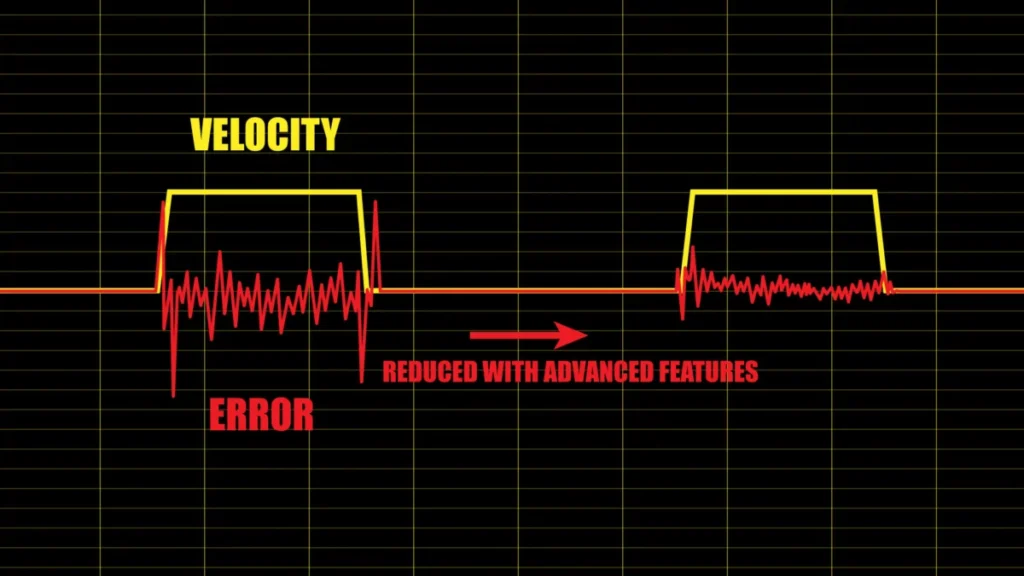
- Software and Algorithms: The intelligence embedded within the controller’s software is a defining characteristic of high-performance systems. Advanced servo control algorithms, often proprietary, go beyond basic PID loops, incorporating feedforward control, disturbance rejection, and adaptive control techniques. These algorithms, combined with flexible real-time multi-threaded programming environments and sophisticated motion optimization tools, allow engineers to program highly complex, precise, and dynamic motion profiles that would be impossible with simpler controllers. The graphical representation of reduced errors through these functions underscores their transformative impact.
Industry Landscape and Implications
The growing demand for high-precision motion control is driven by several key industries. In semiconductor manufacturing, the fabrication of microchips requires positioning accuracy in the nanometer range for photolithography and wafer handling. Medical robotics benefits from motion control for surgical robots that perform intricate procedures with unparalleled precision, and for diagnostic equipment. The aerospace sector relies on precision motion for automated assembly of large components, inspection, and material processing. Advanced manufacturing, including additive manufacturing (3D printing) and laser micromachining, also depends heavily on ultra-precise motion for consistent quality and intricate designs.
The implications of neglecting the critical role of drives and controls are significant. An under-specified control system can lead to costly rework, extended development cycles, increased scrap rates, and ultimately, a failure to meet market demands for product quality and throughput. Conversely, investing in the right drives and controls, even if they appear more expensive initially, can yield substantial returns through improved system performance, higher reliability, reduced maintenance, and the ability to unlock new application possibilities. The true cost of a motion system is not merely the sum of its parts but the maximum performance it can reliably deliver.
Ultimately, precision motion is not merely about how well a motor is controlled; it is, as Foster eloquently puts it, "the art of coordinating information from the target, even the environment, with the variables of the mechanics and motors themselves to achieve the specified goal of the application." This holistic perspective emphasizes that the best hardware, be it mechanics or motors, cannot compensate for an unsophisticated or inadequately configured control loop. The intelligence, adaptability, and responsiveness embedded in drives and controls are what elevate a mechanical assembly into a truly high-performance motion system capable of meeting the rigorous demands of today’s most advanced industrial processes.
This exploration of drives and controls concludes the examination of individual layers in this series. The journey began with an in-depth look at the foundational mechanics in Part 1: Layers of performance and specifications in motion control, followed by an analysis of the motors in Part 2: Layers of performance and specifications in motion control. The series will culminate in Part 4: Layers of performance and specifications in motion control, which will synthesize these elements and likely delve into system integration, software, and overall architectural considerations for achieving peak performance.