The Moon has long been a silent witness to the relentless barrage of the solar wind, a constant stream of charged particles emanating from the Sun. For billions of years, this cosmic bombardment has sculpted its surface. However, groundbreaking new evidence, meticulously analyzed from material returned by China’s Chang’e 6 mission, reveals that this ancient interaction was not uniform across the lunar hemispheres. Particles striking the near side and the far side of the Moon have arrived at different speeds and carried varying amounts of energy, a disparity now strongly linked to the protective influence of Earth’s magnetosphere. These pivotal findings, published in the esteemed journal Nature Geoscience, are reshaping our understanding of the complex interplay between the Sun, Earth, and its natural satellite.
The Moon’s Dusty Archive of Solar Wind History
The solar wind, a vital but potentially damaging outflow from the Sun, consists primarily of protons and electrons. Lacking a substantial atmosphere and a global magnetic field, the Moon’s surface is directly exposed to this energetic particle flux. Over eons, the lunar regolith – the layer of loose, unconsolidated rocky material covering the lunar surface – has acted as an extraordinary archive, preserving a detailed record of this solar wind implantation. Volatile materials, particularly noble gases like helium (He), neon (Ne), argon (Ar), krypton (Kr), and xenon (Xe), delivered by the solar wind, are incorporated into the regolith. Because these elements are chemically inert, they rarely react with other lunar materials, making them exceptionally reliable tracers of solar wind particle entry and accumulation.
Historically, scientific inquiry into these lunar archives was largely confined to samples collected from the Moon’s near side, the hemisphere perpetually facing Earth. This geographical limitation meant that a critical question remained unanswered: did the solar wind’s impact differ systematically between the near and far sides? Without access to material from the far side, a direct comparison was impossible, leaving a significant gap in our understanding of lunar evolution and its interaction with the space environment.
This scientific frontier was dramatically breached with the successful return of the Chang’e 6 mission. In a historic feat of space exploration, China’s robotic probe collected approximately 1.935 grams of lunar regolith from the South Pole-Aitken basin, a vast and ancient impact crater located on the lunar far side. This precious cargo provided, for the first time, the direct physical material needed to embark on a comparative study of solar wind implantation into soils from both hemispheres of the Moon.
Chang’e 6 Samples Unveil Distinct Isotopic Signatures
A dedicated team, spearheaded by researchers at the Institute of Geology and Geophysics (IGG) of the Chinese Academy of Sciences (CAS), undertook the meticulous analysis of the Chang’e 6 regolith. Their comprehensive examination focused on the concentrations and isotopic compositions of the noble gases—helium, neon, argon, krypton, and xenon—trapped within the lunar soil. This ambitious project was led by Xuhang Zhang, a postdoctoral researcher at IGG, working under the guidance of Professor HE Huaiyu. The research also benefited from the collaborative expertise of scientists from the University of Science and Technology of China and members of the Chang’e 7 volatile payload team, underscoring the international significance of this endeavor.
Among the most striking revelations was the distinct isotopic signature of neon found in the Chang’e 6 samples. The regolith from the far side exhibited an average 20Ne/22Ne ratio of 11.34 ± 0.22. This value is significantly lower than those measured in all previously studied near-side lunar samples. Crucially, this lower ratio closely aligns with theoretical predictions for strong solar wind fractionation, a process where isotopic ratios are altered due to differences in mass. The observed pattern strongly suggests that the lunar far side experienced more intense isotopic fractionation, resulting in a relative enrichment of the heavier neon isotope, 22Ne.
Evidence of Deeper Solar Wind Penetration on the Far Side
Further compelling evidence for differential solar wind exposure, particularly concerning the energy of the impacting particles, emerged from the analysis of krypton and xenon isotopes. During carefully controlled stepwise heating experiments, designed to release trapped gases at progressively higher temperatures, the xenon delivered by the solar wind from the Chang’e 6 material was predominantly released at high temperatures, manifesting as a single, distinct peak. In stark contrast, analysis of samples from the Chang’e 5 mission, collected from the near side, revealed a different pattern. Substantial amounts of xenon were released from the Chang’e 5 regolith at both low and high temperatures, indicating a more heterogeneous distribution of implanted solar wind.
This significant contrast between the two hemispheres points to a crucial difference in the penetration depth of solar wind particles. Deeper implantation generally requires particles with higher kinetic energy. Therefore, the observed pattern suggests that the lunar far side was exposed to a solar wind that was not only faster but also carried more energy compared to the wind that reached the near side. This finding challenges previous assumptions about the uniformity of solar wind bombardment across the Moon.
Earth’s Magnetosphere: The Unseen Guardian
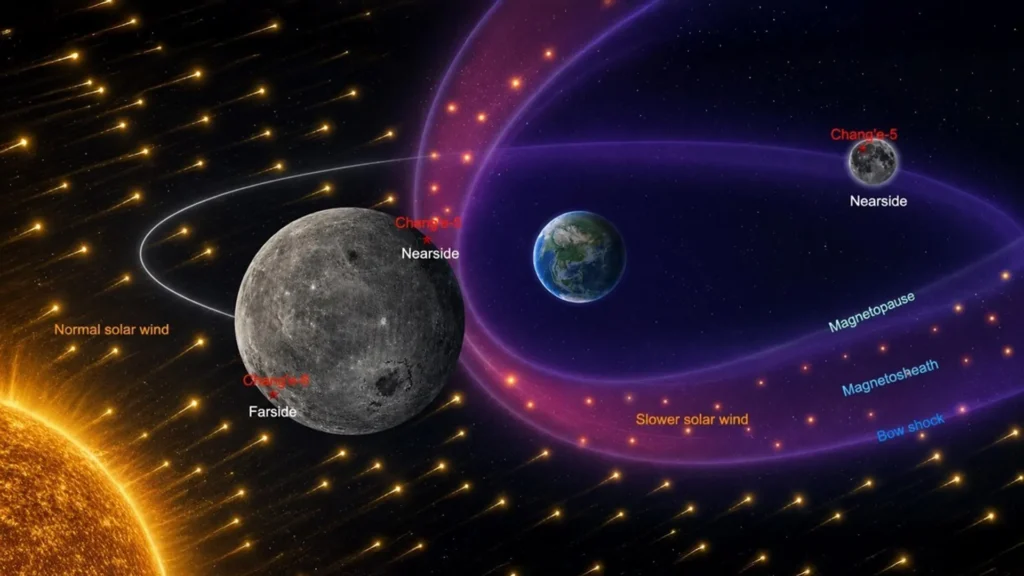
The researchers have put forth a compelling explanation for this observed hemispheric asymmetry: the "speed-governing" effect of Earth’s magnetosphere. As the Moon orbits Earth, it periodically traverses regions within and around Earth’s magnetosphere, particularly the magnetosheath. This region acts as a buffer zone, where the solar wind, normally streaming at speeds of approximately 400 kilometers per second (km/s), is significantly slowed down. Within the magnetosheath, the solar wind velocity can be reduced to as low as roughly 200 km/s.
This deceleration has a profound impact on the solar wind particles that reach the Moon. The reduced energy means that these particles do not penetrate as deeply into the lunar regolith on the side facing Earth – the near side. Their implantation is thus confined closer to the surface. Conversely, the far side of the Moon, perpetually facing away from Earth, is largely shielded from this magnetospheric influence. It remains exposed to the full, unimpeded force of the undisturbed solar wind, allowing the faster, more energetic particles to penetrate much deeper into the lunar soil.
The research team estimates that approximately 25% of the total solar wind exposure recorded in the Chang’e 5 landing site samples on the near side involved this slower, less energetic solar wind flow. In stark contrast, the Chang’e 6 site on the far side showed no discernible evidence of having experienced this protective effect, underscoring the consistent exposure to the more energetic solar wind.
Lunar Soil: A Chronicle of Earth’s Magnetic Past
The analysis of the Chang’e 6 samples thus provides the first direct physical evidence unequivocally demonstrating that Earth’s magnetosphere plays a crucial role in modulating the speed and energy of solar wind particles reaching different parts of the Moon. This influence is not ephemeral; it is permanently etched into the lunar regolith through the depth at which solar wind particles were implanted and the resulting isotopic signatures of the trapped noble gases.
Beyond explaining current lunar surface processes, the researchers propose a far-reaching implication: lunar soil could serve as an invaluable "fossil record" of Earth’s magnetic past. By studying the isotopic composition of heavy noble gases within lunar samples, particularly from the far side, scientists may gain unprecedented insights into the historical strength and behavior of Earth’s magnetosphere over vast geological timescales. When correlated with existing paleomagnetic evidence from terrestrial rocks, these lunar archives could offer a novel and powerful method for tracing the long-term evolution of Earth’s protective magnetic field.
The findings from the Chang’e 6 mission underscore a reality far more complex than previously imagined regarding the intricate relationship among the Sun, Earth, and Moon. They reveal that the Moon has been silently preserving a hidden repository of information about these ancient cosmic interactions, offering scientists a new and exciting avenue to explore the deep history of Earth’s magnetic environment. This discovery opens up a new chapter in lunar science and planetary exploration, promising to unlock secrets that have been buried in the lunar dust for billions of years.
Broader Implications and Future Research
The implications of these findings extend beyond fundamental lunar science. Understanding the interaction of the solar wind with planetary bodies is crucial for future space exploration and the safety of astronauts. Earth’s magnetosphere shields our planet from the most harmful effects of solar storms, but other celestial bodies, like the Moon, lack this protection. The differentiated exposure of the Moon’s hemispheres highlights the critical role planetary magnetic fields play in shaping planetary environments.
This research also opens avenues for re-examining existing lunar sample data with a new perspective. The established differences in noble gas isotopic ratios and implantation depths could be used to refine models of solar wind evolution and its interaction with planetary magnetospheres. Furthermore, the success of the Chang’e 6 mission in returning samples from the far side marks a significant milestone in lunar exploration capabilities. Future missions could be designed to specifically target regions on the Moon that may have experienced unique solar wind exposures, providing even richer datasets for understanding both lunar history and the evolution of our solar system.
The ongoing analysis of the Chang’e 6 samples is expected to yield further insights into the composition and origin of volatile elements on the Moon. These discoveries could have implications for understanding the delivery of water and other essential volatiles to the inner solar system, including Earth. The partnership between scientific curiosity and advanced engineering, as exemplified by the Chang’e missions, continues to push the boundaries of our knowledge, revealing the profound and interconnected nature of celestial bodies. The silent, dusty surface of the Moon, once thought to be a simple record of bombardment, is now understood to hold intricate stories, whispered by the solar wind and modulated by the very planet it orbits.