More than a century after the tragic sinking of the RMS Titanic irrevocably altered global perceptions of maritime safety, the ambitious pursuit of truly unsinkable vessels continues to captivate and drive engineering innovation. This enduring aspiration has recently taken a significant leap forward, not through a grand ship design, but through a foundational material science breakthrough at the University of Rochester’s Institute of Optics. Researchers there have successfully engineered a technique that renders ordinary metal tubes — specifically aluminum — inherently unsinkable, demonstrating their ability to remain afloat indefinitely, irrespective of sustained damage or prolonged submersion. This pioneering development, detailed in a study published in Advanced Functional Materials, promises to reshape paradigms in maritime engineering, safety protocols, and even renewable energy generation.
The Enduring Quest for Unsinkable Vessels: A Historical Context
The sinking of the Titanic in 1912, a disaster that claimed over 1,500 lives, remains a poignant historical benchmark in maritime safety. Heralded as "unsinkable" due to its advanced compartment system, the reality proved devastatingly different. The tragedy catalyzed monumental shifts in international maritime law and ship design, most notably the establishment of the International Convention for the Safety of Life at Sea (SOLAS) in 1914. This convention mandated crucial safety measures, including lifeboat capacity for all on board, continuous radio watch, and stricter hull integrity standards. Despite these advancements, the fundamental challenge of ensuring a vessel’s buoyancy even after significant structural compromise has persisted. Traditional ship design relies on maintaining the integrity of the hull to displace enough water to create an upward buoyant force greater than the ship’s weight, in accordance with Archimedes’ Principle. A breach in the hull leading to water ingress reduces buoyancy, ultimately leading to sinking. The Rochester breakthrough offers a novel solution by fundamentally altering the material’s interaction with water, providing an intrinsic buoyancy that bypasses conventional structural limitations.
The Science of Staying Afloat: Beyond Traditional Buoyancy
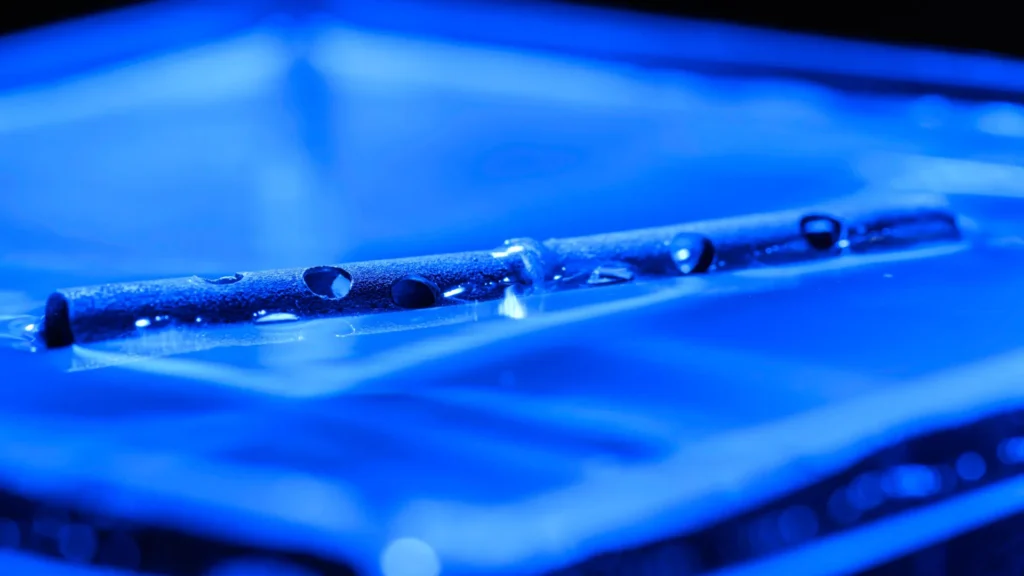
At the heart of this innovation is the meticulous work led by Chunlei Guo, a distinguished professor of optics and physics and a senior scientist at the University of Rochester’s Laboratory for Laser Energetics. Guo’s team focused on modifying the internal surface of aluminum tubes through a precise etching process. This process creates a textured topography characterized by microscopic and nanoscale pits, transforming the surface into a superhydrophobic material. Superhydrophobicity is a material property where a surface repels water so strongly that water droplets form near-perfect spheres and roll off with minimal contact. This phenomenon is often observed in nature, most famously in the lotus leaf effect, where intricate surface structures prevent water from wetting the surface, keeping it clean and dry.
When these treated superhydrophobic tubes are submerged in water, their water-repelling interior captures and holds a stable pocket of air. This trapped air is the linchpin of their unsinkability. Unlike traditional buoyancy where the entire vessel displaces water, here, the air pocket within the tube itself acts as a permanent, incompressible floatation device. The air, being significantly less dense than water, provides a continuous buoyant force, preventing water from filling the tube and consequently keeping it light enough to remain afloat. This ingenious mechanism draws direct inspiration from natural strategies observed in the animal kingdom. Diving bell spiders, for instance, construct underwater "diving bells" by trapping air bubbles against their silk webs, allowing them to breathe underwater for extended periods. Similarly, fire ants form living rafts using their water-resistant bodies, trapping air bubbles to survive floods. The Rochester team has effectively biomimicked these natural strategies, translating them into a robust, engineered solution.
Engineering the Unsinkable: Rochester’s Novel Approach
The technical specifics of Guo’s method involve laser etching the inner surface of the aluminum tubes. This process precisely sculpts the metal at incredibly fine scales, creating a network of tiny air pockets and sharp angles that minimize the contact area between water and the surface. The resulting texture drastically increases the water contact angle, pushing it beyond the 150-degree threshold typically associated with superhydrophobicity. This extreme water repellency ensures that even under pressure or turbulence, the air pocket remains stable and confined within the tube.
A crucial enhancement in this new tube-based design is the inclusion of a physical divider positioned in the middle of the tube. This seemingly simple addition plays a vital role in the system’s resilience. "Importantly, we added a divider to the middle of the tube so that even if you push it vertically into the water, the bubble of air remains trapped inside and the tube retains its floating ability," Professor Guo explained. This divider compartmentalizes the trapped air, preventing it from escaping even when the tube is subjected to external forces that might otherwise dislodge a single, large air bubble. This design feature significantly bolsters the system’s stability and reliability, especially in dynamic environments where tubes might be buffeted or oriented at various angles.
Evolution of the Design: From Disks to Robust Tubes
This latest breakthrough builds upon Professor Guo’s previous research in superhydrophobic floating devices. In 2019, his research group first demonstrated a prototype utilizing two water-repelling disks sealed together to create buoyancy. While effective under controlled conditions, that earlier design exhibited limitations. The disks could lose their ability to float if tilted at extreme angles, allowing water to potentially ingress or the trapped air to escape. This vulnerability highlighted the need for a more robust and stable configuration, particularly for real-world maritime applications where extreme angles and turbulent conditions are commonplace.
The evolution from disks to the current tube-based design represents a significant engineering refinement. The tubular structure inherently offers greater structural integrity and allows for a more secure entrapment of air. The continuous, enclosed nature of the tube, coupled with the internal divider, creates a more resilient system that is far less susceptible to external forces or changes in orientation. This iterative development process underscores the scientific rigor and problem-solving approach employed by Guo’s team, addressing prior limitations to achieve a more universally applicable and durable solution.
Rigorous Testing and Unprecedented Resilience
To validate the efficacy and durability of their unsinkable tubes, the Rochester researchers subjected them to an array of rigorous tests designed to simulate harsh real-world conditions. These tests included prolonged exposure to turbulent environments, mimicking the chaotic motion of ocean waves. "We tested them in some really rough environments for weeks at a time and found no degradation to their buoyancy," Guo stated, emphasizing the remarkable stability of the new design. This extended period of testing without any observed compromise in performance is a critical indicator of the technology’s potential for practical deployment.
Perhaps even more strikingly, the team demonstrated the tubes’ resilience to severe physical damage. Conventional vessels lose buoyancy and sink when their hulls are compromised, leading to water ingress. The Rochester tubes, however, defied this principle. "You can poke big holes in them, and we showed that even if you severely damage the tubes with as many holes as you can punch, they still float," Guo confirmed. This extraordinary resistance to sinking, even after sustaining significant structural damage, fundamentally differentiates this technology from any existing buoyancy solution. The localized nature of the superhydrophobic surface and the internal air pocket mechanism ensure that even if one section is compromised, the overall buoyancy is maintained by the remaining intact areas and trapped air. This feature holds profound implications for enhancing safety in marine environments, where collisions, punctures, or other forms of damage are ever-present risks.
Scalability and Versatility: From Lab to Ocean
The immediate practical applications of this technology are diverse and far-reaching. The researchers have already demonstrated that multiple unsinkable tubes can be interconnected to form larger floating rafts. In laboratory experiments, the team successfully worked with tubes of varying lengths, extending to nearly half a meter. Crucially, Professor Guo confirmed that the design is inherently scalable. This means that the technology can be adapted to create structures large enough to support substantial loads, paving the way for a new generation of floating platforms, buoys, and even foundational elements for future ships.
Imagine lifeboats that cannot be swamped or sunk, even if severely damaged; buoys that maintain their position and function regardless of adverse weather; or modular floating platforms for various purposes, from aquaculture to scientific research, offering unparalleled stability and safety. The modular nature of the tubes allows for flexible design and construction, enabling engineers to tailor the size and load-bearing capacity of floating structures to specific requirements.
Beyond Buoyancy: A New Frontier in Renewable Energy
Beyond its immediate impact on maritime safety and infrastructure, the Rochester team’s research unveiled an unexpected yet highly significant application: renewable energy generation. The researchers demonstrated that rafts constructed from these superhydrophobic tubes possess the capability to capture energy from moving water. This innovative feature suggests a potential role for the technology in generating electricity from ocean waves, adding a crucial renewable energy dimension to its already impressive list of possibilities.
Wave energy conversion (WEC) is a burgeoning field within renewable energy, aiming to harness the immense power of ocean waves. Current WEC devices often face challenges related to durability, efficiency, and cost-effectiveness in harsh marine environments. The unsinkable tubes, with their inherent stability, damage resistance, and ability to remain afloat indefinitely, could provide a robust and resilient platform for such devices. Their ability to interact with water flow in a specific manner could be exploited to drive turbines or other energy harvesting mechanisms, transforming wave motion into usable electricity. This potential application aligns perfectly with the global imperative to transition towards cleaner, sustainable energy sources and could unlock new avenues for offshore renewable energy production.
Expert Perspectives and Broader Implications for Maritime Industries
The unveiling of this technology is poised to generate considerable interest and discussion within the naval architecture, marine engineering, and materials science communities. Experts in naval architecture may view this as a potential paradigm shift, offering a pathway to design ships with unprecedented levels of intrinsic safety, reducing the catastrophic consequences of hull breaches. The SOLAS convention, while robust, could potentially evolve further with the integration of such fundamentally unsinkable components, leading to an even safer global maritime transport system.
Materials scientists will be keen to explore the long-term performance and durability of the superhydrophobic surface in real-world marine environments. Factors such as biofouling (the accumulation of microorganisms, plants, and algae on surfaces), corrosion in saltwater, and the effects of prolonged UV radiation exposure will be crucial considerations for commercialization. However, the fundamental principle of trapped air for buoyancy is inherently robust, suggesting that even if the superhydrophobic coating degrades over time, the underlying structural integrity of the air pocket could still provide significant floatation.
The implications for industries beyond traditional shipping are also profound. The offshore oil and gas industry could benefit from more resilient floating platforms and emergency equipment. Coastal communities vulnerable to rising sea levels or extreme weather events might find applications in resilient infrastructure. Even search and rescue operations could be enhanced by equipment that is impervious to sinking. The technology’s scalability means it could support everything from personal flotation devices to massive industrial platforms, fundamentally altering how we interact with and utilize marine environments.
Addressing the Future: Challenges and Opportunities
While the potential of unsinkable metal tubes is immense, the journey from laboratory breakthrough to widespread commercial application involves navigating several practical challenges. Key among these will be the cost-effectiveness of large-scale manufacturing of the laser-etched tubes. Developing efficient, high-throughput etching processes will be critical to making the technology economically viable for broad adoption. Furthermore, comprehensive long-term testing in diverse marine conditions, including extreme temperatures, salinity variations, and sustained mechanical stress, will be necessary to fully understand the material’s lifespan and maintenance requirements. Regulatory bodies will also need to assess and approve the technology for various applications, potentially leading to new standards and certifications for "unsinkable" components.
Despite these hurdles, the opportunities presented by this innovation are transformative. It promises a future where maritime travel is inherently safer, where essential marine infrastructure is more resilient, and where new avenues for clean energy generation are unlocked. The ability to create materials that defy traditional limitations of buoyancy opens a vast landscape for innovation, potentially leading to safer shipping, more sustainable energy, and a deeper understanding of biomimicry’s power in engineering.
This groundbreaking project was made possible through the generous support of several key organizations, underscoring the collaborative nature of cutting-edge scientific research. The National Science Foundation provided crucial funding for the fundamental scientific inquiry, while the Bill and Melinda Gates Foundation’s involvement highlights the technology’s potential for broader societal impact, possibly in areas like humanitarian aid or infrastructure development in challenging environments. Additionally, the University of Rochester’s Goergen Institute for Data Science and Artificial Intelligence contributed to the project, emphasizing the interdisciplinary approach often required for such complex innovations. The collective investment in this research heralds a new era in material science and engineering, one where the long-held dream of unsinkable structures inches closer to becoming a tangible reality.