Water covers approximately 71% of Earth’s surface, acting as the fundamental solvent for all known life, yet its behavior deviates significantly from that of nearly every other liquid. Among its most well-known, and indeed most crucial, peculiarities is its expansion upon freezing rather than contracting—a characteristic that allows ice to float, preventing oceans and lakes from freezing solid from the bottom up. This, however, is just one of more than 70 known anomalies that set water apart, from its unusually high specific heat capacity to its elevated surface tension and dielectric constant. For decades, scientists have attributed these unique traits to dynamic changes in water’s microscopic structure as temperature and pressure fluctuate. Despite extensive research, a consistent and unified framework to describe and quantitatively compare these intricate structural transformations has remained elusive, impeding a complete understanding of this most ubiquitous and vital substance.
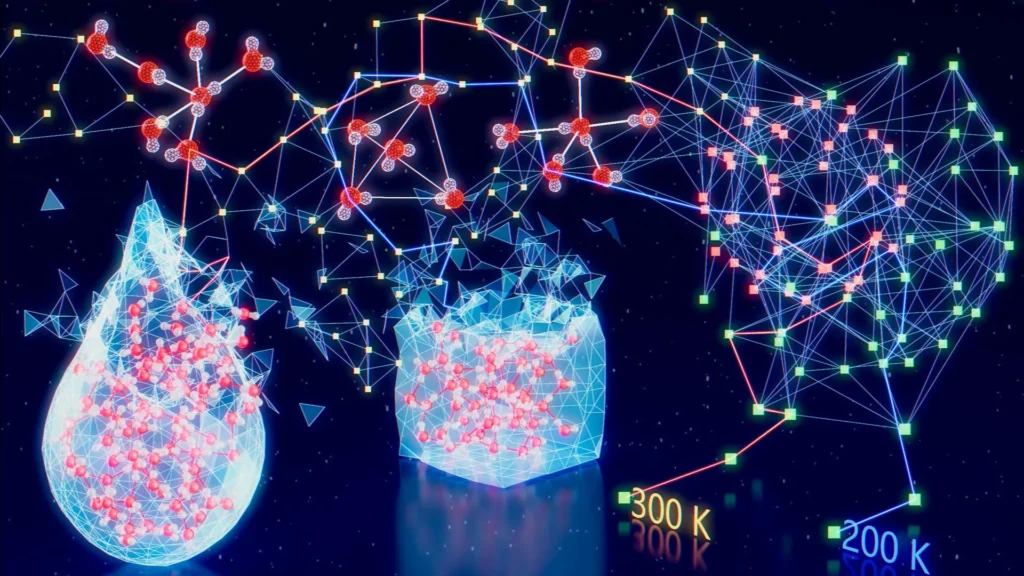
Now, a significant breakthrough from researchers at the University of Osaka promises to overcome this long-standing challenge. Leveraging the power of artificial intelligence (AI), their newly developed system offers a unified methodology for evaluating and comparing various models and descriptors used to characterize the microscopic structure of supercooled water. This innovative approach helps pinpoint which structural descriptions most effectively capture the critical features responsible for water’s enigmatic properties. The seminal findings, which stand to revolutionize the study of water, were recently published in the prestigious journal Communications Chemistry.
The Profound Mystery of Water’s Anomalies
Water’s anomalous properties are not mere scientific curiosities; they are foundational to life on Earth and play a critical role in geological and climatic processes. Unlike most liquids that become denser as they cool, water reaches its maximum density at approximately 4 degrees Celsius (39.2 degrees Fahrenheit). Below this temperature, it begins to expand, culminating in a significant volume increase upon freezing. This unique density inversion ensures that ice forms on the surface of water bodies, insulating the liquid beneath and allowing aquatic life to survive even in harsh winters.
Beyond its density anomaly, water exhibits a host of other unusual characteristics:
- High Specific Heat Capacity: Water requires a substantial amount of energy to change its temperature, which helps regulate Earth’s climate and prevents extreme temperature fluctuations in living organisms.
- High Latent Heat of Fusion and Vaporization: Significant energy is absorbed or released during phase changes (melting/freezing, evaporation/condensation), making water an effective thermal buffer.
- High Surface Tension: Its strong cohesive forces, due to hydrogen bonding, enable capillary action, vital for plant nutrient transport.
- High Dielectric Constant: Water’s ability to dissolve a wide range of substances, making it the "universal solvent," is linked to this property, allowing it to screen charges effectively.
Scientists widely agree that these macro-scale behaviors stem from the peculiar way water molecules interact at the atomic and molecular levels, primarily through a dynamic network of hydrogen bonds. Each water molecule (H₂O) can form up to four hydrogen bonds with neighboring molecules, creating a constantly shifting, three-dimensional network. Understanding the precise geometry and dynamics of this network has been the holy grail of water research for decades.
The Elusive State of Supercooled Water
The journey from liquid water to solid ice is typically initiated at a "nucleation site," a microscopic point where molecules can align into an orderly crystal lattice. These sites can be impurities, dust particles, or even minute scratches on a container’s surface. However, in the absence of such nucleation points, water can be cooled far below its normal freezing point of 0°C (32°F) while remaining in a liquid state—a phenomenon known as supercooled water.
This unusual state, which can extend down to approximately -41°C (-41.8°F) before spontaneous crystallization (homogeneous nucleation) occurs, is where water’s anomalous properties become even more pronounced and enigmatic. Within this supercooled regime, scientists hypothesize that water’s peculiar behaviors are exacerbated by a delicate balance between two distinct, competing forms of liquid water: a high-density liquid (HDL) and a low-density liquid (LDL).
At the molecular level, the HDL state is characterized by more compact, disordered arrangements of water molecules, where hydrogen bonds might be slightly distorted or fewer in number per molecule. Conversely, the LDL state involves more open, tetrahedral-like structures, resembling the ordered, but expanded, network found in ice, where each water molecule is ideally hydrogen-bonded to four neighbors. As temperature rises, the more compact HDL structures gain dominance over the more open LDL arrangements, influencing the overall density and other macroscopic properties of the liquid. The existence of a "liquid-liquid critical point" in supercooled water, where these two liquid phases might become indistinguishable, remains one of the most hotly debated and actively researched topics in physical chemistry.
A Historical Perspective on Water Modeling
The scientific quest to understand water’s structure dates back centuries, with significant progress made in the 20th century following the elucidation of the hydrogen bond concept. Early models were largely conceptual, relying on intuition and limited experimental data. The advent of computational chemistry and molecular dynamics (MD) simulations in the latter half of the 20th century provided unprecedented tools to probe water’s behavior at the atomic scale. Researchers could simulate the movement and interactions of thousands of water molecules over picoseconds to nanoseconds, generating vast datasets of structural and dynamic information.
However, interpreting these vast datasets proved challenging. To characterize the local arrangement of water molecules, researchers developed numerous "structural descriptors" over the years. These included:
- Tetrahedral bond order parameter (q): Measures the degree to which a water molecule and its nearest neighbors adopt a perfect tetrahedral arrangement, characteristic of ice. A value of 1 indicates perfect tetrahedral ordering, while 0 indicates random distribution.
- Local density: Simply the number of molecules within a certain radius of a central molecule.
- Radial distribution functions (RDFs): Provide information about the probability of finding a molecule at a certain distance from another, revealing coordination shells.
- Voronoi tessellation analysis: Divides space into regions around each molecule, providing insights into local packing.
The problem was that these descriptors were developed independently by different research groups, often for specific applications or to highlight particular aspects of water’s structure. Consequently, they often employed different scales, dimensions, and types of information, making direct comparisons incredibly difficult. This fragmentation hindered the development of a unified theoretical framework and made it challenging to ascertain which descriptors were truly the most effective and insightful for capturing the fundamental structural changes underlying water’s anomalies. Without a common language, synthesizing findings across different studies remained a significant hurdle.
AI’s Transformative Role: Osaka University’s Breakthrough
Recognizing the limitations of traditional analytical methods in sifting through the complexity of water’s molecular arrangements, researchers at the University of Osaka turned to artificial intelligence. Their innovative approach, led by corresponding author Kang Kim and senior author Nobuyuki Matubayasi, represents a pivotal moment in the computational study of complex liquids.
"Past studies have shown that using machine learning to classify and understand structural data is effective," explains Kang Kim, highlighting the growing utility of AI in scientific discovery. "We specifically wanted to incorporate a neural network model into this study to evaluate how accurate the descriptors were at capturing key structural information, in a way that is like human cognition." This analogy underscores the system’s ability to learn and identify patterns in a manner that mirrors human intuition, but at a speed and scale impossible for a human observer.
The methodology involved training a sophisticated neural network model. The researchers fed this AI system an extensive dataset of structural information generated from molecular dynamics simulations of supercooled water. These simulations provided atomistic details of water molecules forming and breaking hydrogen bonds, transitioning between various local configurations under different temperature and pressure conditions. Through repeated cycles of trial and error, the neural network learned to discern meaningful patterns within these molecular structures, particularly distinguishing between the more compact HDL and the more open LDL configurations. This iterative learning process allowed the AI to develop an internal representation of what constitutes these distinct structural states.
Unveiling Water’s Hidden Structures with AI
Once trained, the AI network was deployed to evaluate the efficacy of various existing structural descriptors. "The network used what it had learned to compare how 16 descriptors differentiated between LDL and HDL structures at different temperatures," reports Nobuyuki Matubayasi. "In this way, we determined the most efficient descriptors." The AI’s ability to systematically test and rank these diverse descriptors, all developed independently and with varying degrees of success, provides an unprecedented level of clarity and standardization to the field. It moves beyond qualitative assessments, offering a quantitative metric for the utility of each descriptor in distinguishing the subtle yet critical differences between water’s proposed liquid states.
This unified framework, by identifying the most potent structural descriptors, offers a clearer lens through which to observe the microscopic mechanisms driving water’s macroscopic anomalies. It provides a consistent benchmark, allowing future research to build upon a foundation of rigorously validated tools rather than relying on a fragmented collection of disparate metrics.
Dr. Elena Petrova, a theoretical chemist specializing in complex fluids at the ETH Zurich, who was not involved in the Osaka study, commented on its significance: "This work by the Osaka team is a crucial step forward. For too long, the field has struggled with comparing apples and oranges when it comes to structural descriptors. By providing an AI-driven, objective metric for their effectiveness, they’re not just offering a new tool; they’re laying the groundwork for a more coherent and accelerated understanding of water, and potentially other complex liquids where similar challenges exist."
Broader Implications and Future Outlook
The ramifications of the University of Osaka’s research extend far beyond the immediate study of supercooled water. This AI-powered framework promises to significantly improve scientists’ understanding of how subtle microscopic structural changes are intimately connected to the thermodynamic and dynamic behaviors of water.
Fundamental Science: The findings could provide definitive evidence for or against the existence of a liquid-liquid critical point in water, a hypothesis that has been debated for decades. A clearer understanding of the HDL and LDL states will unlock deeper insights into phase transitions, nucleation processes, and the fundamental physics of hydrogen bonding.
Climate Science: Water’s phase transitions are central to atmospheric processes, including cloud formation, precipitation, and the dynamics of ice in glaciers and polar regions. A more accurate microscopic understanding could lead to improved climate models and more precise predictions of future climate scenarios.
Biology and Biochemistry: Water is the solvent of life, and its unique properties are essential for biological processes such, as protein folding, enzyme function, and the structural integrity of cell membranes. Insights into water’s structural dynamics could illuminate its role in these complex biological systems, potentially aiding in drug discovery and the design of novel biomaterials.
Materials Science and Engineering: The ability to precisely control water’s behavior at the molecular level has applications in numerous fields. This research could guide the development of more effective antifreeze agents, advanced desalination technologies, and novel materials that interact with water in specific, desired ways, such as water-repellent coatings or highly absorbent hydrogels.
The Future of AI in Scientific Discovery: Beyond its immediate impact on water research, this study serves as a powerful testament to the transformative potential of artificial intelligence in fundamental scientific inquiry. By automating the arduous task of evaluating and comparing complex theoretical models, AI can accelerate the pace of discovery, allowing human researchers to focus on hypothesis generation and experimental design. The framework developed by the Osaka team could be adapted to study other complex liquids, amorphous solids, or even self-assembling molecular systems where understanding local structure is paramount.
In essence, the University of Osaka’s deployment of AI has not only provided new clues to water’s hidden structure but has also forged a more consistent and efficient pathway for future exploration. By guiding the development of even better tools for studying water’s intricate molecular structure, this research ensures that the quest to fully comprehend Earth’s most vital liquid will continue with unprecedented precision and insight.