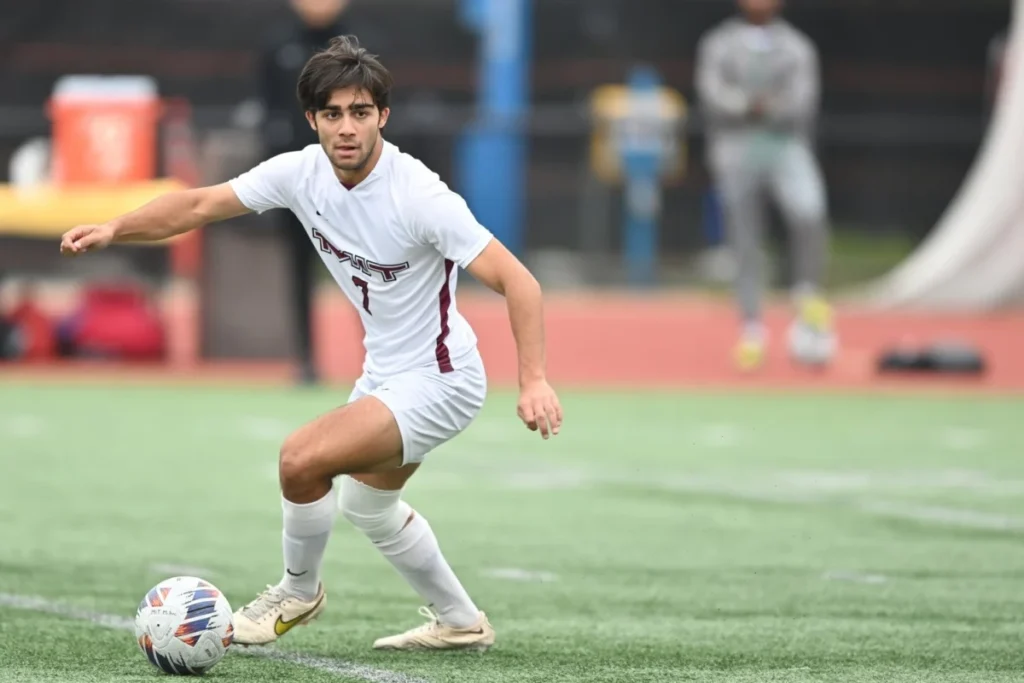
The trajectory of a high-performance student-athlete often involves a difficult choice between premier athletic programs and elite academic institutions. For Dilin Meloni, a former Massachusetts Boys Soccer Player of the Year and high school All-American, the decision to attend the Massachusetts Institute of Technology (MIT) was not merely a compromise between these two worlds, but a deliberate integration of them. Now a rising senior double-majoring in Nuclear Science and Engineering (Course 22) and Physics (Course 8), Meloni has become a central figure in redefining the student-athlete experience at one of the world’s most rigorous technical universities. His journey, from a standout recruit at Needham High School to a leader within the MIT Student-Athlete Advisory Committee (SAAC), highlights the evolving relationship between competitive sports and high-level scientific research.
Meloni’s path to MIT was forged through a unique spark of academic curiosity. While still a junior at Needham High School, he encountered a research paper published by the MIT Plasma Science and Fusion Center (PSFC). This introduction to the complexities of nuclear fusion and plasma physics provided the necessary catalyst for his college search. While his athletic pedigree could have facilitated entry into various Division I programs, the opportunity to contribute to the "Engineers" both on the soccer pitch and within the laboratory proved to be the deciding factor. Today, his life is a testament to the "dual-engineer" identity: an attacking midfielder who orchestrates plays on the field and a scholar who navigates the complexities of nuclear energy.
The Academic Rigor of Course 22 and Course 8
At MIT, the academic load is famously demanding, often described as "drinking from a firehose." For Meloni, this challenge is compounded by the specific requirements of a double major in Physics and Nuclear Science and Engineering. Course 22, the Nuclear Science and Engineering department, is historically one of the smaller but most specialized departments at the Institute, focusing on the applications of nuclear processes, radiation detection, and the development of fusion energy. Course 8, the Physics department, provides the theoretical foundation necessary to understand the universe at its most fundamental level.
Meloni’s summer internship at Commonwealth Fusion Systems (CFS) serves as a bridge between his classroom learning and real-world application. CFS, a private firm spun out of MIT’s Plasma Science and Fusion Center, is currently working on the SPARC project—a compact, high-field fusion device designed to produce net energy. Meloni’s involvement in such a high-stakes environment underscores the caliber of MIT student-athletes. He notes that while the overlap between varsity athletics and the nuclear engineering department is relatively small, he is actively working to recruit and encourage younger players to pursue these challenging technical paths.
The rarity of Meloni’s academic combination within the athletic community highlights a broader trend at MIT. While many student-athletes gravitate toward Course 6 (Electrical Engineering and Computer Science) or Course 15 (Management), the pursuit of theoretical physics and nuclear engineering requires a specific type of discipline that mirrors the rigors of competitive soccer. Meloni describes his time in the lab as a space where he interacts with a diverse range of researchers who often have no connection to the athletic world, providing him with a balanced perspective that prevents the "siloing" often experienced by specialized students.
The Social Architecture of MIT Athletics
One of the most significant misconceptions regarding MIT is the nature of its social life. Contrary to the stereotype of the isolated researcher, Meloni emphasizes that the athletic community serves as the primary engine for social integration at the Institute. For fall athletes, the integration begins almost immediately upon arrival. Preseason training starts two weeks before the general student body arrives, allowing freshmen to form deep bonds with peers who share similar values regarding discipline, time management, and competitive drive.
This "common ground" is essential for navigating the high-pressure environment of MIT. Meloni’s social circle is heavily influenced by his participation in the soccer program, extending into his fraternity, which is largely comprised of teammates from the soccer, football, swimming, and track programs. This subculture provides a support system that understands the unique pressures of balancing four-hour practice blocks with problem sets that can take upwards of twenty hours a week to complete.
However, Meloni is quick to point out that athletics at MIT do not define a student’s entire existence. The culture of the Institute ensures that academic responsibilities remain the priority. This balance is a hallmark of the NCAA Division III philosophy, which emphasizes the "student" in student-athlete, though the level of competition remains high. The MIT soccer team, for instance, competes in the New England Women’s and Men’s Athletic Conference (NEWMAC), a league known for its academic prestige and athletic parity.
Leadership through the Student-Athlete Advisory Committee (SAAC)
Beyond the field and the lab, Meloni has taken on a significant leadership role as a representative on the Student-Athlete Advisory Committee (SAAC). This organization serves as the formal link between the student-athlete body and the MIT administration, specifically the Department of Athletics, Physical Education, and Recreation (DAPER). Representing 33 varsity sports—one of the largest athletic programs in the country—is a logistical and diplomatic challenge.
Under Meloni’s leadership, the SAAC has shifted toward a more proactive and collaborative model. Last summer, Meloni and the SAAC co-president initiated a comprehensive outreach program, meeting with coaches and athletes from every sport to identify "pain points" in their experience. This data-driven approach allowed the committee to present a prioritized list of needs to the administration.
Key issues identified by the committee included:
- Facility Allocation: With 33 teams vying for limited space, the management of the new Sports Performance Facility and the main turf fields is a constant source of friction. Meloni’s role involves negotiating how time is allocated to ensure that both high-profile field sports and pool-based sports like water polo and swimming have equitable access.
- Nutritional Support: The quality and availability of food for athletes who often miss standard dining hall hours due to practice and travel is a recurring concern.
- NCAA Legislation: The SAAC also serves as a forum for discussing national changes in collegiate athletics, ensuring that MIT’s policies remain aligned with both NCAA regulations and the school’s unique academic mission.
Meloni’s background in student governance—having served on his town’s school committee and state-level committees in high school—prepared him for the complexities of institutional bureaucracy. He views his role not just as a voice for complaints, but as a mediator who must explain the logistical and financial realities of the university to his fellow students.
Bridging the Gap: Administration and Student Life
The 2023-2024 academic year marked what Meloni describes as a "tipping point" in the relationship between student-athletes and the MIT administration. Historically, varsity athletes have occasionally felt like an underrepresented group within the broader campus culture. Issues such as unauthorized track use during soccer practices or conflicts with student clubs over field bookings have contributed to a sense of frustration.
However, Meloni reports a significant shift in the willingness of DAPER and Student Life staff to engage in meaningful dialogue. The administration has begun to view the SAAC not just as a committee for athletic issues, but as a consulting body for broader student life initiatives. This recognition stems from the fact that athletes represent a significant percentage of the MIT undergraduate population. By improving the experience for these students, the administration effectively improves the campus climate for a large and highly active segment of the student body.
The "middle ground" approach advocated by Meloni emphasizes compromise. He acknowledges that while students will always ask for more resources, understanding the "cost associated with everything" is vital. This pragmatic outlook has fostered a more respectful and productive relationship with administrators, leading to "small changes that lead to big changes."
Implications and Future Outlook
The story of Dilin Meloni is emblematic of the modern MIT student: a multi-faceted individual who refuses to be confined to a single discipline. His ability to navigate the high-energy world of startup-driven fusion research at Commonwealth Fusion Systems while simultaneously captaining an athletic community and leading a governance committee serves as a model for the next generation of "Engineers."
From a broader perspective, Meloni’s work with the SAAC highlights the importance of student agency in elite academic institutions. His philosophy—"if there’s an area where you can make some change, why not go do it yourself?"—reflects the entrepreneurial spirit that MIT seeks to cultivate. As he enters his senior year, Meloni’s focus remains on ensuring that the communication channels he helped strengthen remain open long after he graduates.
In the context of the NCAA’s changing landscape, where the focus often shifts toward professionalization and revenue, the MIT model championed by Meloni offers a refreshing alternative. It is a model where the value of sports lies in the community it builds, the discipline it instills, and the platform it provides for students to advocate for their own needs. For Dilin Meloni, the fields of MIT and the laboratories of the Plasma Science and Fusion Center are not two different worlds; they are two different laboratories for the same experiment: the pursuit of excellence.