The fundamental laws of thermodynamics have long dictated a rigid symmetry in how materials interact with energy: the efficiency with which a surface absorbs heat is traditionally equal to the efficiency with which it emits it. This principle, known as Kirchhoff’s Law of Thermal Radiation or the principle of reciprocity, has stood as a cornerstone of physics since 1859. However, a pioneering international research initiative led by Professor Koichi Okamoto and Dr. Shunsuke Murai at Osaka Metropolitan University’s Graduate School of Engineering has successfully challenged this paradigm. By developing a sophisticated device that utilizes magneto-optical materials and phase-change alloys, the team has demonstrated a method to decouple absorption and emission, effectively "programming" heat in a manner previously reserved for electronic data.
For over a century and a half, the inability to separate these two processes has limited the efficiency of thermal management systems. In a reciprocal system, if a material is designed to be a high-performance absorber of solar energy, it is inherently a high-performance emitter of that same energy, often leading to unwanted heat loss. The ability to break this symmetry—allowing a material to absorb energy from one direction or wavelength while suppressing emission in that same direction—represents a "Holy Grail" for engineers working on energy conversion, infrared sensing, and next-generation cooling technologies.
The Architecture of Non-Reciprocal Thermal Control
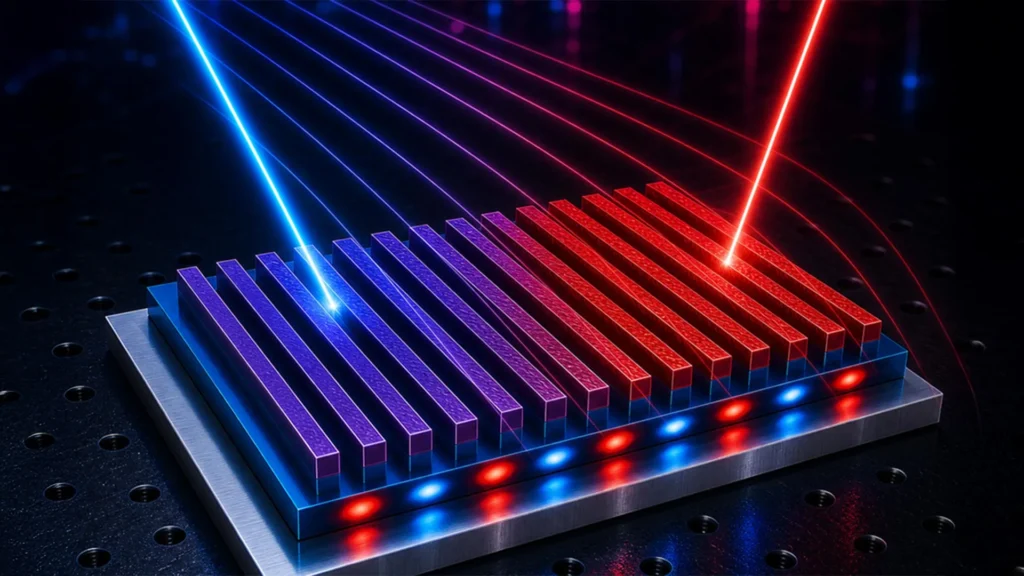
The breakthrough centers on a complex multi-layered device that integrates magneto-optical materials with a specific chalcogenide glass known as GST (Germanium-Antimony-Tellurium). Magneto-optical materials are unique in their ability to alter their refractive index and electromagnetic response when subjected to an external magnetic field. This property allows for the breaking of time-reversal symmetry, the underlying physical reason why reciprocity usually occurs.
When a magnetic field is applied to the device, the path of the thermal photons is altered. By pairing this with GST—a phase-change material frequently used in rewritable optical discs and non-volatile memory (NVRAM)—the researchers added a layer of "intelligence" to the system. GST can transition between an amorphous state and a crystalline state when triggered by temperature or electrical pulses. These two states have vastly different optical properties, allowing the device to not only control the direction of heat but also to "remember" its configuration.
Dr. Shunsuke Murai, a lead researcher on the project, noted that the integration of these materials allows for a level of precision that was previously theoretical. "By manipulating the interaction between the magnetic field and the phase-change state of the material, we have made heat radiation behave in a ‘smarter’ way," Dr. Murai stated. "This isn’t just about moving heat; it’s about controlling it with the same logic we use to control bits in a computer."
Surpassing Previous Technical Limitations
Prior to this development, other research teams had attempted to achieve non-reciprocal thermal radiation, but these efforts were hampered by significant practical hurdles. Most earlier designs relied on "steep angle" interactions, meaning the non-reciprocal effects only occurred when light or heat struck the material at a very sharp, near-parallel angle. This significantly reduced the total amount of energy that could be captured or emitted, rendering the devices inefficient for real-world applications like solar panels or industrial sensors.
The Osaka Metropolitan University team’s device operates effectively at "normal incidence," or near-straight-on angles. This ensures that the maximum possible surface area is utilized for energy transfer, a critical requirement for scaling the technology. Furthermore, previous experimental models often required a constant power supply or a continuous magnetic field to maintain their state. If the power was cut, the material would revert to a standard reciprocal state, losing its "programmed" thermal directionality.
The new device overcomes this through the use of the GST phase-change layer. Because the crystalline or amorphous states of GST are stable, the device retains its thermal properties even after the external power or magnetic trigger is removed. This non-volatility is a landmark achievement in thermal photonics, paving the way for "thermal memory" where heat flow patterns can be stored and retrieved.
A Chronology of Development in Thermal Photonics
The journey to this breakthrough has been decades in the making, reflecting a broader shift in physics from observing natural laws to actively engineering them.
- 1859: Gustav Kirchhoff formulates the Law of Thermal Radiation, stating that emissivity equals absorptivity at equilibrium.
- Early 2000s: Theoretical physicists begin proposing the use of magneto-optics to break reciprocity in photonic crystals.
- 2014-2017: Initial laboratory experiments demonstrate non-reciprocity in the microwave and far-infrared spectrums, but require massive superconducting magnets and operate only at extreme angles.
- 2020: Research shifts toward the integration of phase-change materials to provide tunability to thermal emitters.
- 2023: The international team led by Osaka Metropolitan University begins testing the combination of magneto-optical effects with GST to achieve non-volatile, normal-incidence control.
- 2024: The team publishes findings confirming that they have achieved a programmable, non-reciprocal thermal device that maintains its state without continuous power.
Supporting Data and Performance Metrics
The experimental data provided by the research team highlights the stark difference between this new device and traditional materials. In standard materials, the ratio of absorption to emission is 1:1. In the OMU device, the researchers observed a significant shift in the emissivity-to-absorptivity ratio when the magnetic field was engaged and the GST was in its crystalline state.
Furthermore, the switching contrast—the difference in performance between the "on" and "off" states—was found to be substantially higher than in previous iterations. While earlier models showed a 5-10% variance in thermal directionality, the new device leverages the drastic refractive index change of the GST to achieve a much more pronounced "switching" effect. This allows the material to act as a thermal gate, essentially a transistor for heat.
The device’s ability to operate at normal incidence also means it can be integrated into existing semiconductor fabrication processes. Because the materials used are compatible with current thin-film deposition techniques, the path to commercialization is significantly shorter than for other exotic metamaterials.
Broader Implications for Energy and Defense
The implications of programmable thermal materials extend across several multi-billion-dollar industries. One of the most immediate applications is in the field of Thermophotovoltaics (TPV). TPV systems convert heat directly into electricity using photovoltaic cells. By using a non-reciprocal emitter, engineers can ensure that heat is directed solely toward the PV cell and prevented from radiating back toward the source, potentially doubling the efficiency of waste-heat recovery systems in factories and power plants.
In the aerospace sector, the technology could revolutionize spacecraft thermal management. Satellites are often subjected to intense solar radiation on one side while facing the vacuum of space on the other. A programmable thermal skin could allow a satellite to absorb solar energy to power its systems while simultaneously preventing that same surface from radiating heat back into the cabin, or vice versa, depending on the mission’s needs.
The defense industry is also closely monitoring these developments for infrared (IR) camouflage and sensing. If a material can be programmed to emit heat in a direction away from an enemy’s IR sensors, it could effectively render vehicles or installations "thermally invisible" from specific vantage points without requiring complex active cooling systems.
Expert Reactions and Future Outlook
While the research community has hailed the breakthrough, some experts suggest that the next challenge lies in the strength of the magnetic fields required. Currently, magneto-optical effects often require relatively strong magnets to achieve maximum efficiency.
"The work by Okamoto and Murai is a brilliant demonstration of how material science can bypass the ‘unbreakable’ laws of the past," said a senior researcher in nanophotonics not involved in the study. "The next step for the industry will be to achieve these same non-reciprocal effects using smaller, permanent magnets or even purely electrical switching to make the technology viable for consumer electronics."
Professor Okamoto remains optimistic about the trajectory of the research. "Our ultimate goal is to develop compact devices that can actively control heat radiation, much like electronic circuits control the flow of electricity," he said. "Such devices could be used in smarter infrared sensors, more efficient energy systems, and new types of photonic memory that store information using light and heat instead of electrical charges."
As the world seeks more efficient ways to manage energy and reduce the carbon footprint of industrial processes, the ability to "program" heat represents a fundamental shift. By moving away from the passive thermal management of the past and toward the active, intelligent thermal circuits of the future, the team at Osaka Metropolitan University has opened a new chapter in the study of light and matter. The era of the thermal transistor may soon be upon us, changing everything from how we cool our homes to how we power our reach into deep space.