U.K. air taxi developer Vertical Aerospace is charting a course towards certifying its innovative Valo electric aircraft in 2029, a slight adjustment from its previously announced timeline. This strategic recalibration, revealed by Chief Engineer David King, reflects the company’s commitment to finalizing the Valo’s design this year while simultaneously preparing for rigorous flight testing and regulatory approval. The Valo, designed to carry six passengers, was initially slated for certification and entry into service in 2028.
The revised schedule indicates a phased approach to bringing the Valo to market, with Vertical Aerospace aiming to complete the construction and certification of components for seven Valo prototypes by 2027. These prototypes will be instrumental in initiating flight testing, marking a significant step up in scale from the four-passenger models the company has been operating since 2022. This progression underscores Vertical Aerospace’s ambition to mature its electric vertical takeoff and landing (eVTOL) technology for commercial application.
Farnborough Airshow Demonstrations Highlight Technological Maturity
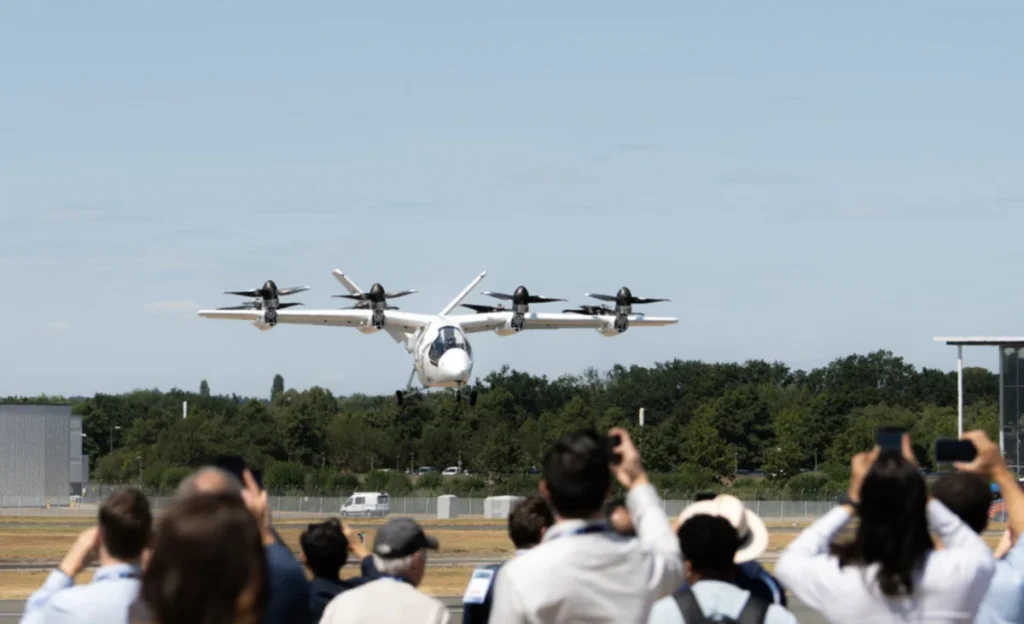
The recent Farnborough International Airshow served as a crucial platform for Vertical Aerospace to showcase the advanced capabilities of its technology. David King, speaking via video call, highlighted the significance of the demonstration flights conducted by the VA-1X prototype. These displays, which commenced on Monday and continued throughout the week, featured the aircraft’s ability to perform seamless vertical takeoffs and landings, followed by a complete transition to forward, horizontal flight.
"One of the objectives of us here this week is to spread the word that the technology is mature," King stated, emphasizing the smooth and effective execution of the transition maneuvers. This public demonstration aimed to instill confidence in the viability and reliability of eVTOL aircraft for future transportation networks.
During a flight on Monday, the VA-1X exhibited a smooth approach in forward flight culminating in a vertical landing. However, a minor anomaly was observed where one of the four forward tilt-propellers appeared to tilt upwards slightly ahead of the others, as captured in broadcast footage. Vertical Aerospace addressed this observation, explaining that the aircraft’s advanced flight control software had intentionally commanded the earlier tilt of the inner left propeller.
"The aircraft’s flight control software commanded the inner left tilt earlier than usual in response to a sudden large gust of wind," a spokesperson clarified via email. "When we looked at the data, this was the normal and correct response to a change in conditions in landing. As a number of people have observed, the aircraft stayed incredibly stable throughout. This is a testament to the aircraft’s ability to operate safely and comfortably in unexpected circumstances." This explanation underscores the sophisticated nature of the flight control systems designed to manage dynamic environmental conditions and ensure passenger safety.
Design Evolution and Propulsion Strategy
King further elaborated on the ongoing development of the Valo’s design, noting continuous refinements to its aerodynamics and control software. The Valo’s cabin configuration is designed to accommodate two rows of three passengers each, offering a comfortable and efficient passenger experience.
"It’s not the exact same software build, but for the purposes of understanding the aerodynamic characteristics, the majority of the software design is behind us," King commented on the progress of software development. This indicates that the core functionalities and performance parameters of the Valo are largely established, paving the way for detailed integration and testing.
A significant aspect of Vertical Aerospace’s development strategy involves a shift in propulsion systems for its upcoming prototypes. While the two current VA prototypes undergoing flight testing are fully electric, the next iteration will incorporate a hybrid-electric propulsion system. This evolution is a strategic move to address potential range limitations and operational flexibility.
"We’re going to keep doing flight testing to learn as much as we can. On aircraft three later this year, we will install a turboelectric generator system that we have in our lab, essentially the baggage bay of the aircraft," King revealed. "And then we will do the risk reduction technology demonstration of our hybrid-electric derivative next year." This phased approach to hybrid-electric technology allows for thorough testing and validation before full integration into the production aircraft. The move towards hybrid-electric propulsion acknowledges the current landscape of battery technology and charging infrastructure, offering a more pragmatic solution for initial commercial operations.
Government Support and Future Production
In parallel with its technological advancements, Vertical Aerospace is actively seeking government support to facilitate the establishment of its manufacturing capabilities. The company is currently in negotiations with the U.K. government for a grant of up to £10 million (approximately $13.5 million USD). This funding is earmarked to partially finance the construction of Vertical Aerospace’s initial aircraft production site.
While King acknowledged that the grant amount is modest in the context of the company’s overall fundraising of $800 million, he emphasized its symbolic and strategic importance. "It’s small from a finance perspective," he stated, "but it’s important regardless. The funding amounts to ‘a commitment from the government to say we’re going to work with you, to do something new and innovative in commercial aviation.’" This potential grant signifies a crucial endorsement from the U.K. government, signaling its commitment to fostering innovation within the burgeoning advanced air mobility sector.
The Broader Landscape of Air Taxi Development
Vertical Aerospace’s journey reflects the broader ambitions and challenges within the global air taxi industry. Companies worldwide are racing to develop and certify eVTOL aircraft, aiming to revolutionize urban and regional transportation. Key players like Joby Aviation, Archer Aviation, and Lilium are also progressing through design, testing, and certification phases, each with unique technological approaches and timelines.
The certification process for eVTOL aircraft is inherently complex, requiring stringent adherence to safety standards set by aviation authorities such as the Federal Aviation Administration (FAA) in the United States, the European Union Aviation Safety Agency (EASA), and the U.K.’s Civil Aviation Authority (CAA). Delays are not uncommon as manufacturers refine their designs and demonstrate compliance with evolving regulations.
The Valo’s six-passenger capacity positions it as a potentially significant player in the air taxi market, capable of serving routes with higher passenger demand. The hybrid-electric variant, in particular, could offer a compelling solution for longer-range operations or regions where charging infrastructure is less developed, expanding the addressable market for air taxi services.
The successful demonstration of the VA-1X at Farnborough, despite minor technical observations, reinforces the growing maturity of eVTOL technology. The ability to perform complex flight maneuvers reliably is a critical step towards public acceptance and regulatory approval.
Implications for Future Transportation
The successful development and deployment of aircraft like the Valo have profound implications for the future of transportation. Air taxis promise to alleviate urban congestion, reduce travel times, and offer a more sustainable alternative to traditional modes of transport, especially for intercity travel. The environmental benefits of electric and hybrid-electric propulsion are also a significant driving force behind this technological shift.
However, challenges remain, including scaling production, establishing robust operational infrastructure (vertiports, charging stations), developing air traffic management systems for eVTOLs, and ensuring public acceptance and affordability. The financial viability of air taxi services will depend on achieving economies of scale and optimizing operational efficiency.
Vertical Aerospace’s strategic approach, combining a phased development of its aircraft with a focus on government partnerships and technological advancement, positions it as a key contender in this rapidly evolving industry. The company’s commitment to rigorous testing and iterative design improvements, as demonstrated by its progress and transparency, will be crucial in navigating the path to certification and the eventual widespread adoption of air taxi services. The target of 2029 for Valo certification, while a slight adjustment, represents a realistic and achievable goal in the complex world of aviation innovation.