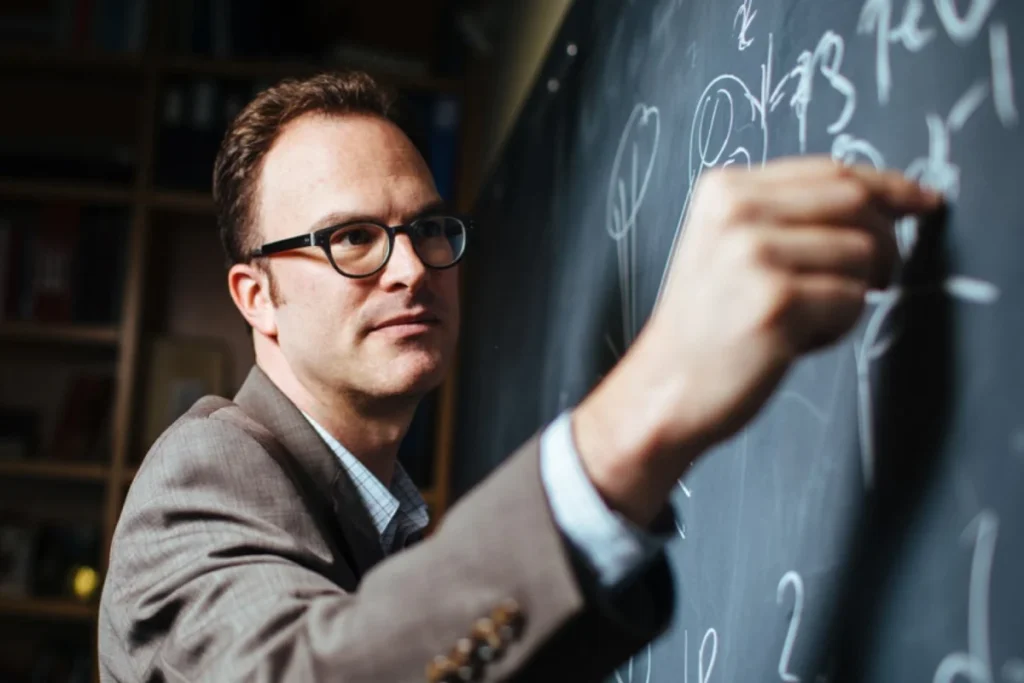
The Massachusetts Institute of Technology has officially named Professor Jesse Thaler as the next director of the Laboratory for Nuclear Science (LNS), marking a significant leadership transition for one of the world’s premier research institutions. Effective August 1, Thaler succeeds Professor Bolek Wyslouch, who has concluded a distinguished ten-year tenure at the helm of the laboratory. Thaler, a prominent theoretical particle physicist, assumes this role at a pivotal moment when the integration of artificial intelligence and machine learning is fundamentally reshaping the landscape of fundamental physics. As the William and Emma Rogers Professor of Physics within the MIT Center for Theoretical Physics — a Leinweber Institute (CTP-LI), Thaler brings a unique expertise in combining quantum field theory with advanced computational techniques to solve complex problems in subatomic physics.
The appointment has been met with significant enthusiasm from the academic leadership at MIT. Nergis Mavalvala, the Dean of the MIT School of Science and the Curtis and Kathleen Marble Professor of Astrophysics, underscored the importance of Thaler’s background in an era of rapid technological evolution. Dean Mavalvala noted that Thaler’s pioneering research on particle jets at the Large Hadron Collider (LHC) and his leadership in the field of AI-integrated physics make him the ideal candidate to steer the LNS into a future defined by AI-driven discovery. The transition reflects a broader trend in the scientific community where the traditional boundaries between theoretical physics, data science, and experimental engineering are increasingly blurred.
A Legacy of Excellence: The History and Evolution of the LNS
The Laboratory for Nuclear Science holds a storied place in the history of American science. Established in 1946, shortly after the end of World War II, the LNS was founded to coordinate and support research in the emerging fields of nuclear and particle physics. In the decades since its inception, the laboratory has expanded its scope far beyond its original mandate. Today, the LNS serves as a multidisciplinary hub for research spanning cosmology, gravity, quantum field theory, and quantum information science.
Under the outgoing leadership of Professor Bolek Wyslouch, the LNS maintained its status as a cornerstone of the MIT Department of Physics. Wyslouch’s decade of service saw the laboratory navigate the complexities of modern experimental physics, including significant contributions to the Compact Muon Solenoid (CMS) experiment at the LHC. As the laboratory moves into its next chapter under Thaler, it remains the administrative and intellectual home for a vast network of researchers, including the Center for Theoretical Physics (CTP), which Thaler will now oversee as part of his directorial duties.
The Intersection of Particle Physics and Artificial Intelligence
Professor Jesse Thaler’s research is at the forefront of what many call the "second revolution" in particle physics. For years, the field relied on traditional statistical methods to interpret the results of high-energy collisions. However, the sheer volume of data generated by facilities like the Large Hadron Collider—often referred to as a "data deluge"—has necessitated the development of more sophisticated tools.
Thaler’s work focuses on particle jets, which are the sprays of particles produced when high-energy quarks and gluons are ejected from a collision. By applying machine learning algorithms to these jets, Thaler and his team have been able to extract more information from LHC data than was previously thought possible. These techniques allow physicists to better distinguish between known processes and potential signals of "new physics," such as dark matter or supersymmetric particles.
The implications of this work extend far beyond the walls of the physics lab. As Thaler has observed, the algorithms developed to handle the complexities of subatomic particle tracks are often applicable in other fields, including medical imaging, autonomous systems, and finance. This cross-pollination of ideas is a hallmark of Thaler’s career and a central theme of his vision for the LNS.
Leadership at the NSF AI Institute (IAIFI)
Since 2020, Jesse Thaler has served as the inaugural director of the National Science Foundation (NSF) AI Institute for Artificial Intelligence and Fundamental Interactions, known as IAIFI (pronounced "eye-fi"). This institute was established with the ambitious goal of advancing physics knowledge—from the smallest building blocks of nature to the largest structures in the universe—while simultaneously pushing the boundaries of machine learning.
Under Thaler’s guidance, IAIFI has become a model for interdisciplinary collaboration. The institute recently received a renewal of its funding for another five years, a testament to the success of its initial phase. The renewal ensures that the institute will continue to support high-risk, high-reward research that bridges the gap between the "black box" of AI and the rigorous, first-principles-based world of physics.
With Thaler moving to the directorship of the LNS, Professor Mike Williams, a colleague in the MIT Department of Physics and a key figure in the LHCb experiment at CERN, will take over as the director of IAIFI. This transition ensures continuity in the collaborative relationship between the LNS and IAIFI, particularly as the LNS prepares to engage with the Department of Energy’s (DOE) Genesis Mission. The Genesis Mission is specifically designed to leverage AI for scientific discovery, aligning perfectly with the research trajectories established by Thaler and Williams.
Educational Innovation and the Next Generation of Scientists
One of Thaler’s most significant contributions during his time at IAIFI has been his commitment to education and workforce development. Recognizing that the future of science depends on researchers who are fluent in both physics and data science, Thaler was instrumental in creating a new doctoral program at MIT. Developed in collaboration with the MIT Institute for Data, Systems, and Society (IDSS), this program allows students to earn a PhD in physics, statistics, and data science.
Furthermore, IAIFI established a dedicated postdoctoral fellowship program. These fellowships provide early-career researchers with the intellectual freedom to pursue projects that do not fit neatly into traditional disciplinary silos. By giving young scientists the space to build connections across different universities and career stages, Thaler has fostered a vibrant ecosystem of innovation. He has expressed a strong desire to bring this transformative framework to the LNS, ensuring that the laboratory remains a destination of choice for the world’s most promising scientific talent.
Philanthropy and the Center for Theoretical Physics
The administrative scope of the LNS directorate includes oversight of the MIT Center for Theoretical Physics — a Leinweber Institute (CTP-LI). The CTP is one of the most prestigious centers for theoretical research in the world, and it recently received a significant boost through the philanthropy of the Leinweber Foundation.
Last year, the Leinweber Foundation made a landmark donation to establish a network of theoretical physics research institutes, with MIT’s CTP as a central node. According to the Science Philanthropy Alliance, this gift represents the largest philanthropic commitment ever made to the field of theoretical physics. This infusion of capital provides the CTP—and by extension, the LNS—with the resources needed to support long-term, fundamental research that might not otherwise receive federal funding. It allows theorists the "intellectual venture capital" to explore radical new ideas about the nature of space, time, and matter.
Biographical Background and Career Milestones
Jesse Thaler’s journey to the directorship of the LNS is marked by a history of academic excellence and high-impact research. He earned his Bachelor of Science in math and physics from Brown University in 2002, followed by a PhD in physics from Harvard University in 2006. His doctoral work set the stage for his career-long fascination with the mathematical structures underlying particle interactions.
From 2006 to 2009, Thaler was a fellow at the Miller Institute for Basic Research in Science at the University of California at Berkeley. The Miller Fellowship is one of the most competitive and prestigious awards for young scientists, providing them with the opportunity to conduct independent research at a critical stage of their careers. Thaler joined the MIT faculty in 2010, where he quickly rose through the ranks, eventually becoming the William and Emma Rogers Professor of Physics.
Throughout his career, Thaler has been a prolific author and a sought-after speaker at international conferences. His ability to communicate complex theoretical concepts to diverse audiences has made him a leading voice in the effort to integrate AI into the physical sciences.
Analysis: The Future of Nuclear Science in an AI Era
The appointment of Jesse Thaler signals a strategic shift for the Laboratory for Nuclear Science. While the laboratory will continue its fundamental mission of investigating the building blocks of matter, the methodology of that investigation is clearly shifting toward a data-centric approach.
The "heroic theoretical calculations" Thaler mentions are becoming increasingly reliant on automated systems that can navigate the immense complexity of quantum field theory. As experimental facilities like the LHC and the upcoming Electron-Ion Collider (EIC) at Brookhaven National Laboratory generate unprecedented amounts of data, the ability to process that data in real-time using AI will be the difference between discovery and missed opportunity.
Furthermore, the LNS under Thaler is likely to become a more prominent player in the national conversation regarding AI ethics and "AI for Science." By developing algorithms that are physically grounded—meaning they obey the laws of thermodynamics and conservation—Thaler’s team is working toward a form of AI that is more interpretable and reliable than the standard models used in consumer applications.
Conclusion
As Professor Jesse Thaler prepares to take the helm of the MIT Laboratory for Nuclear Science on August 1, the institution stands on the threshold of a new era. With the support of the NSF, the Department of Energy, and unprecedented philanthropic backing from the Leinweber Foundation, the LNS is uniquely positioned to lead the global scientific community in the quest to understand the fundamental laws of nature. Thaler’s vision of a collaborative, AI-empowered, and educationally progressive laboratory promises to not only advance our knowledge of the subatomic world but also to provide the tools and talent necessary to solve the complex challenges of the 21st century.
The transition from Professor Bolek Wyslouch to Professor Jesse Thaler represents both a continuation of MIT’s commitment to excellence and a bold step into a future where the artificial and the fundamental work in tandem to unlock the secrets of the universe.