Petoi has emerged as a significant player in the educational and hobby robotics sector, offering a line of programmable quadruped robots designed to introduce users to advanced robotics concepts through engaging, hands-on experiences. The company’s latest offerings, the Nybble Q robotic cat and the Bittle X V2 robotic dog, represent notable advancements in accessibility, programmability, and interactive features. These kits, reviewed in Make: Vol 94, aim to bridge the gap between complex engineering and user-friendly exploration, providing a robust platform for learners from intermediate hobbyists to educators seeking dynamic STEM tools. With prices set at $435 for the Nybble Q and $469 for the Bittle X V2 + Arm, Petoi positions its products as premium educational tools that offer substantial depth for programming and customization.
Deep Dive into the Nybble Q: An Advanced Robotic Feline
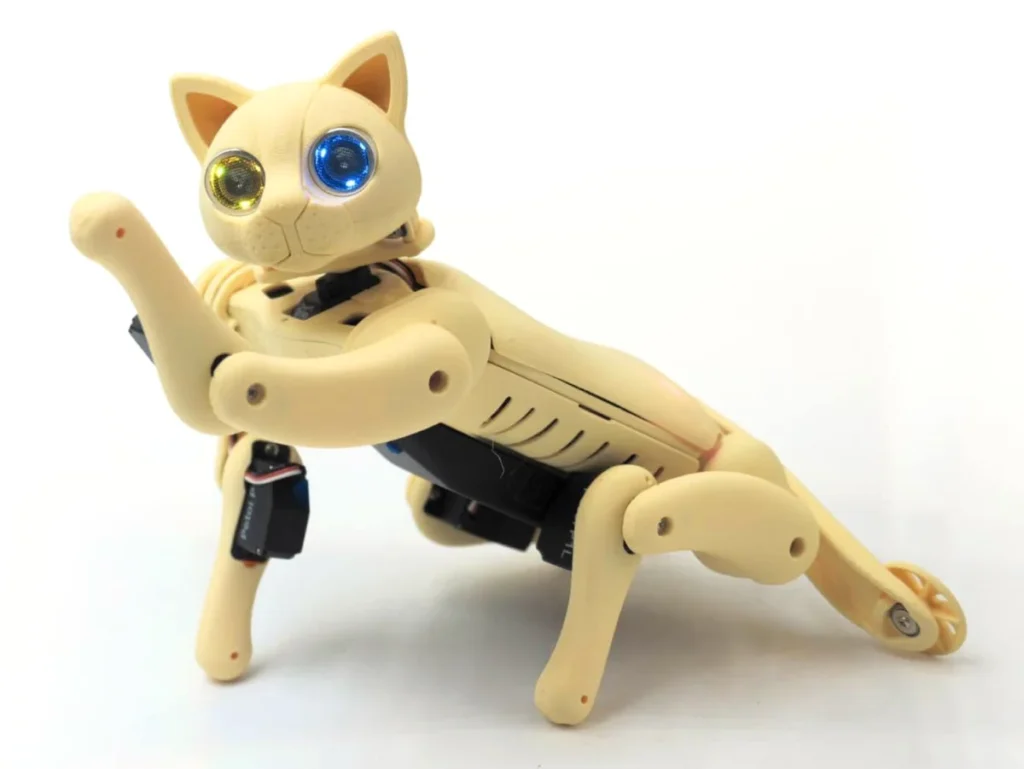
The Petoi Nybble Q, a servo-packed, palm-sized robotic cat, has quickly become a standout demonstration piece due to its immediate responsiveness and sophisticated design. Building upon the legacy of its wooden predecessor, the original Nybble, the Q model introduces a sleeker 3D-printed body, an upgraded control board, enhanced servos, and integrated voice control capabilities. This evolution marks a deliberate step towards greater durability, aesthetic appeal, and advanced functionality, making the robot more robust for repeated use and more engaging for interactive demonstrations.
Out of the box, the Nybble Q boasts an impressive array of built-in responses to various voice commands, allowing users to interact with the robot without initial programming. This plug-and-play functionality makes it an immediate source of entertainment and an excellent entry point for new users, as highlighted by the reviewer’s experience in convincing an educator to adopt one for classroom use. The accuracy of the voice recognition system is particularly noteworthy, consistently interpreting commands despite occasional, amusing misinterpretations. This feature minimizes reliance on external controls, such as the micro:bit-powered remote, enhancing the intuitive user experience.

Beyond its entertainment value, the Nybble Q is engineered for deep educational exploration. It supports programming across multiple platforms, including mobile and desktop applications, leveraging popular coding languages and environments such as Arduino, Python, and Mind+ block coding. This multi-faceted approach caters to a wide range of skill levels, from beginners utilizing visual block coding to more advanced users delving into text-based programming. The availability of accompanying lessons further solidifies its role as a comprehensive educational tool, guiding users through fundamental robotics principles.
The Nybble Q’s sensor suite significantly contributes to its interactive capabilities and educational potential. It features an extra servo dedicated to tail wagging, adding to its lifelike movements, and incorporates distance sensors for environmental awareness. Its color-changing eyes serve as intuitive indicators, providing feedback on the robot’s "mood" or operational status. A crucial component for dynamic movement is the onboard Inertial Measurement Unit (IMU), which allows the robot to detect its orientation and attempt to self-right after a fall. This autonomous recovery mechanism, while taking a few seconds on smooth surfaces, demonstrates practical application of sensor data in real-time decision-making, offering valuable insights into balance and stability control in robotics.
The Nybble Q also offers substantial expandability for users seeking to push the boundaries of its capabilities. It can integrate with a Raspberry Pi, allowing for distributed cognitive load between the more powerful single-board computer and the BiBoard V1.0, the robot’s primary control board. This architectural flexibility enables the implementation of more complex AI algorithms, vision processing, or advanced navigation routines. Servo feedback control is another advanced feature, permitting users to manually manipulate the robot’s limbs to design custom actions, fostering a deeper understanding of kinematics and motion planning. The robust online community further enhances the learning experience, serving as a vital resource for troubleshooting and sharing innovative projects, complementing the provided hardware documentation and curriculum.
Bittle X V2: The Versatile Robotic Canine
The Petoi Bittle X V2, the robotic dog counterpart, builds upon the foundational Bittle model with its own set of significant upgrades designed for enhanced performance and versatility. Similar to the Nybble Q, the Bittle X V2 features built-in voice control and an upgraded ESP32-based board, providing a more powerful and responsive processing core. While it initially lacks the ultrasonic eyes found on the Nybble Q, its modular design allows for the integration of various sensors in its mouth, including light, motion, and gesture sensors, and even an advanced AI camera module. This modularity underscores Petoi’s commitment to customization and caters to different project requirements, from basic environmental interaction to sophisticated computer vision applications.

A particularly unique and high-value option for the Bittle X V2 is the inclusion of a robot arm, which replaces the traditional head. This configuration transforms the quadruped into a mobile manipulator, capable of performing tasks such as picking up and tossing small objects using unlockable macros. The reviewer noted the surprising strength of this arm, which adds a new dimension to the robot’s utility beyond mere locomotion. However, the trade-off is a reduction in the "nimbleness and expandability" associated with the standard Bittle head configuration, which allows for more diverse sensor integrations. This choice highlights Petoi’s strategy of offering specialized variants to cater to different user interests and project goals.
The Bittle X V2, whether equipped with a head or a robot arm, is designed with durability in mind, making it suitable for environments where more robust interaction might occur. Its form factor and component choices reflect a balance between sophisticated functionality and practical resilience. The availability of a Bittle X V2 kit without the arm provides a more cost-effective entry point while still offering a "solid bot" with substantial capabilities.
The Petoi Philosophy: Bridging the Gap in Robotics Education
Petoi’s robot pets are more than just advanced toys; they are sophisticated intermediate projects that strategically remove the initial hurdles of complex robotics development, allowing users to focus on creative application and programming. The design philosophy centers on providing a partially assembled, highly capable platform where the difficult engineering work—such as circuit board design, low-level motor control, and initial firmware development—has already been handled. This approach enables users to "skip to the fun part," which involves programming behaviors, integrating additional sensors, and exploring advanced concepts without getting bogged down in foundational hardware design.
The modular nature of both the Nybble Q and Bittle X V2 exemplifies this philosophy. While the bots arrive largely preassembled, they are not sealed units. Users are encouraged to interact with the internal components, albeit with care. For instance, the reviewer’s experience with a non-wagging tail on the Nybble Q, resolved by simply moving a servo plug, demonstrates the accessible nature of minor repairs and modifications. This level of access, though exposing delicate components like ribbon cables, is crucial for fostering a deeper understanding of the robot’s internal workings and empowering users to customize and troubleshoot. The fact that users "don’t make you assemble any circuit boards, but they don’t lock you out of them either" perfectly encapsulates this balanced approach.

The comprehensive curriculum and vibrant online community are integral to Petoi’s educational mission. The structured lessons guide users through programming fundamentals and advanced robotics concepts, providing a pedagogical framework for learning. The active online community acts as a dynamic support network, offering peer-to-peer assistance, shared projects, and a platform for collaborative learning, which is invaluable for both beginners and experienced makers tackling complex challenges.
Technical Foundations and Educational Value
The choice of microcontrollers and programming environments in Petoi robots is deliberate and reflects a commitment to educational efficacy. The Nybble Q’s upgraded board and the Bittle X V2’s ESP32-based board provide robust processing power suitable for real-time control and sensor data processing. The ESP32, in particular, is a popular choice in the IoT and maker communities due to its integrated Wi-Fi and Bluetooth capabilities, offering seamless connectivity for remote control and data logging. The BiBoard V1.0, often paired with a Raspberry Pi, represents a scalable architecture that allows for incremental complexity in projects, from simple command-response to complex AI-driven behaviors.
The support for Arduino, Python, and Mind+ block coding is critical for catering to a broad educational spectrum. Mind+ offers a visual, drag-and-drop interface ideal for introducing programming logic to younger learners or absolute beginners. Arduino, with its C++ like syntax, is a widely adopted platform for microcontroller programming, providing a pathway to understanding embedded systems. Python, known for its readability and extensive libraries, is an industry standard for robotics, AI, and data science, making it an excellent choice for advanced users to implement sophisticated algorithms, including machine learning and computer vision.
The inclusion of various sensors—ultrasonic distance sensors, color-changing eyes, light, motion, gesture sensors, and AI camera modules—transforms these robots into interactive learning platforms. These sensors allow users to explore concepts such as environmental perception, object detection, navigation, and human-robot interaction. The IMU, for instance, provides data on acceleration and angular velocity, crucial for implementing stable locomotion and self-balancing algorithms. Servo feedback control further enhances the educational experience by enabling precise manipulation and custom gait design, offering practical lessons in inverse kinematics and motor control.

Broader Implications and Future Outlook
The Petoi programmable robot pets are poised to significantly impact STEM education and the broader maker movement. By democratizing access to advanced quadruped robotics, Petoi lowers the barrier to entry for individuals and institutions interested in exploring complex robotic systems. This accessibility is crucial for inspiring the next generation of engineers, scientists, and innovators. Students can gain practical experience with coding, electronics, mechanics, and artificial intelligence, skills that are increasingly vital in a technology-driven world.
The open-ended nature of these platforms fosters creativity and problem-solving. Users are not limited to pre-programmed functions but are empowered to design, experiment, and innovate. This aligns with modern pedagogical approaches that emphasize active learning and project-based education. The ability to integrate additional components, such as Grove sensors or more powerful computing modules like the Raspberry Pi, ensures that the robots can grow with the user’s skills and ambitions, providing long-term educational value.
In a market increasingly saturated with educational robotics kits, Petoi distinguishes itself by offering sophisticated, high-performance quadrupeds that rival the complexity of research-grade robots in a more approachable package. While consumer-grade robots often prioritize ease of use over depth, and industrial robots prioritize precision over accessibility, Petoi strikes a balance, offering a robust platform for intermediate learning. The active community support and comprehensive curriculum further enhance the value proposition, creating an ecosystem where continuous learning and innovation are encouraged.
Looking ahead, the modular design and software flexibility of Petoi robots suggest a promising future. As sensor technology advances and AI algorithms become more accessible, users will likely continue to push the boundaries of what these platforms can achieve. The foundation laid by the Nybble Q and Bittle X V2—combining advanced hardware with open-ended programmability and strong community support—positions Petoi as a leader in making complex robotics an engaging and attainable field for a global audience. These robots are not merely tools for learning; they are catalysts for creativity, preparing individuals to contribute to the evolving landscape of robotics and artificial intelligence.