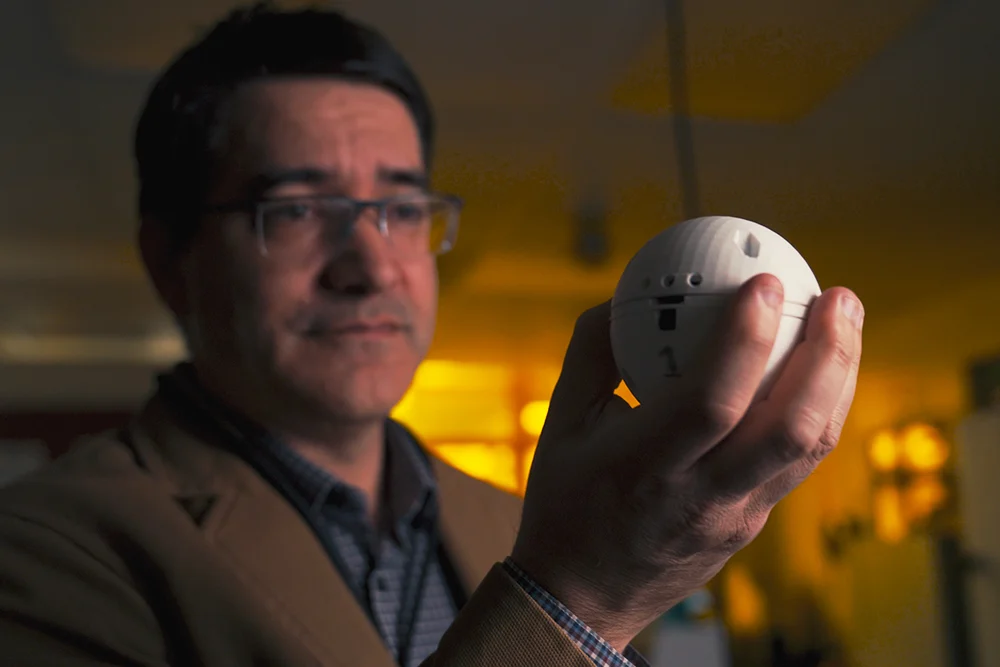
Researchers at MIT Lincoln Laboratory have unveiled a groundbreaking innovation poised to significantly enhance the safety and operational effectiveness of military service members, first responders, and law enforcement personnel. The newly developed device, codenamed TOSSIT, is a compact, throwable sensor designed to provide immediate and remote detection of hazardous vapors and aerosols. This technological advancement addresses a critical gap in current threat detection capabilities, particularly concerning substances that have historically posed significant challenges for small, deployed sensor systems.
The TOSSIT sensor, roughly the size of a baseball, offers a versatile deployment mechanism, allowing it to be tossed, dropped from drones, or launched into areas of concern. Once deployed, it actively samples the surrounding air. Its core detection mechanism relies on an internal camera that monitors color changes on a removable dye card. These color shifts are indicative of the presence of specific chemical threats, ranging from potent nerve and blister agents, which are of paramount concern in military and counter-terrorism scenarios, to dangerous byproducts of industrial chemical accidents and even airborne particulates like fentanyl dust. Upon detecting a threat, TOSSIT immediately alerts users through a connected mobile application or via built-in alarms on the sensor itself, providing crucial early warning to mitigate exposure and guide appropriate responses.
This development arrives at a time when the threat landscape is increasingly complex and diverse. The proliferation of chemical weapons, the rise of synthetic opioids like fentanyl, and the potential for industrial accidents to release toxic substances necessitate advanced, portable, and cost-effective detection solutions. Traditional methods of detecting such threats often involve bulky equipment, time-consuming analysis, or direct human exposure, all of which present significant risks. TOSSIT aims to revolutionize this paradigm by offering a rapid, remote, and accessible means of threat identification.
Origins and Development of TOSSIT
The genesis of TOSSIT lies in the ongoing research efforts at MIT Lincoln Laboratory, a federally funded research and development center sponsored by the U.S. Department of Defense. The laboratory has a long-standing commitment to developing cutting-edge technologies that address national security challenges. The development of TOSSIT was driven by a clear need identified by military and first responder communities for a sensor that could effectively detect a broad spectrum of airborne hazards, including those in vapor and aerosolized solid forms, which are often difficult to quantify with existing technologies.
The project, led by principal investigator Richard Kingsborough, focused on creating a device that was not only effective in its detection capabilities but also practical for field deployment. Key design considerations included miniaturization, ease of use, ruggedness, and affordability. The spherical design was chosen for its aerodynamic properties, facilitating accurate and predictable deployment. The removable dye card system was a crucial innovation, allowing for a visual indicator that could be interpreted by an internal camera, thereby enabling the sensor to function autonomously and transmit data wirelessly.
The development process involved extensive testing and refinement. Researchers simulated various environmental conditions and chemical exposure scenarios to validate TOSSIT’s performance and reliability. Field trials, conducted in collaboration with potential end-users, provided invaluable feedback, ensuring that the device met the stringent requirements of real-world operations. This iterative approach, grounded in scientific rigor and user-centric design, has culminated in a technology ready for operational deployment.
Technical Capabilities and Detection Mechanisms
The efficacy of TOSSIT hinges on its sophisticated yet elegantly simple detection system. The core of the sensor is a specially formulated dye card, designed to undergo a distinct color change when exposed to specific chemical compounds. These dyes are selected based on their reactivity with target analytes, such as chemical warfare agents like sarin or VX, or toxic industrial chemicals such as phosgene or ammonia.
Upon deployment, TOSSIT begins to ingest ambient air. This air is channeled over the surface of the dye card. If a target chemical is present above a certain concentration threshold, it will react with the dye, causing a visible color alteration. The internal camera within TOSSIT continuously monitors the dye card. Advanced image processing algorithms are employed to detect subtle color shifts and interpret them as positive identifications of specific chemical threats.
The TOSSIT system is designed to detect a range of threats, and the dye cards can be customized or swapped out to target different classes of chemicals. For instance, one card might be optimized for nerve agents, while another could be sensitive to blister agents or volatile organic compounds. This modularity enhances the sensor’s versatility and adaptability to evolving threat environments.
Beyond visual detection, TOSSIT incorporates a communication module that transmits the collected data. This can manifest as a simple alert on a user’s smartphone application, displaying the type of chemical detected and its approximate concentration. Alternatively, the sensor can be programmed to emit audible or visual alarms directly, providing immediate localized warning. The ability to remotely monitor multiple TOSSIT sensors deployed across a wide area offers a comprehensive situational awareness picture, enabling command personnel to make informed decisions regarding evacuation, containment, or neutralization strategies.
Addressing Unmet Needs in Threat Detection
The introduction of TOSSIT addresses a significant gap in current chemical threat detection capabilities, particularly concerning solid aerosols. While vapor detection has seen advancements, the ability to quickly and safely identify airborne solid particles – such as toxic dusts generated by explosions, chemical manufacturing incidents, or even biological agents – has remained a challenge. These particles can be inhaled, leading to severe health consequences, and can contaminate surfaces over a wide area.
"TOSSIT fills an unmet need, providing a low-cost sensing option for vapors and solid aerosol threats — think toxic dust particles — that would otherwise not be detectable by small deployed sensor systems," stated Richard Kingsborough, the principal investigator for the project. This statement underscores the device’s potential to democratize access to advanced threat detection, making it more widely available and cost-effective than existing complex instrumentation.
The low cost associated with TOSSIT is a critical factor in its potential widespread adoption. By leveraging accessible materials and a streamlined design, MIT Lincoln Laboratory has managed to develop a high-performance sensor that is economically viable for mass deployment. This is particularly important for organizations with limited budgets, such as local fire departments or smaller law enforcement agencies, who may not have the resources to invest in more expensive, specialized equipment.
Implications for National Security and Public Safety
The implications of TOSSIT for national security and public safety are far-reaching. In a military context, TOSSIT can provide forward-deployed units with an invaluable early warning system. Service members operating in potentially contaminated environments can deploy TOSSIT to assess the threat level before committing to an area, thereby reducing the risk of exposure to chemical agents. This capability is crucial for mission success and the preservation of personnel safety in theaters of operation where chemical threats are a persistent concern.
For first responders, TOSSIT offers a transformative tool for managing domestic emergencies. In the event of a chemical spill at an industrial facility, a terrorist attack involving chemical agents, or the discovery of illicit drug manufacturing operations that may release hazardous airborne substances, TOSSIT can provide immediate intelligence. This allows incident commanders to implement appropriate protective measures, such as issuing evacuation orders or deploying specialized HazMat teams, with greater confidence and speed. The ability to quickly ascertain the presence and nature of airborne toxins can significantly reduce the risk of injury or fatality among both responders and the civilian population.
Law enforcement agencies also stand to benefit, particularly in operations involving hazardous materials or the detection of dangerous substances like fentanyl dust. The ease of deployment and remote monitoring capabilities of TOSSIT can enhance officer safety during raids, arrests, or the investigation of scenes where unknown or dangerous airborne compounds may be present.
Transition to Operational Use and Future Development
Following extensive testing and validation, the TOSSIT technology is currently undergoing a transition to operational use within the U.S. military. This signifies a critical milestone, moving the innovation from the laboratory to the field where it can directly contribute to national security objectives. The transfer process typically involves further collaboration with military procurement agencies and defense contractors to scale up production and integrate TOSSIT into existing military equipment and protocols.
While the initial focus is on military applications, there is significant potential for TOSSIT to be adapted for broader civilian use. Discussions with emergency management agencies and public safety organizations are likely to follow, exploring how this technology can be made accessible to a wider range of first responders.
The future development of TOSSIT may also involve further enhancements. Researchers might explore expanding the range of detectable chemicals, improving the sensitivity and specificity of the dye cards, and integrating more advanced data analytics for threat prediction and plume modeling. Miniaturization of the power source and communication systems could also lead to even more compact and longer-lasting sensor units. The potential for networked sensor arrays, where multiple TOSSIT devices communicate with each other to form a comprehensive threat map, represents another exciting avenue for future innovation.
Conclusion
The development of the TOSSIT device by MIT Lincoln Laboratory marks a significant advancement in the field of threat detection. By offering a low-cost, throwable, and remotely operable sensor capable of identifying a wide array of hazardous vapors and aerosols, TOSSIT promises to enhance the safety and effectiveness of military personnel and first responders. Its practical design, coupled with its sophisticated detection capabilities, addresses a critical need in a world facing increasingly diverse and complex chemical threats. As this technology transitions into operational use, it stands to redefine the standards for airborne hazard detection and contribute substantially to both national security and public safety initiatives. The successful implementation of TOSSIT underscores the vital role of ongoing research and development in providing innovative solutions to critical societal challenges.