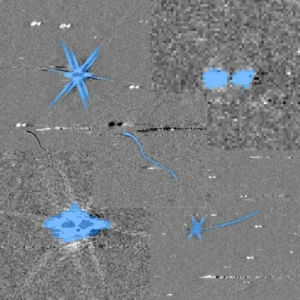
China’s Tianwen-1 spacecraft has achieved a remarkable feat, capturing detailed images of the interstellar object 3I/ATLAS as it journeyed through the vicinity of Mars. The China National Space Agency (CNSA) announced that the Tianwen-1 orbiter utilized its sophisticated high-resolution camera to photograph the comet from an impressive distance of approximately 30 million kilometers (18.6 million miles). This observation marks a significant contribution to our understanding of objects originating from beyond our solar system and showcases the advanced capabilities of China’s deep space exploration program.
Tianwen-1, which has been diligently orbiting the Red Planet for an extended period of four years and eight months, positioned itself as one of the closest spacecraft to observe 3I/ATLAS since its initial discovery. The interstellar object was first identified on May 7th, 2025, a date that has now become etched in the annals of space observation due to this remarkable encounter. The close proximity afforded by Tianwen-1’s orbital path allowed for unprecedented detail in the captured imagery.
Revealing the Comet’s Celestial Features
The newly released images from Tianwen-1 provide compelling visual evidence supporting the classification of 3I/ATLAS as a comet. A distinct tail, a hallmark of cometary activity, is clearly visible extending behind the object. Furthermore, a luminous cloud of gas and dust, known as a coma, envelops the object’s nucleus. These features are indicative of volatile materials within the object beginning to subl when exposed to the Sun’s warmth.
Scientists have meticulously processed multiple images, creating an animation that meticulously traces the comet’s trajectory as it progresses towards its closest approach to the Sun. This series of observations significantly bolsters the growing body of evidence suggesting that 3I/ATLAS is composed of water and other volatile compounds. These materials are believed to have initiated their sublimation process as the object traversed the inner solar system, a phenomenon characteristic of comets.
The successful observation of 3I/ATLAS by Tianwen-1 also serves as a crucial precursor and a valuable preview of the ambitious scientific objectives planned for China’s upcoming Tianwen-2 mission. This future endeavor is slated to investigate a Near-Earth Asteroid (NEA) before embarking on a study of a comet, further underscoring China’s commitment to unraveling the mysteries of solar system formation and evolution.
The Challenge of Capturing a Fleeting Target
The technical team responsible for operating Tianwen-1’s High-Resolution Imaging Camera (HiRIC) commenced their preparations for this unique celestial encounter in early September. Their meticulous work involved a comprehensive suite of activities, including numerous simulations designed to predict the object’s path and appearance, rigorous theoretical modeling to optimize observation parameters, and detailed inspections of the instrument itself to ensure its readiness.
Photographing 3I/ATLAS presented a formidable challenge due to a confluence of factors. The object was not only distant but also relatively small, with an estimated diameter of approximately 5.6 kilometers (3.5 miles). Adding another layer of complexity was its significant velocity. The comet was hurtling through space at an estimated speed of around 58 kilometers per second (36 miles per second). When considering its motion relative to Tianwen-1, this speed escalated to a staggering approximately 86 kilometers per second (53.5 miles per second), making it an exceptionally difficult target to track and image.
Moreover, the HiRIC camera, while highly capable, was not originally engineered for the specific task of observing such a dim celestial body. Its primary design focus was on imaging the bright features of the Martian surface, a task akin to that performed by instruments aboard other spacecraft orbiting Mars, such as the European Space Agency’s Mars Express and the ExoMars Trace Gas Orbiter (TGO).
A Collaborative Effort: European Orbiters Join the Observation
In a testament to international scientific collaboration, both European orbiters, Mars Express and the ExoMars Trace Gas Orbiter, also turned their cameras towards 3I/ATLAS on October 3rd. Mars Express utilized its High Resolution Stereo Camera (HRSC) for the observation, while the ExoMars spacecraft employed its Colour and Stereo Surface Imaging System (CaSSIS).
Detecting 3I/ATLAS with these instruments proved to be an exceptionally demanding undertaking. When compared against the brightly illuminated Martian surface features, 3I/ATLAS appeared remarkably faint, estimated to be between 10,000 and 100,000 times dimmer. This extreme difference in brightness necessitated highly sensitive instruments and sophisticated data processing techniques.
The High Resolution Stereo Camera (HRSC) aboard Mars Express typically operates with an exposure time of 0.5 seconds. In contrast, the Colour and Stereo Surface Imaging System (CaSSIS) has the capability to extend its exposure to 5 seconds. Tianwen-1’s HiRIC collected its observations with its own specialized parameters, though its specific exposure time has not been publicly disclosed. However, it is known that HiRIC was engineered for exceptional temporal precision and rapid operational cycles. These advanced capabilities were instrumental in enabling the team to acquire the latest image, despite the resulting visual characteristics, which appear somewhat grainy and blurry due to the inherent challenges of imaging a faint, fast-moving object at such a distance.
A Rare Sample From Another Star System: Implications for Astrobiology
The significance of observing 3I/ATLAS extends far beyond its visual appeal. Like the two previously identified interstellar objects, ‘Oumuamua and Borisov, 3I/ATLAS offers exceptional opportunities for both astronomical and astrobiological research. Asteroids and comets are essentially time capsules, preserving residual materials from the formation of planetary systems. An object originating from interstellar space, therefore, may contain invaluable clues about the conditions and composition of planetary systems orbiting other stars.
The study of such an extraterrestrial visitor could provide profound insights into the diverse processes of planetary system formation across the galaxy and the types of materials that are common in these nascent systems. The prospect of missions specifically designed to intercept and study interstellar objects, for which numerous conceptual designs are currently being explored, holds the potential to gather scientific data that would be unattainable through conventional telescopic observations alone.
The only comparable alternative for acquiring such unique information would involve undertaking the monumental task of sending spacecraft directly to another star system. Such an endeavor would necessitate vast amounts of time, resources, and technological advancements that are currently beyond our reach. Therefore, intercepting interstellar visitors within our own solar system represents a more feasible and immediate path to answering fundamental questions about our cosmic origins and the prevalence of life-supporting materials in the universe.
The Dawn of Interstellar Chase Missions
The scientific community is abuzz with the prospect of future spacecraft being equipped and prepared to intercept newly discovered interstellar objects. The ability to examine these visitors at close range promises to revolutionize our understanding of exoplanetary environments and the building blocks of worlds beyond our own.
One promising initiative already in advanced stages of development is the European Space Agency’s Comet Interceptor mission. This ambitious project is anticipated to be completed by 2029. Rather than targeting a specific object from the outset, Comet Interceptor is designed to lie in wait in deep space, ready to be redirected towards a suitable comet or another promising interstellar target should one be detected. This "target of opportunity" approach highlights a strategic shift towards actively pursuing these rare cosmic messengers.
The successful observation of 3I/ATLAS by Tianwen-1, alongside the concurrent efforts by European missions, underscores the growing global interest and capability in tracking and studying these enigmatic interstellar travelers. As our observational technologies advance and our understanding of the solar system deepens, the era of actively chasing and studying interstellar visitors appears to be dawning, promising a new frontier in our quest to comprehend the universe and our place within it. The data collected from these missions will undoubtedly enrich our knowledge of cosmic evolution and the potential for life beyond Earth.