At the foundational level of modern automated systems, communication protocols are the invisible threads that enable complex machinery to operate with precision and efficiency. While broad-scale network protocols like Ethernet, EtherCAT, and CAN facilitate connectivity between drives, motors, and centralized controllers across industrial environments, a different class of communication standard governs the intricate dialogue occurring within the very heart of these systems: at the circuit board level of controllers and microcontrollers. Among these, the Serial Peripheral Interface (SPI) stands out as a ubiquitous and highly effective solution for synchronous serial data transmission, proving indispensable in a vast array of embedded applications, particularly within motion control systems.
SPI is an input-output standard widely adopted in embedded systems for short-distance, high-speed communication between various integrated circuits (ICs). Conceived by Motorola in the mid-1980s, SPI offered a robust yet simple method for connecting microcontrollers to peripheral devices. Its design prioritizes speed and efficiency, making it a cornerstone for applications where latency and footprint are critical considerations. Unlike some other serial protocols, SPI operates in full-duplex mode, allowing simultaneous data transmission and reception, a significant advantage for real-time control and feedback mechanisms prevalent in motion systems.
Unpacking the Technical Architecture of SPI
At its most fundamental physical layer, SPI employs a four-wire serial interface, distinguishing it from asynchronous protocols like UART or more complex bus systems like I²C. These four wires are:
- SCLK (Serial Clock): Generated by the master device, this signal synchronizes data transfer between the master and slave(s).
- MOSI (Master Out Slave In): This line carries data transmitted from the master to the slave device.
- MISO (Master In Slave Out): This line carries data transmitted from the slave device to the master.
- SS/CS (Slave Select/Chip Select): An active-low signal generated by the master to select a specific slave device. Each slave requires its own dedicated SS line from the master.
This architecture enables full-duplex communication, meaning data can be sent and received concurrently, significantly improving throughput for applications requiring rapid command execution and feedback. Data rates can vary considerably, typically ranging from a few megahertz (MHz) up to 10 MHz or even higher in specialized implementations, making it suitable for high-speed data exchange. The flexibility of SPI also extends to its data frame size, which can be programmed from two bits up to 24 bits, depending on the specific application requirements and the microcontroller’s capabilities. This adaptability allows developers to optimize data packets for different types of peripherals, from simple status flags to complex sensor readings or motor control commands.
The Strategic Advantages of SPI in Embedded Design
The widespread adoption of SPI stems from several key advantages it offers to embedded system designers:
- Simplicity: SPI is inherently simpler than many other communication protocols. It doesn’t require complex addressing schemes like I²C, nor does it involve start/stop bits or parity checking like UART, which reduces overhead and simplifies implementation in both hardware and software.
- High Speed: With dedicated data lines for master-to-slave and slave-to-master communication, and a clock signal generated by the master, SPI can achieve very high data transfer rates. This is crucial for applications where real-time responsiveness is paramount, such as high-precision motor control or rapid sensor data acquisition.
- Full-Duplex Operation: The ability to transmit and receive data simultaneously is a significant benefit, especially in control loops where commands need to be sent while feedback (e.g., motor position, current) is being received.
- Low Pin Count (Relative to Parallel Buses): While requiring more pins than I²C for multiple slaves, SPI still offers a substantial reduction in pin count compared to parallel bus systems. A parallel bus transmitting 8 bits of data would require at least 8 data lines plus control signals, whereas SPI achieves the same with just four. This directly translates to significant savings in printed circuit board (PCB) space, reduced trace complexity, and lower manufacturing costs – all critical factors in miniaturized embedded systems.
- Flexibility: The protocol allows for flexible data frame sizes and does not impose specific timing constraints beyond the clock signal, giving developers more control over communication parameters.
However, it is also important to acknowledge some limitations. SPI lacks an inherent acknowledgement mechanism, meaning the master must assume the slave received the data or implement higher-level software checks. It also requires a separate Chip Select (CS) line for each slave device, which can increase pin count on the master if many slaves are present. Despite these, its advantages often outweigh the drawbacks for many embedded applications.
SPI’s Indispensable Role in Motion Control Circuits
In the realm of motion control, SPI’s attributes make it an ideal candidate for connecting microcontrollers to a diverse array of peripheral devices, particularly motor drivers, sensors, and specialized motion control ICs. Typically, a motor driver equipped with SPI connectivity will feature an SPI port that interfaces directly with a microcontroller. This microcontroller then dispatches control signals – such as Pulse Width Modulation (PWM) signals for speed regulation, step and direction signals for stepper motors, or torque commands for servo motors – to the driver. In more integrated designs, the entire control mechanism, including signal generation, might reside on the same chip as the driver, further streamlining the system.
Beyond mere control, SPI is also heavily utilized for diagnostic purposes. Modern motor drivers and motion control ICs often incorporate extensive diagnostic features, providing feedback on motor current, temperature, fault conditions, and encoder positions. This diagnostic data is efficiently transmitted back to the microcontroller via SPI, enabling real-time monitoring, fault detection, and predictive maintenance capabilities. Such granular insight is critical for ensuring the reliable and safe operation of automated systems, from industrial robots to medical pumps.
Master/Follower Configurations and Daisy-Chaining
SPI is particularly adept at handling master/follower (or master/slave) configurations. In a typical setup, a single master microcontroller communicates with one or more follower devices. When multiple slave devices are present, each slave typically has its own dedicated Slave Select (SS) line. The master activates the appropriate SS line to initiate communication with a specific slave, allowing multiple peripherals to share the same MOSI, MISO, and SCLK lines.
An alternative configuration, known as daisy-chaining, is often employed to minimize the number of SS lines required when multiple similar slave devices are used. In a daisy-chain, the MOSI output of one slave is connected to the MOSI input of the next, and so on. Data is shifted through the chain, allowing the master to communicate with all slaves sequentially or broadcast commands. This method is especially useful for managing multiple motor drivers or sensor arrays with reduced pin overhead.
Real-World Applications: Illustrative Examples
The impact of SPI in motion control is best understood through concrete examples from leading manufacturers:
1. Analog Devices TMC429 Motion Controller:
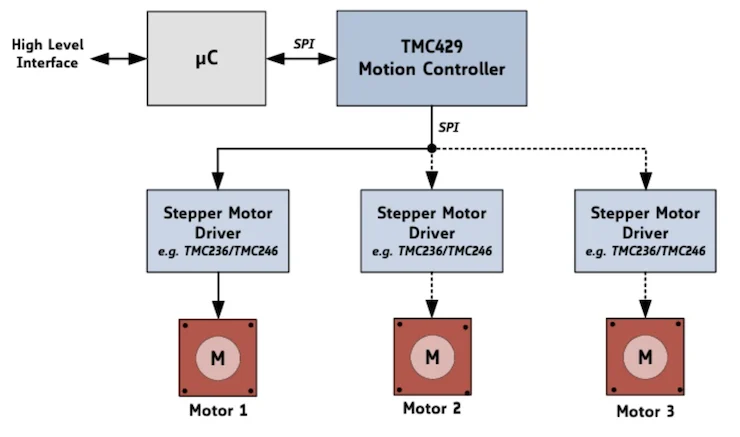
The Analog Devices (formerly Trinamic) TMC429 motion controller chip exemplifies SPI’s utility in sophisticated motion systems. The TMC429 functions as a dedicated three-axis motion controller, specifically designed for applications requiring precise stepper motor positioning. It receives high-level commands from a higher-level microcontroller (e.g., a host CPU) via one of its SPI interfaces. In turn, the TMC429 controls stepper motor positions by generating precise step and direction pulses, which are then sent to individual stepper motor driver chips. These driver chips translate the step and direction signals into the coil currents necessary to move the stepper motors.
Crucially, the TMC429 itself utilizes two separate four-wire SPI interfaces. One interface facilitates communication with the overarching microcontroller, allowing for configuration, command input, and status feedback. The second SPI interface is dedicated to communicating with up to three daisy-chained stepper motor drivers (e.g., TMC2130, TMC2209, or similar integrated drivers). This dual-SPI architecture allows for a hierarchical control structure, offloading complex real-time pulse generation from the main microcontroller and enabling highly synchronized multi-axis motion. Such integration is vital in applications like industrial automation, CNC machinery, and high-precision laboratory equipment, where coordinated movement across multiple axes is essential.
2. Toshiba TB9104FTG Automotive Gate Driver:
The automotive sector represents a rapidly expanding frontier for motion control, driven by the increasing electrification of vehicle subsystems. Modern vehicles feature dozens, if not hundreds, of small motors controlling everything from window lifts and seat adjustments to advanced thermal management systems and active aerodynamic components. Toshiba’s TB9104FTG gate driver, designed for brushed DC motors in automotive applications, showcases the integral role of SPI in this context. This gate driver features integrated SPI, which allows a vehicle’s Electronic Control Unit (ECU) to precisely control the motor’s operation. Beyond simple on/off control, the integrated SPI facilitates advanced functionalities such as configuring PWM drive parameters, reading diagnostic information (e.g., overcurrent, overtemperature, short-circuit detection), and even fine-tuning motor current sense amplifiers circuitry embedded within the chip. This level of integrated control and diagnostics via SPI is critical for ensuring the reliability, efficiency, and safety of automotive motor systems, while simultaneously reducing the wiring complexity and footprint in space-constrained vehicle environments.
3. Broader Industry Adoption:
The trend of integrating SPI into motion control solutions is not limited to a few specific examples. Major semiconductor manufacturers like STMicroelectronics, Texas Instruments, Infineon, and NXP extensively incorporate SPI into their microcontrollers, motor drivers, and specialized motion control ICs. These components are deployed across a vast spectrum of applications:
- Industrial Automation: Robotics, conveyor systems, automated guided vehicles (AGVs), and pick-and-place machines rely on SPI for precise motor control and sensor integration.
- 3D Printing Systems: The accurate movement of print heads and build platforms is critical, with SPI enabling microcontrollers to command stepper motor drivers with high fidelity.
- Medical Devices: Precision pumps, diagnostic equipment, and surgical robots often utilize SPI for reliable control of miniature motors and sophisticated sensor feedback.
- Aerospace and Defense: High-reliability systems often leverage SPI for its robustness and straightforward implementation in critical control surfaces and sensor arrays.
- Consumer Electronics: Drones, camera gimbals, and even advanced home appliances increasingly feature embedded motion control powered by SPI-enabled components.
The Evolving Landscape and Future Implications
As embedded systems continue to shrink in size, increase in complexity, and demand higher levels of performance, the role of SPI remains as vital as ever. Its inherent advantages—simplicity, speed, full-duplex capability, and low pin count relative to parallel buses—ensure its continued relevance in a rapidly evolving technological landscape.
Comparison with Other Protocols for Context:
To fully appreciate SPI, it’s useful to briefly compare it with other common intra-chip communication protocols:
- I²C (Inter-Integrated Circuit): Developed by Philips, I²C uses only two wires (SDA for data, SCL for clock) and supports multiple masters and slaves via an addressing scheme. However, it is typically slower than SPI, operates in half-duplex mode, and has more overhead due to its addressing mechanism. I²C is often preferred for slower peripherals like EEPROMs or real-time clocks, or when minimizing pin count is paramount, even at the cost of speed.
- UART (Universal Asynchronous Receiver/Transmitter): UART is a two-wire (TX/RX) asynchronous serial protocol, meaning it doesn’t require a shared clock line. While simpler in terms of wiring, it relies on precisely matched baud rates and adds overhead with start and stop bits. It’s excellent for point-to-point communication with devices like GPS modules or Bluetooth modules, but generally slower and less suitable for multi-device, high-speed, synchronized communication than SPI.
SPI effectively fills a niche between these simpler protocols and the more complex, higher-level network protocols like EtherCAT or CAN. While EtherCAT provides deterministic, high-speed communication across an entire industrial network, SPI excels at the direct, chip-to-chip communication within a single controller board, forming the bedrock upon which these larger networks ultimately rely.
Future Outlook:
The future of SPI in motion control appears secure. The trend toward highly integrated System-on-Chip (SoC) solutions, where microcontrollers, motor drivers, and even power stages are combined onto a single die, will continue to leverage SPI for internal communication paths. As the Internet of Things (IoT) and edge computing proliferate, there will be an ever-increasing demand for compact, efficient, and robust motion control solutions in smart devices, wearables, and autonomous systems. SPI’s proven track record for reliability and performance at the hardware level positions it as a key enabler for these advancements.
Furthermore, innovations in semiconductor manufacturing continue to push the boundaries of SPI’s capabilities, allowing for even higher clock speeds and more flexible configurations. While no formal standard exists for SPI (leading to slight variations in implementation across manufacturers, primarily in clock polarity and phase modes), its fundamental principles remain consistent, allowing for broad interoperability. Careful consideration of these modes (CPOL and CPHA) during system design ensures seamless communication.
In conclusion, the Serial Peripheral Interface, though a behind-the-scenes workhorse, is an absolutely critical component in the intricate ecosystem of modern motion microcontrollers and embedded systems. Its simplicity, speed, full-duplex capability, and efficiency in terms of board space make it the go-to choice for developers seeking reliable, high-performance communication between microcontrollers and the myriad of peripherals that bring automated systems to life. As automation and connectivity continue to define technological progress, SPI’s foundational role in enabling precise, real-time motion control will only grow in significance.