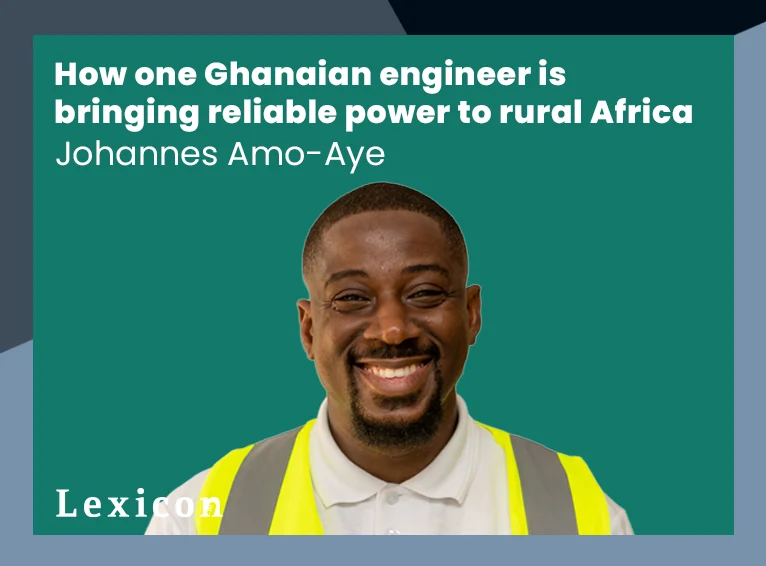
In a significant stride towards eradicating energy poverty across Africa, MINAGIE Energy, spearheaded by its co-founder and CEO Johannes Amo-Aye, is deploying an innovative, locally developed hybrid renewable energy system known as the Fusion Wind Turbine. This groundbreaking technology, a subject of a recent Lexicon podcast episode by Interesting Engineering, is specifically designed to provide reliable electricity to underserved rural clinics, schools, and communities, addressing a critical development challenge with an African-led solution. The initiative underscores a growing movement to empower local engineers and foster sustainable infrastructure from within the continent.
The narrative of the Fusion Wind Turbine is deeply rooted in Johannes Amo-Aye’s personal experiences and professional conviction. Growing up in the South Labadi suburb of Accra, Ghana, recurrent power outages were a constant feature of daily life. These interruptions were not mere inconveniences; they profoundly impacted his childhood, leaving a lasting impression that would ultimately shape his career path. He vividly recalls "waking up in the morning in my own sweat on the floor" due to failed air conditioning or fans, and completing homework by candlelight, a common plight for millions across the continent. This pervasive unreliability of electricity, he states, "wasn’t just inconvenient; it was undermining dignity." Such firsthand encounters with energy poverty ignited a fervent desire within Amo-Aye to not only understand the problem but to engineer tangible, sustainable solutions. His vision for MINAGIE Energy was born from this frustration: to demonstrate that Africa possesses the ingenuity and capability to solve its own problems with African solutions.
The Genesis of an Innovation: Addressing Africa’s Energy Deficit
The challenge of energy poverty in Sub-Saharan Africa is monumental. According to the International Energy Agency (IEA), over 600 million people in Sub-Saharan Africa still lack access to electricity, representing more than 75% of the global population without power. This deficit has profound implications for health, education, economic development, and overall quality of life. In rural areas, where grid extension is often economically unfeasible or technically challenging, communities remain reliant on inefficient and polluting alternatives like kerosene lamps, diesel generators, or biomass, perpetuating a cycle of underdevelopment and environmental degradation. The United Nations Sustainable Development Goal 7 (SDG 7) aims to ensure access to affordable, reliable, sustainable, and modern energy for all by 2030, a goal that initiatives like MINAGIE Energy are directly working to achieve.
Johannes Amo-Aye’s journey from a frustrated child in a blackout-prone Accra to a pioneering engineer leading a renewable energy company is a testament to the power of personal motivation intertwined with a societal need. His background as an engineer, coupled with a deep understanding of the local context, positioned him uniquely to tackle this complex issue. The Royal Academy of Engineering’s recognition of him as part of the 2026 Africa Prize for Engineering Innovation cohort further validates the significance and potential impact of his work. The prize celebrates innovators developing scalable solutions to local challenges, perfectly aligning with MINAGIE Energy’s mission.
The Fusion Wind Turbine: A Hybrid Solution for Rural Africa
The Fusion Wind Turbine stands out not merely as another renewable energy system but as a meticulously engineered solution tailored for African conditions. Unlike conventional single-source systems, it integrates a vertical-axis wind turbine with a solar arch, combining the strengths of both wind and solar power into a single, modular unit. This hybrid approach is crucial for providing continuous, reliable electricity throughout the day and night. "When the sun goes down, it’s also harnessing wind power," Amo-Aye explains, highlighting the system’s ability to overcome the intermittency inherent in single-source renewable energy technologies.
Beyond its dual-source capability, the Fusion Wind Turbine boasts a design optimized for longevity and minimal maintenance, critical factors in remote African settings. Traditional wind turbines often rely on complex gearboxes and lubricants, which necessitate regular maintenance and the availability of specialized parts – a significant hurdle in areas with limited technical infrastructure. MINAGIE Energy’s design ingeniously sidesteps these issues by employing a gearless system. "Our system does not use a drop of oil throughout its lifespan," Amo-Aye states, emphasizing the reduction in operational complexity and cost. This translates into an expected lifespan of 20 to 25 years, with routine maintenance largely confined to cleaning the solar panels. Such practicality ensures that the system remains viable and effective even in the most isolated communities, where access to technical support and replacement parts can be severely constrained.
Transforming Lives: Impact on Healthcare and Education
The impact of reliable electricity extends far beyond mere convenience, particularly in vital sectors like healthcare and education. For rural healthcare facilities, consistent power is a matter of life and death. Amo-Aye poignantly articulates this, stating, "We can’t afford power outages when lives are at stake." He recounts a harrowing experience during an early site assessment at a health facility in Ghana’s Eastern Region. A clinic administrator warned that the electricity would fail within thirty minutes, a warning Amo-Aye initially dismissed as an exaggeration. However, precisely at noon, as his team was conducting an energy audit in the maternity ward, "the lights went out." This stark reality brought home the profound consequences of unreliable power. He pondered, "What if someone I care about is being operated on or being taken care of, or a child of mine is in an incubator?" This incident solidified his conviction that the hybrid approach was not just about technical efficiency but about "safeguarding lives and learning."
The most powerful testimony to the Fusion Wind Turbine’s impact comes from the personal stories of those whose lives have been directly touched. Amo-Aye shared the tragic account of Mavis, a woman in a rural community who went into labor at night. Due to the local clinic’s lack of reliable electricity, midwives were forced to deliver her baby using only two mobile phone torches balanced precariously on windowsills. Under these perilous conditions, critical warning signs were missed, and tragically, "the child was born with severe jaundice, and unfortunately, the child died." This devastating outcome underscores the desperate need for basic infrastructure.
However, the narrative took a turn for the better after the installation of MINAGIE Energy’s system. When Mavis returned to the same facility to give birth again, the conditions were dramatically different. The clinic was bathed in reliable lighting, essential medical equipment functioned dependably, and power was constant throughout the delivery. This transformation allowed healthcare professionals to provide proper care, turning clinics "from places of uncertainty into centers of trust." The benefits extended to healthcare workers themselves, with nurses and midwives reporting increased feelings of safety, confidence, and preparedness to perform their critical duties. Beyond healthcare, reliable electricity also empowers educational institutions, enabling extended study hours, access to digital resources, and improved learning environments, thereby fostering a brighter future for the next generation.
A Paradigm Shift: Local Ownership and Empowerment
A cornerstone of MINAGIE Energy’s philosophy is its unwavering commitment to local ownership and manufacturing. Approximately 90% of the Fusion Wind Turbine’s components are manufactured within Ghana. While certain specialized components, such as neodymium magnets, still require importation, the emphasis on local production is central to the company’s mission. "We want to own the product itself," Amo-Aye asserts. This strategic choice offers multifaceted benefits: it significantly reduces manufacturing and deployment costs, stimulates local economies through job creation, and ensures the ready availability of spare parts – a crucial advantage in preventing prolonged system downtimes in remote areas.
More profoundly, local manufacturing fosters a sense of pride and ownership within the communities served. "People know the solution is theirs. They know it was built by their own engineers," Amo-Aye explains. This psychological aspect is vital for the long-term sustainability of the projects. To further embed this sense of ownership and ensure operational continuity, MINAGIE Energy implements the MTEDI program. Through this initiative, young people within the communities where installations occur receive comprehensive training in maintenance, troubleshooting, and system management. This strategy moves beyond mere remote monitoring, creating local expertise and employment opportunities simultaneously. By equipping communities with the skills to maintain their own infrastructure, MINAGIE Energy is not just delivering electricity; it is building capacity and fostering self-reliance. This approach strongly counters the historical reliance on imported solutions and foreign expertise, proclaiming, "Africa is not waiting for solutions to be imported. We are building our own."
Ghana’s Energy Landscape and the Road Ahead
Ghana, like many African nations, has made significant strides in increasing electrification rates, yet substantial disparities persist, particularly between urban and rural areas. While the national electrification rate hovers around 85%, rural access can be significantly lower. The challenges include an aging grid infrastructure, high connection costs for remote households, and the financial sustainability of utility companies. Off-grid renewable energy solutions, like the Fusion Wind Turbine, are thus not merely supplementary but essential components of a holistic national energy strategy. They offer a decentralized, cost-effective, and environmentally friendly pathway to universal energy access, circumventing the immense capital and logistical challenges of extending the national grid to every remote village.
Currently, MINAGIE Energy has installations successfully operating in various rural locations across Ghana. However, Johannes Amo-Aye’s ambitions extend far beyond national borders. The company envisions deploying additional systems across the continent, scaling up its technician training programs, and expanding its renewable energy footprint to other African nations. This ambitious expansion, however, is not without its hurdles. Financing remains a significant challenge, requiring substantial capital for manufacturing scale-up and deployment. Supply chain complexities, especially for imported specialist components, and the logistics of building extensive technical support networks across diverse geographies also present considerable obstacles.
Despite these challenges, Amo-Aye remains steadfastly optimistic. He views the Fusion Wind Turbine as more than a piece of technology; "It is a statement," he declares. It is a powerful statement about the potential of local innovation, the imperative of energy independence, and the inherent ability of African engineers to conceive and implement solutions for uniquely African challenges. Looking a decade into the future, Amo-Aye envisions a landscape dotted with hundreds of Fusion Wind Turbine installations, supported by thousands of locally trained technicians, delivering cleaner, more reliable energy to communities that have historically been marginalized and left behind.
Broader Implications: A Blueprint for Sustainable Development
The work of MINAGIE Energy carries profound broader implications, offering a potential blueprint for sustainable development across Africa. Economically, the emphasis on local manufacturing creates a domestic industrial base, fostering skilled jobs and reducing reliance on imports, thereby retaining wealth within the continent. The MTEDI program directly addresses youth unemployment, a pervasive issue, by equipping young people with valuable technical skills in a rapidly growing sector. Socially, the provision of reliable electricity dramatically improves living standards, enhancing health outcomes, educational opportunities, and overall community resilience. Environmentally, the hybrid wind-solar system offers a clean energy alternative, significantly reducing carbon emissions and dependence on fossil fuels, aligning with global climate change mitigation efforts.
Furthermore, MINAGIE Energy’s model promotes a bottom-up approach to development, empowering communities to take charge of their own energy future. This localized, community-centric model stands in contrast to top-down infrastructure projects that often fail to account for local needs or foster local ownership. By proving that high-quality, sustainable energy solutions can be designed, manufactured, and maintained locally, MINAGIE Energy is setting a precedent for other African innovators and policymakers. It demonstrates that true energy transition in Africa must be inclusive, locally driven, and responsive to the specific challenges and opportunities of the continent.
To encapsulate his overarching mission, Johannes Amo-Aye articulates a clear and compelling vision: "reliable energy that leaves no one behind." While the full realization of this ambitious vision requires sustained effort, investment, and collaboration, the tangible impact already being felt in Ghana’s rural clinics and communities offers a powerful testament to the transformative potential of the Fusion Wind Turbine. It is a beacon of hope, illuminating a path towards a more equitable, empowered, and sustainable future for millions across Africa.