In 2022, the global construction industry was a significant contributor to climate change, accounting for over 7 percent of total carbon emissions. This stark figure, highlighted by the International Energy Agency (IEA), underscores the urgent need for innovative solutions to mitigate the environmental impact of building our world. A critical area of concern is the sheer volume of materials used in construction, raising the question of how much of this material is truly necessary. Researchers at the Massachusetts Institute of Technology (MIT) have unveiled a groundbreaking framework that promises to address this challenge by making topology optimization, a powerful design technique, practical for large-scale engineering projects.
Topology optimization, a computational method, excels at determining the most efficient material distribution within a given design space to achieve optimal structural performance, often resulting in significant material reduction – in some cases, up to 90 percent. Such a reduction could translate into multi-gigaton decreases in building-related emissions. However, the widespread adoption of this technique has been hampered by a fundamental disconnect: topology-optimized designs are frequently too complex and impractical to construct within realistic time and budget constraints, rendering them largely confined to research labs and niche applications like 3D printing.
The MIT team, led by Associate Professor Josephine Carstensen and PhD student Zane Schemmer, has bridged this critical gap. Their innovative framework, detailed in a recent publication in the journal Automation in Construction, introduces a novel approach that integrates constructability constraints directly into the topology optimization process. This allows engineers to guide the algorithmic generation of structures, limiting their complexity and ensuring that the resulting designs are feasible for real-world construction.
"There’s an interplay between the materials you’re using, the constructability of designs, and the optimization of the structure," stated Professor Carstensen, MIT’s Gilbert W. Winslow (1937) Career Development Professor in Civil Engineering. "You need to be able to address all three at the same time. That’s what we tried to do here."
The researchers’ methodology enables users to define parameters such as the maximum number of components that can meet at any given joint and the minimum size of individual structural elements. This level of control ensures that the generated designs adhere to practical building standards and manufacturing capabilities. Furthermore, their framework builds upon previous advancements by accommodating the use of multiple materials within a single structure, intelligently distributing loads based on each material’s unique properties and defining how these components should connect.
"In the literature, there’s sometimes been a disconnect between the carbon savings you can achieve on a computer and the realistic carbon savings you can achieve for built structures – especially when it comes to design technologies like topology optimization," Professor Carstensen explained. "The problem lies in the lack of constructability of designs. These designs have been perceived as too difficult to make with conventional methods, so they are never even attempted. That’s what is exciting about our approach: we can add constraints so that you will never be in a situation where the design that comes out is too hard to make."
Bridging the Gap: From Theoretical Optimization to Practical Construction
Topology optimization has been a subject of academic interest for decades. Its core principle involves using sophisticated algorithms to iteratively refine a design, removing material from areas where it is not structurally essential, thereby creating lighter and often more material-efficient structures. The resulting forms, however, can be organic and intricate, resembling delicate skeletal frameworks or complex branching patterns. While these designs are mathematically optimal in terms of material usage for a given load, they often present significant logistical and fabrication challenges for conventional construction methods.
"A big question Josephine and I were asking is why isn’t industry using it?" recalled Zane Schemmer, the paper’s lead author. "What are the obstacles that prevent industry from designing things more efficiently, and how can we fill the gaps between research and real life?"
The MIT team’s research sought to address these obstacles by consolidating and enhancing existing approaches to topology optimization. A key innovation is the framework’s capacity to design structures incorporating multiple materials. This multi-material capability is crucial for maximizing sustainability, as it allows for the strategic use of materials based on their performance characteristics, local availability, and embodied carbon.
"A big aspect of sustainability going forward will be not only using less material, but also implementing materials efficiently based on considerations like where you are in the world, your access to materials, and each of their associated carbon costs," Schemmer elaborated.
To achieve this integration, the researchers employed a class of mathematical algorithms known as mixed-integer programming. These algorithms are adept at making binary decisions, such as selecting a specific material for a component or determining the nature of a connection. This is essential because in construction, a structural element is typically made of one material, not a blend. For instance, a beam might be made of steel or wood, but not a 72% timber and 28% steel composite. The algorithm thus designates specific components for specific materials and then optimizes the connections and overall structure based on these material assignments.
The framework also incorporates a more nuanced understanding of material properties and connection behaviors, which are critical in real-world engineering. For example, while steel is excellent for compression members like struts, it is not ideal for tension-carrying elements like cables. The model accounts for these differences, ensuring that materials are used appropriately. Moreover, it moves beyond the simplified connection models often used in research, which are more akin to how parts join in additive manufacturing. Instead, it recognizes the distinct rules and constraints associated with joining materials like timber versus steel in conventional construction.
"In 3D printing, the way things come together is easy," Professor Carstensen observed. "In construction, that’s not the case. If you’re building with timber, there’s a certain rule set, versus steel has a different rule set."
By allowing users to specify parameters like the maximum number of connections at a joint and the minimum angle between connected components, the system generates designs that are not only structurally sound but also practical to assemble. The inclusion of minimum size limits for parts further enhances their manufacturability and ease of handling on a construction site.
"It’s tough to give a contractor these complex, intricate designs because it’s going to be super difficult to build," Schemmer stated. "A lot of times contractors won’t pick up a project like that to begin with."
Demonstrating Real-World Impact: Case Studies and Material Trade-offs
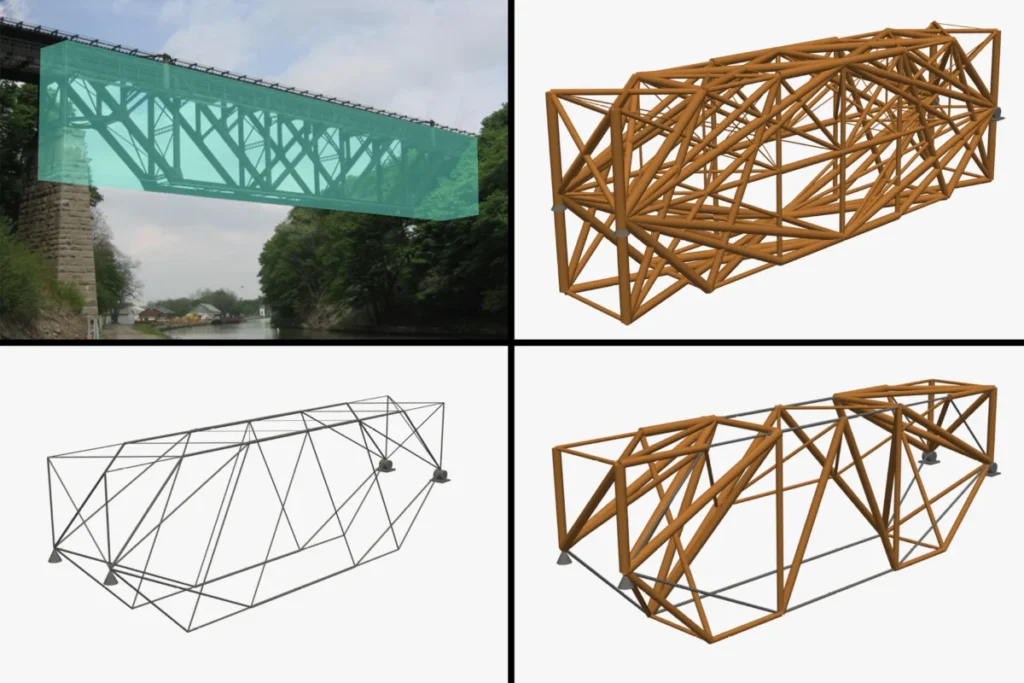
To validate their approach, the MIT researchers applied their framework to design various truss structures for buildings and bridges, using steel, wood, and combinations of both. They compared designs generated by their constrained topology optimization with those produced by conventional, unconstrained methods. The results showcased dramatic differences in the final structural configurations, highlighting how the applied constraints fundamentally altered the construction approach.
As a practical illustration, they used the Lockport "Upside-Down Bridge" near Buffalo, New York, as a case study. By applying individual constraints, such as a minimum angle for part connections or minimum part sizes, to the bridge’s truss design, they were able to observe the precise impact of each constraint on the resulting structural form. This granular analysis helps engineers understand the trade-offs involved in specifying different constructability requirements.
The team also explored the environmental and structural implications of using different material combinations. They designed identical truss structures using only wood, only steel, and a hybrid of wood and steel. These analyses revealed distinct performance characteristics and carbon footprints for each option.
"We saw how the system knew that you could design a bridge of pure steel, but that might not be best from a carbon standpoint," Schemmer noted. "Or you could design a bridge out of purely timber, but that might not be the strongest. But these materials can work together, so you use timber for the carbon savings and steel where you need extra strength, and there’s a balance you can find in these structures." This demonstrates how the framework can guide engineers toward optimal solutions that balance structural integrity, cost-effectiveness, and environmental sustainability.
Computational Feasibility and Future Trajectories
While the researchers acknowledge that their approach is more computationally intensive than some existing methods, they emphasize its practical feasibility for most civil engineering firms. Their experiments were successfully conducted using a MacBook Pro, suggesting that the computational demands are manageable with readily available hardware.
"It’s computationally a little tougher to solve, but there’s a lot of tools coming out nowadays that make these problems a lot more feasible," Schemmer commented. "This approach has been avoided by industry in the past, but now we think it’s a practical way to solve problems dealing with variable constraints."
The MIT team believes that with increased computational resources, their framework could be scaled to design significantly larger and more complex structures, extending beyond homes, small buildings, and bridges to encompass a wider range of infrastructure projects.
Looking ahead, Professor Carstensen indicated that the team plans to construct scaled-down physical prototypes of structures designed by their model. This will serve to further validate the accuracy of their computational predictions and the real-world performance of the optimized designs. They also aim to incorporate additional constraints into their model to further streamline its integration into the workflows of civil engineers tasked with designing the world’s infrastructure.
"As a structural engineer by training, I was never taught how to design for low-carbon," Schemmer reflected. "To tackle a problem as big as climate change, addressing the built environment is a great place to start. One of the most tangible things we can do is work at the layer of construction, at the design stage, because that’s a fundamental step that we can control. There’s a lot of decisions we make early on that lead us to use extra material we don’t need."
This research, supported by the MIT Morningside Academy for Design, represents a significant stride towards a more sustainable construction industry. By making advanced optimization techniques practical for everyday engineering, MIT’s innovation has the potential to dramatically reduce material consumption and, consequently, the carbon footprint of the built environment, offering a tangible pathway to mitigate climate change. The integration of constructability into the design process is not merely an engineering improvement; it is a crucial step towards building a more sustainable future.