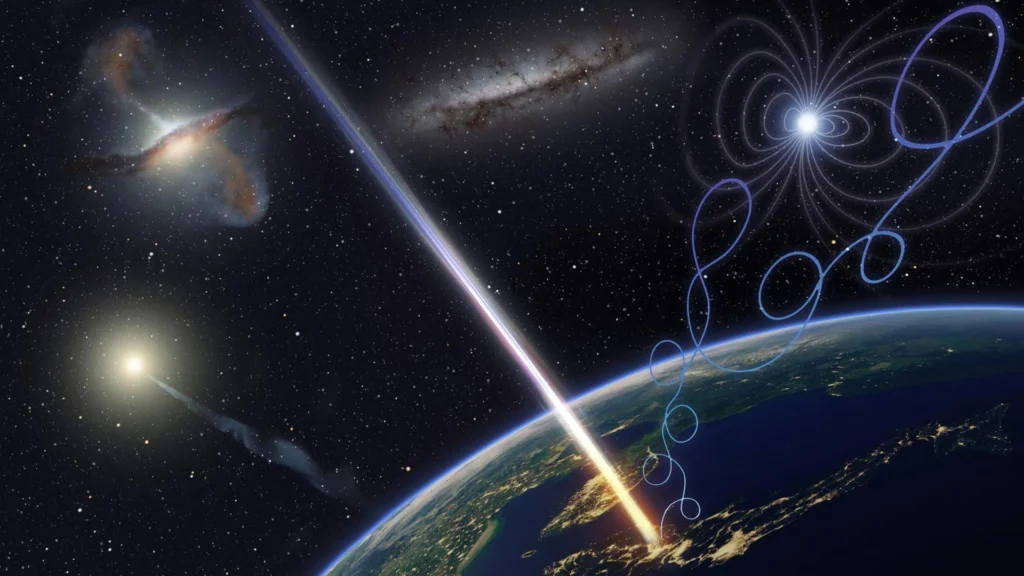
The vast expanse of the cosmos remains the ultimate laboratory for high-energy physics, hosting phenomena that dwarf the capabilities of any human-engineered technology. Among the most enduring enigmas in modern astrophysics is the origin of ultrahigh-energy cosmic rays (UHECRs)—subatomic particles that traverse intergalactic space at nearly the speed of light, carrying kinetic energies so immense they defy standard explanations. A groundbreaking study led by researchers at Penn State University, recently published in the prestigious journal Physical Review Letters, proposes a transformative theory: the most energetic of these particles may not be simple protons or light atoms, but rather ultraheavy atomic nuclei, potentially heavier than iron. This discovery offers a compelling solution to the "Amaterasu particle" mystery and provides a new framework for understanding the universe’s most violent cataclysms.
The Detection of the Amaterasu Particle
In May 2021, the Telescope Array project, a vast network of surface detectors covering 700 square kilometers in the high desert of Utah, registered an event that sent shockwaves through the scientific community. A single subatomic particle struck the Earth’s atmosphere with an energy of approximately 244 exa-electron volts (EeV). To put this in perspective, one EeV is a quintillion (1,000,000,000,000,000,000) electron volts. This single particle carried the kinetic energy equivalent to a professional tennis ball served at 95 miles per hour, condensed into a space smaller than an atom.
Named the "Amaterasu particle" after the sun goddess in Japanese mythology, the event represents one of the most powerful cosmic-ray detections in history. It stands second only to the legendary "Oh-My-God" particle, which was recorded in 1991 with an energy of 320 EeV. However, the Amaterasu particle presented a unique conundrum. When astrophysicists traced its trajectory back into space, they found it originated from the "Local Void"—a desolate region of space bordering our Milky Way galaxy that contains almost no visible galaxies, stars, or known high-energy sources.
The absence of a clear source led to two possibilities: either the particle was deflected significantly by magnetic fields, or our understanding of how these particles travel through space is incomplete. The Penn State research suggests the latter, focusing on the chemical composition of the rays themselves as the key to unlocking their origin.
A Chronology of Cosmic Ray Discoveries
The quest to understand cosmic rays has spanned over a century, marked by incremental breakthroughs and recurring mysteries.
- 1912: Victor Hess discovered cosmic radiation via a high-altitude balloon flight, proving that ionizing radiation enters the atmosphere from outer space rather than from the Earth itself.
- 1962: The first ultrahigh-energy cosmic ray, exceeding 10 EeV, was detected at the Volcano Ranch array in New Mexico. This proved that the universe was capable of accelerating particles to energies far beyond what could be explained by local galactic sources like supernovae.
- 1966: Kenneth Greisen, Georgiy Zatsepin, and Vadim Kuzmin independently calculated the "GZK limit." They theorized that UHECRs should interact with the Cosmic Microwave Background (CMB)—the afterglow of the Big Bang—causing them to lose energy. This implied that any particle detected above 50 EeV must have originated from a relatively "local" source within 300 million light-years.
- 1991: The "Oh-My-God" particle was detected by the University of Utah’s Fly’s Eye experiment. At 320 EeV, it shattered the GZK limit, sparking decades of debate over whether the physics of the CMB interaction was understood or if the sources were much closer than believed.
- 2021/2023: The detection and subsequent analysis of the Amaterasu particle (published in late 2023) confirmed that the Oh-My-God event was not an anomaly, but a recurring feature of the high-energy universe.
The Physics of Ultraheavy Nuclei
Traditionally, scientists assumed that UHECRs were mostly protons (hydrogen nuclei) or light nuclei like helium. However, the Penn State team, led by Professor Kohta Murase, utilized advanced computer simulations to model the behavior of much heavier elements.
"Ultrahigh-energy cosmic rays can only be accelerated by some of the most powerful sources in the universe," explained Murase, a professor of physics, astronomy, and astrophysics at the Penn State Eberly College of Science. "When we detect individual cosmic-ray particles such as the Amaterasu particle here on Earth, we can often use their energies, arrival directions and expected magnetic deflections to infer their possible cosmic sources."
The team’s simulations revealed a critical distinction: at extreme energy levels (exceeding 100 EeV), ultraheavy nuclei—those with more protons and neutrons than iron—lose their energy more slowly than their lighter counterparts. While protons are easily "slowed down" by their interactions with the CMB photons, ultraheavy nuclei possess a different cross-section of interaction, allowing them to traverse greater intergalactic distances while maintaining their extreme kinetic energy.
This finding suggests that the Amaterasu particle might have originated from a much more distant source than previously thought. If it were an ultraheavy nucleus, it could have survived a journey across millions of light-years of "void" space, whereas a proton would have dissipated its energy long before reaching the Utah detectors.
Violent Cosmic Furnaces: Potential Sources of Acceleration
The existence of ultraheavy nuclei at such energies implies the existence of "cosmic accelerators" of unimaginable power. To strip the electrons from a heavy atom and accelerate its nucleus to nearly the speed of light requires environments with extreme magnetic fields and gravitational forces.
Professor Murase and his collaborators identified several primary candidates for these accelerators:
- Binary Neutron Star Mergers: When two neutron stars—the ultra-dense remnants of exploded stars—spiral into each other, they create a kilonova. This event is not only a source of gravitational waves but is also believed to be a primary site for the "r-process" nucleosynthesis, which creates heavy elements like gold, platinum, and uranium.
- Collapsars and Hypernovae: The death of a massive, rapidly rotating star can lead to the formation of a black hole. The resulting explosion, or hypernova, can power relativistic jets that serve as perfect "launchpads" for heavy atomic nuclei.
- Magnetars: These are neutron stars with magnetic fields a quadrillion times stronger than Earth’s. The rotational energy of a magnetar can, in theory, accelerate particles to EeV levels.
The research notes that these sources are often associated with gamma-ray bursts (GRBs), the most luminous electromagnetic events in the universe. If the highest-energy cosmic rays are indeed ultraheavy nuclei, then the frequency of these cosmic explosions matches the observed arrival rates of particles like Amaterasu.
Analyzing the North-South Discrepancy
One of the most intriguing aspects of UHECR research is the statistical difference observed between the Northern and Southern Hemispheres. The Telescope Array in Utah (Northern Hemisphere) and the Pierre Auger Observatory in Argentina (Southern Hemisphere) have reported slight variations in the energy spectrum and the arrival directions of these particles.
The Penn State study posits that if ultraheavy nuclei contribute significantly to the cosmic ray flux, it could explain these discrepancies. Heavy nuclei are more susceptible to deflection by the Milky Way’s magnetic fields due to their higher nuclear charge (Z). This means that their apparent arrival direction might be "smeared" or shifted. Because the magnetic field of our galaxy is asymmetrical, the way these particles are deflected would vary depending on whether they are entering from the north or the south, leading to the different patterns observed by global observatories.
Future Observatories and Global Collaboration
The research conducted by Murase and his team, which included collaborators from the Yukawa Institute for Theoretical Physics in Japan and Virginia Tech, sets a new agenda for the next generation of astrophysical observatories.
"The origins and acceleration mechanisms of ultrahigh-energy cosmic rays have been among the biggest mysteries in the field for more than 60 years," Murase noted. To solve this mystery, the scientific community is looking toward upgraded facilities.
- AugerPrime: An upgrade to the Pierre Auger Observatory in Argentina, AugerPrime is designed specifically to improve "mass composition" sensitivity. By better distinguishing between protons, iron, and ultraheavy nuclei, it will provide the empirical data needed to confirm the Penn State simulations.
- Global Cosmic Ray Observatory (GCOS): A proposed next-generation facility that would provide full-sky coverage with unprecedented sensitivity, allowing scientists to map the "cosmic ray sky" with the same precision we currently have for the electromagnetic (light) sky.
Broader Implications for Modern Science
The realization that the universe may be bombarding Earth with ultraheavy atomic nuclei from distant black hole births or neutron star collisions has implications beyond just astrophysics. It touches upon the fundamental laws of particle physics and the history of matter in the universe.
If these particles are indeed ultraheavy nuclei, they represent a direct sample of matter from the most extreme environments in existence—places where the laws of physics are pushed to their breaking points. Studying them allows scientists to probe the nature of the "r-process" and the evolution of heavy elements that eventually make up planets and, ultimately, life itself.
Furthermore, the study highlights the necessity of multi-messenger astronomy—the practice of combining data from light (photons), gravitational waves, neutrinos, and cosmic rays. By aligning the detection of an ultraheavy cosmic ray with a gravitational wave signal from a neutron star merger, scientists could finally pinpoint the exact "smoking gun" of these cosmic bullets.
As researchers refine their simulations and new detectors come online, the mystery of the Amaterasu particle may transition from an unexplained anomaly to a cornerstone of our understanding of the high-energy universe. The Penn State research has provided the roadmap; now, the scientific community must follow the trail of these ultraheavy ghosts across the intergalactic void.