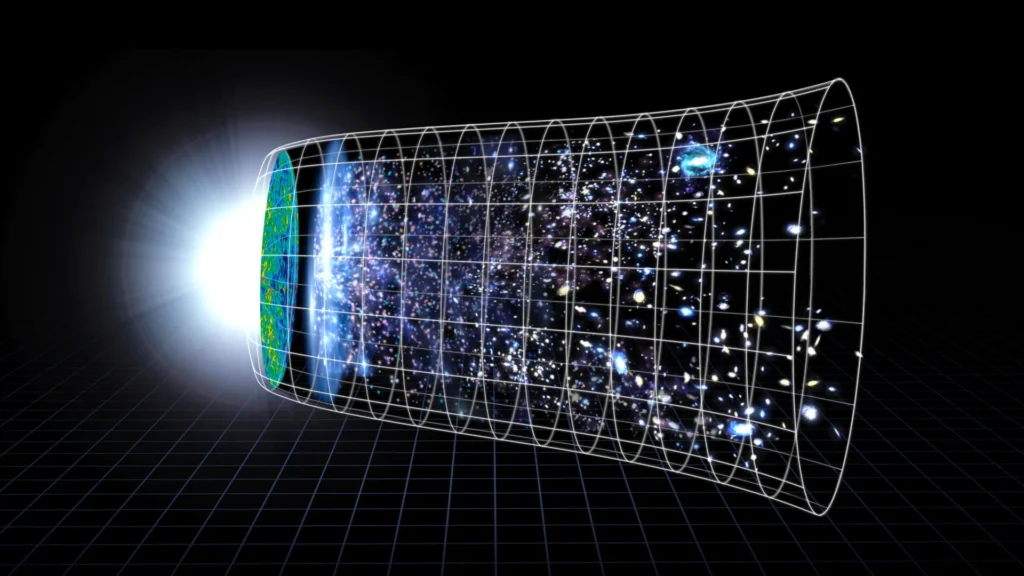
The universe, a vast and dynamic entity, presents astronomers with a profound challenge when it comes to mapping its distances: space itself is not a static backdrop but a continuously expanding canvas. This cosmic inflation means that light, the messenger from distant celestial bodies, embarks on a journey through a universe that is perpetually stretching. Galaxies continue to emit photons, but these ancient beams of light can spend billions of years traversing the cosmos before reaching our telescopes. During this immense voyage, the fabric of spacetime between these galaxies and our vantage point on Earth is continually growing, increasing the average separation between them on grand scales.
This inherent dynamism fundamentally alters our perception of cosmic distances. When a telescope captures the light from a galaxy billions of light-years away, the image we observe is not a snapshot of its current location. Instead, it is a portrait of that galaxy as it appeared when the light began its arduous journey. To accurately estimate its present distance, astronomers must employ sophisticated cosmological models that meticulously account for the universe’s expansion throughout the light’s travel time.
The Prevailing Cosmological Framework: LCDM and Its Implications
The leading cosmological model currently guiding these estimations is the Lambda-CDM (LCDM) model. This framework incorporates two enigmatic components: cold dark matter, an invisible form of matter that exerts gravitational influence, and dark energy, a mysterious force driving the accelerated expansion of the universe. While a comprehensive discussion of the intricate strengths and limitations of the LCDM model warrants its own dedicated exploration, it is important to note that alternative cosmological theories, while offering different nuances, do not drastically alter the fundamental principles governing distance measurements in an expanding universe as described here.
The Observable Horizon: A Paradoxical Panorama
Our understanding of the universe’s age, estimated to be approximately 13.77 billion years, is often juxtaposed with the observation that the most distant regions we can currently perceive extend to roughly 45 billion light-years. This apparent paradox arises directly from the continuous expansion of space. During the entire duration that light from these remote regions has been traveling towards us, the universe has been stretching, effectively carrying those regions further away from us.
This boundary, beyond which we cannot observe, is known by several terms: the particle horizon, the cosmological horizon, or the comoving horizon. Regardless of the nomenclature adopted, it delineates the outer perimeter of our observable bubble, marking the greatest cosmic distances accessible to our current observational capabilities. The seeming contradiction – a universe of 13.77 billion years old with observable distances of 45 billion light-years – is resolved by understanding that the universe’s expansion can, and does, outpace the speed of light over vast stretches of space.
The Physics of Expansion: Transcending Light Speed Limits
This phenomenon does not, as it might initially suggest, violate the fundamental laws of physics. The speed of light, a universal constant, imposes a limit on how quickly objects can traverse through space within a localized region. An observer, for instance, will never witness a nearby rocket ship accelerating past them at a speed exceeding that of light.
Cosmic expansion operates on a different principle. Distant galaxies are not necessarily accelerating through space in the conventional sense. Rather, it is the very fabric of spacetime between us and those galaxies that is expanding. Special relativity, which governs the behavior of objects moving through space, does not impose the same restrictions on the rate at which large-scale distances across the universe can increase.
Astronomers possess a method for estimating the speed at which a galaxy is receding from us: measuring its redshift. As a galaxy moves away, the wavelengths of its emitted light are stretched, shifting towards the redder end of the electromagnetic spectrum. This phenomenon, first meticulously documented by astronomer Edwin Hubble, provided crucial evidence for the expanding nature of the universe.
In an expanding universe, a general correlation exists: the more distant a galaxy, the faster it recedes. This is because a greater volume of expanding space lies between that galaxy and our observational point. More intervening space translates to a larger distance that can be stretched over time. The theoretical point at which galaxies begin to recede from us faster than the speed of light is known as the Hubble distance, which is currently estimated to be around 13.77 billion light-years.
Glimpses of the Farthest Reaches: Light’s Long Journey and Cosmic Horizons
The ability to observe galaxies that lie beyond the Hubble distance is a testament to the temporal nature of light. The light reaching us today from these extremely distant galaxies was emitted billions of years ago, at a time when those galaxies were significantly closer to our region of the universe. Furthermore, it is conceivable that we may, in the future, receive light from galaxies located even farther away, provided that their light commenced its journey towards us when they were within a closer proximity.
However, there exists an ultimate cosmic boundary known as the cosmological event horizon. This horizon, distinct from the event horizon of a black hole, currently lies approximately 17 billion light-years away. Any light emitted at this present moment from beyond this boundary will, irrevocably, never reach us, irrespective of how long we wait. The relentless expansion of space will perpetually increase the distance, rendering it impossible for such light to traverse the ever-growing chasm.
Dark Energy’s Influence: A Vanishing Frontier
The accelerating expansion of the universe, a phenomenon attributed to dark energy, exacerbates this cosmic separation. The cosmological event horizon, while a dynamic entity, is projected to expand in the future, eventually approaching a maximum distance of roughly 60 billion light-years.
Even with this expansion, our ability to observe all objects within this projected horizon will be limited. Light originating from the most remote galaxies will undergo such extreme stretching of its wavelengths that it will effectively vanish from our observable spectrum, becoming undetectable.
In approximately 100 billion years, a profound cosmic transformation is anticipated: every galaxy beyond our immediate galactic neighborhood, the Local Group, is predicted to fade from sight, lost to us forever. Future inhabitants of the universe will likely experience a cosmos that appears significantly smaller and more sparsely populated than the one we are capable of observing today. This ongoing cosmic evolution raises profound questions about the future of astronomical observation and humanity’s place within an ever-changing universe.
The implications of this cosmic expansion are far-reaching. For cosmologists, it necessitates continuous refinement of our models and observational techniques. The search for evidence of dark energy and its precise properties remains a paramount objective, as it holds the key to understanding the ultimate fate of the universe.
For the broader public, these discoveries offer a humbling perspective on our place in the grand cosmic narrative. The vastness of space and time, coupled with the dynamic nature of the universe, underscores the profound mysteries that still lie beyond our current grasp. The ongoing quest to unravel these cosmic enigmas continues to push the boundaries of human knowledge and inspire a deeper appreciation for the universe we inhabit. The constant stretching of space means that even as we gaze at the stars, the universe is subtly, yet irrevocably, changing our cosmic address book, pushing the most distant frontiers further and further into the unreachable unknown. This ongoing cosmic ballet of expansion and light travel dictates not only what we can see but also how we understand our past and contemplate our future within this grand, evolving tapestry.