Scientific advancements rarely erupt into existence fully formed. Instead, they typically emerge from a crucible of persistent research and incremental progress, where the extraordinary gradually transitions into the commonplace. Now, researchers stand at a potential inflection point in this evolutionary trajectory. A collaborative effort between the University of Michigan and the Air Force Research Laboratory (AFRL) has culminated in the successful demonstration of 3D printing intricate tubular structures. These engineered materials possess a unique internal geometry that enables them to actively suppress vibrations with a level of efficacy previously unseen in naturally occurring substances. These innovative creations fall under the umbrella of mechanical metamaterials, a class of engineered substances whose remarkable properties are derived not from their chemical composition, but from their meticulously designed structure.
The potential applications for materials capable of blocking or significantly reducing vibrations are vast and far-reaching, poised to revolutionize numerous sectors including transportation, construction, aerospace, and advanced manufacturing. The findings, detailed in the latest issue of Physical Review Applied, represent a significant real-world manifestation of decades of theoretical exploration and sophisticated computer modeling. This work has moved beyond abstract concepts to produce tangible structures that can passively disrupt the propagation of vibrations.
"The true novelty lies in the realization that we can actually fabricate these complex structures," stated James McInerney, a research associate at AFRL and a key contributor to the project. McInerney previously served as a postdoctoral fellow at the University of Michigan, working under the guidance of Xiaoming Mao, a distinguished professor of physics and a co-author of the new study. "We are optimistic that these advancements can be harnessed for beneficial purposes, with vibration isolation being a primary focus in this particular instance."
This groundbreaking research received substantial backing from governmental agencies dedicated to fostering technological innovation. Partial funding was provided by the Defense Advanced Research Projects Agency (DARPA) and the Office of Naval Research, underscoring the strategic importance of such advanced material science. Further support was extended through the U.S. National Research Council Research Associateship Program, expertly administered by the National Academies of Sciences, Engineering, and Medicine, highlighting a commitment to nurturing scientific talent and cutting-edge research.
The collaborative team included Serife Tol, an associate professor of mechanical engineering at the University of Michigan, who brought her expertise in mechanical design and analysis. Othman Oudghiri-Idrissi from the University of Texas contributed to the theoretical underpinnings of the research. The practical fabrication and experimental validation benefited from the contributions of Carson Willey and Abigail Juhl from AFRL, ensuring a seamless transition from concept to physical realization.
A Paradigm Shift: Geometry Over Chemistry
Professor Mao elaborated on the fundamental shift in material science that this research represents. "For centuries, humanity has primarily enhanced materials by altering their chemical makeup. Our work, however, is rooted in the burgeoning field of metamaterials, where it is the intricate geometry – rather than the chemical composition – that bestows upon them unusual and highly useful properties," Mao explained. "These fundamental geometric principles are scalable, applicable from the nanoscale to the macroscale, thereby imparting extraordinary robustness and functionality to the materials we create."
This approach marks a significant departure from traditional material science, which has historically focused on manipulating atomic and molecular structures. Metamaterials, by contrast, leverage the power of design and arrangement. The team’s work integrates principles from classical structural engineering, modern physics, and advanced manufacturing techniques, notably additive manufacturing, commonly known as 3D printing.
The Dawn of Precision Manufacturing
"There is a very real probability that we will soon be able to manufacture materials from the ground up with an astonishing degree of precision," McInerney emphasized. "The overarching vision is to create materials with highly specific architectures, prompting us to ask critical questions: What novel functionalities can we unlock with such precisely engineered substances? How can we develop materials that are fundamentally different from those we currently rely upon?"
As Professor Mao articulated, the innovation lies not in altering a material’s intrinsic chemical properties but in exploring how controlled manipulation of shape and structure at a fine scale can yield entirely new and advantageous mechanical characteristics. This principle is not entirely alien to nature. Biological systems often exhibit remarkable properties due to their geometric design; for instance, human bones and the shells of plankton achieve exceptional strength and resilience through intricate internal structures, despite being composed of relatively simple materials. By employing advanced technologies like 3D printing, scientists can now meticulously replicate and even enhance these natural design strategies in a wide array of materials, including metals and polymers, to achieve effects that were previously unattainable.
"The objective is not to replace conventional materials like steel and plastics entirely, but rather to utilize them more effectively and intelligently by integrating them into these novel, architectured designs," McInerney clarified.
Bridging Historical Insights with Modern Innovation
While this research is undeniably at the forefront of technological innovation, its conceptual foundations are deeply rooted in historical scientific inquiry. One significant influence is the work of James Clerk Maxwell, the eminent 19th-century physicist. Though renowned for his seminal contributions to electromagnetism and thermodynamics, Maxwell also explored the realm of mechanics. His investigations led to the development of design principles for creating stable structures composed of repeating subunits, known as Maxwell lattices, which offer inherent structural integrity.
Another crucial conceptual pillar for the current study emerged in the latter half of the 20th century, with the realization that intriguing and often perplexing material behaviors could be observed at the edges and boundaries of substances. This led to the birth of topology as a field of study relevant to materials science, a discipline that continues to actively investigate these phenomena and explore their practical applications.
"Approximately a decade ago, a seminal publication demonstrated that Maxwell lattices could exhibit a topological phase," McInerney recalled. This discovery opened up new avenues for understanding how the arrangement of matter could lead to robust and unique physical properties.
From Theory to Tangible Reality: The Kagome Tube
Over the ensuing years, McInerney and his colleagues have diligently explored the implications of this topological insight, particularly as it pertains to vibration isolation. Their efforts have culminated in a sophisticated model that explains the underlying behavior and provides a blueprint for designing real-world objects exhibiting these properties. The recent success in fabricating such objects using 3D-printed nylon serves as definitive proof of their model’s advanced stage of development.
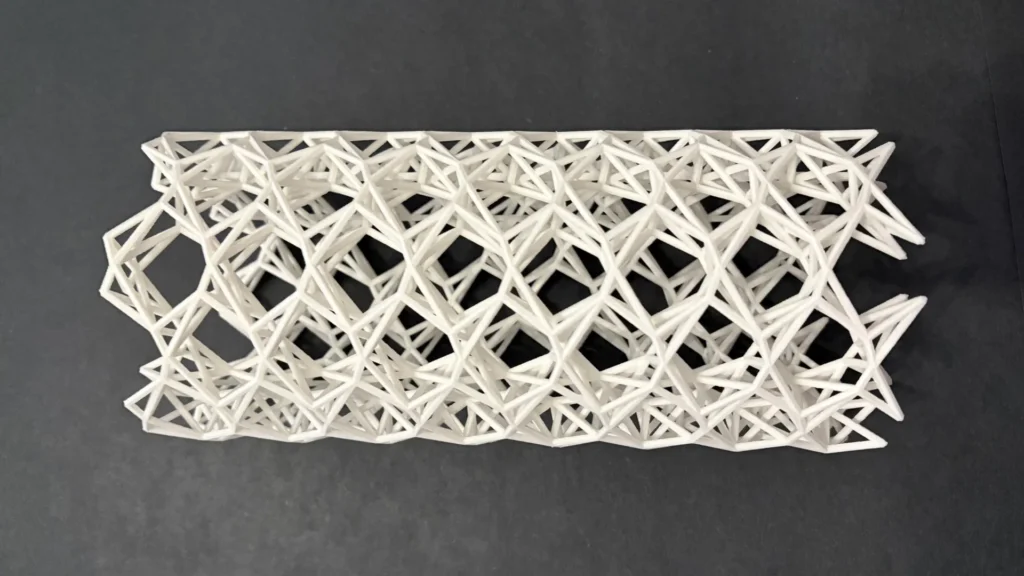
A visual inspection of these structures reveals the significant manufacturing challenges they presented until the advent of advanced 3D printing. They bear a striking resemblance to a chain-link fence that has been intricately folded and then rolled into a cylindrical form, complete with interconnected inner and outer layers. Physicists have termed these specific configurations "kagome tubes," a nomenclature derived from the traditional Japanese basket weaving technique that utilizes similar interlocking geometric patterns.
However, the researchers acknowledge that this achievement represents merely the initial step in unlocking the full potential of these novel structures. A critical trade-off has been identified: the greater a structure’s efficacy in suppressing vibrations, the lesser its capacity to support weight. This presents a significant engineering challenge, potentially an unacceptable compromise for many practical applications. Nevertheless, it also highlights intriguing fundamental questions and opportunities for further research.
Navigating Uncharted Territory: Testing and Characterization
As these unprecedented structures move from laboratory curiosities to potential real-world applications, a parallel need arises for the development of new standards and methodologies for their testing, characterization, and assessment. This represents a frontier that excites McInerney and his colleagues.
"Because we are dealing with such novel behaviors, we are still in the process of uncovering not only the theoretical models but also the most effective ways to test these materials, the conclusions we can reliably draw from those tests, and how to integrate these findings into practical design processes," McInerney explained. "I believe these fundamental questions must be thoroughly addressed before we can definitively answer questions pertaining to specific applications. This is an exciting challenge, as it pushes the boundaries of materials science and engineering."
The implications of this work extend beyond immediate applications. The ability to precisely control material properties through geometric design opens up possibilities for creating structures that are not only lightweight and vibration-resistant but also possess tailored acoustic insulation, enhanced impact absorption, or even controlled energy dissipation. The principles demonstrated in these kagome tubes could be adapted to a wide range of materials and scales, potentially leading to quieter aircraft, more stable bridges, smoother high-speed trains, and more resilient electronic devices.
The successful demonstration of these complex, geometrically engineered structures through 3D printing signifies a pivotal moment. It bridges theoretical physics and advanced manufacturing, paving the way for a new generation of materials with properties previously confined to the realm of imagination. The continued exploration of these metamaterials promises to redefine the limits of what is possible in material science and engineering, ushering in an era of unprecedented control over the physical world.