Mercedes-Benz is poised to reignite a beloved chapter in its storied G-Class lineage, announcing the revival of the G-Class Cabriolet almost a decade after the last open-top iteration of the formidable off-roader was discontinued. This significant development signals a strategic move by the German luxury manufacturer to tap into a niche market that cherishes both extreme capability and uninhibited open-air motoring. The return of the Cabriolet is not merely a nostalgic nod to the past but a calculated expansion of the G-Class portfolio, catering to a discerning clientele seeking exclusivity and a unique driving experience.
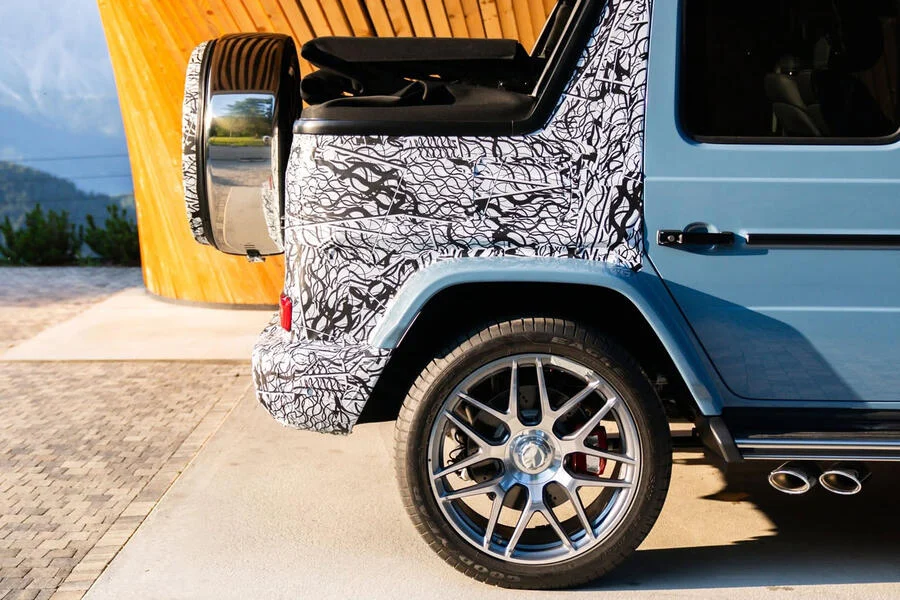
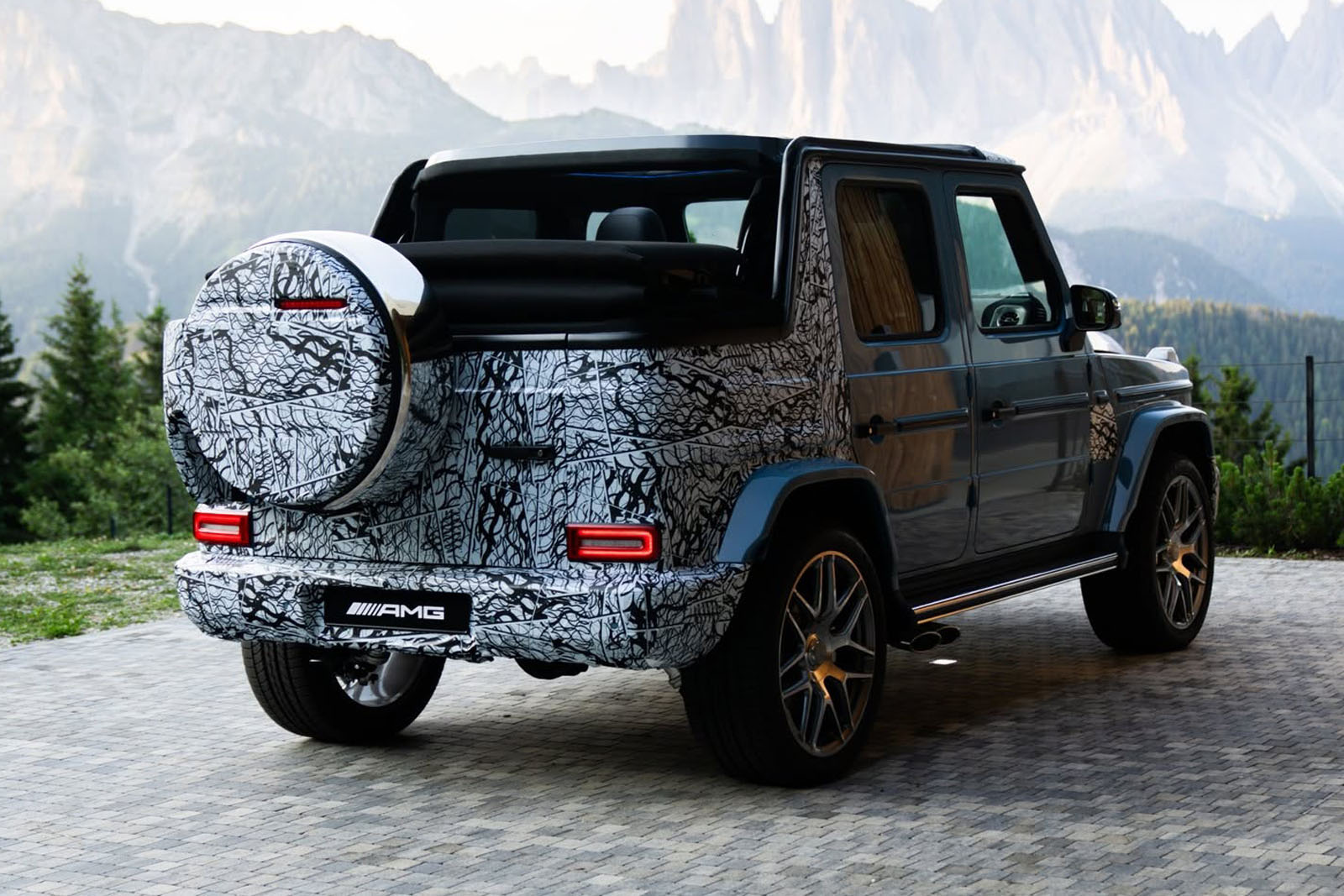
Recent spy shots and leaked images offer a tantalizing glimpse into the new G-Class Cabriolet, showcasing its distinctive silhouette with the fabric roof elegantly stowed. The visual evidence suggests a design that thoughtfully integrates the retractable roof mechanism, a feat that has historically presented engineering challenges for such robust vehicles. Crucially, the folded fabric top occupies the rear section of the vehicle, a design choice that inherently alters the cargo space compared to its hard-top counterpart, the regular G-Class. This adaptation is a direct consequence of the Cabriolet’s fundamental structural modifications required to accommodate the folding roof, a trade-off that buyers in this segment are typically willing to accept for the privilege of open-air driving.
While Mercedes-Benz has maintained a deliberate silence regarding the precise technical specifications of the new G-Class Cabriolet, the available imagery provides compelling clues. The presence of a distinctly aggressive AMG derivative, characterized by its prominent side-exit exhausts, strongly suggests that the top-tier performance variant will be a cornerstone of the new model range. This is consistent with the established G-Class philosophy, where AMG versions represent the pinnacle of both power and exclusivity. For context, the current AMG G63, the benchmark for the regular G-Class, is propelled by a potent 577 brake horsepower (bhp) twin-turbocharged V8 petrol engine. It is highly probable that the Cabriolet will either adopt a similar powertrain or a closely related iteration, ensuring that its open-top nature does not compromise the exhilarating performance expected of an AMG G-Class.
The absence of an official launch date fuels anticipation, but the fact that the drop-top vehicle is already undergoing rigorous testing and represents a variant of a model currently in production strongly indicates an imminent arrival. Industry analysts and enthusiasts alike are speculating that the G-Class Cabriolet could be unveiled and available for purchase within the coming months. This accelerated development cycle is not unusual for Mercedes-Benz, particularly when leveraging an existing and highly successful platform like the current generation G-Class, which underwent a significant overhaul in 2018, marking its first complete redesign since its inception in 1979.
The exclusivity and bespoke nature of the G-Class Cabriolet are expected to be reflected in its pricing. It is widely anticipated that the new model will command a substantial premium over the already high-priced current G-Class models, which currently start in the UK at over £130,000. This price differential is justifiable, considering the complex engineering, specialized manufacturing processes, and limited production volumes typically associated with open-top versions of such high-performance, body-on-frame SUVs. The premium pricing strategy aligns with Mercedes-Benz’s positioning of the G-Class as an ultra-luxury icon, and the Cabriolet variant will undoubtedly occupy the uppermost echelon of this exclusive segment.
The history of the G-Class is intrinsically linked to its open-top variants, with the Cabriolet being an integral part of the original lineup introduced in 1979. These early two-door, short-wheelbase models offered a raw, unadulterated off-roading experience, a testament to the G-Wagen’s utilitarian roots. This open-top tradition continued for decades, with production of these early Cabriolets extending until 2013, cementing their status as cherished collector’s items among off-road enthusiasts and vintage Mercedes-Benz aficionados. The enduring appeal of these models underscores the market’s appetite for a modern interpretation of the G-Class Cabriolet.
Beyond the standard Cabriolet, Mercedes-Benz has also explored more extravagant open-top concepts within the G-Class family. The ultra-luxury four-door G-Class Maybach G650 Landaulet, introduced in 2017, stands as a prime example. This limited-edition marvel, produced in a mere 99 units, was a tour de force of opulence and engineering prowess. It featured a unique configuration with a fixed front cabin and a retractable fabric roof over the rear seating area, effectively creating a "Landaulet" style. Powered by a colossal 621 bhp twin-turbocharged 6.0-litre V12 petrol engine and based on the high-riding G63 4×4², the Maybach G650 Landaulet was an automotive statement piece. Its price tag, approaching £600,000 in the UK, positioned it as one of the most exclusive and expensive SUVs ever produced, highlighting Mercedes-Benz’s capability to blend extreme off-road capability with unparalleled luxury and bespoke design. The success and allure of the Landaulet, despite its astronomical price, likely influenced the decision to revisit a more broadly appealing, albeit still exclusive, G-Class Cabriolet.
Engineering Challenges and Market Appeal
The revival of the G-Class Cabriolet presents a fascinating engineering challenge. Integrating a robust and reliable convertible roof mechanism into the G-Class’s signature boxy, ladder-frame chassis requires meticulous design and advanced manufacturing techniques. Unlike unibody construction found in most modern SUVs, the G-Class’s traditional body-on-frame architecture, crucial for its legendary off-road prowess, necessitates significant structural reinforcement to compensate for the removal of the fixed roof. This ensures that the vehicle maintains its torsional rigidity and structural integrity, vital for both on-road handling and off-road durability.
The folded fabric top’s placement, occupying the rear, also implies a revised interior layout. While the exact configuration remains under wraps, it is probable that the rear seating capacity might be slightly compromised compared to the hard-top G-Class, or the overall interior space might be reconfigured to accommodate the roof mechanism. This is a common compromise in convertible vehicles, where the pursuit of open-air driving often necessitates a re-evaluation of practicality.
The target market for the G-Class Cabriolet is likely to be a highly affluent and discerning demographic. These individuals are not only seeking a vehicle with exceptional off-road credentials but also one that offers a distinctive statement of individuality and luxury. The open-top G-Class caters to those who desire the commanding presence and go-anywhere capability of the G-Wagen, combined with the exhilaration and sensory experience of open-air motoring. This segment often values exclusivity, heritage, and the ability to stand out from the crowd.
Historical Context and Precedent
The G-Class has a rich and multifaceted history, originating as a military vehicle in the late 1970s before evolving into a civilian icon. Its utilitarian origins are evident in its robust construction, permanent four-wheel drive, and locking differentials – features that have earned it unparalleled respect in the off-road community. The introduction of convertible variants early in its life cycle demonstrated Mercedes-Benz’s intention to offer a versatile vehicle that could adapt to various environments and user needs.
The discontinuation of the G-Class Cabriolet in 2013 left a void for enthusiasts who appreciated its unique blend of ruggedness and open-air freedom. The intervening years have seen a significant shift in the automotive landscape, with SUVs and luxury vehicles experiencing unprecedented demand. This trend, coupled with a renewed appreciation for automotive heritage and niche models, provides a fertile ground for the return of the G-Class Cabriolet.
The success of other high-end convertible SUVs, such as the Range Rover Evoque Convertible (though positioned at a lower price point and with a different target audience), suggests that there is a demonstrable market for such vehicles, even if they remain niche. The G-Class Cabriolet, however, will occupy a far more exclusive and performance-oriented space within this segment.
Potential Powertrain and Performance Expectations
Given the AMG badging observed in the spy shots, the new G-Class Cabriolet is expected to offer formidable performance. While the exact engine specifications are yet to be confirmed, it is reasonable to infer that it will be equipped with a powerful V8 engine, likely mirroring or closely related to the unit found in the AMG G63. This would translate to an output in the region of 577 bhp, delivering blistering acceleration and a commanding presence on the road.
The inclusion of AMG performance in a convertible G-Class raises interesting questions about its intended use. While the G-Class is renowned for its off-road capabilities, the Cabriolet’s focus might lean more towards luxurious open-air cruising and exhilarating on-road performance, while retaining the inherent off-road DNA. The engineering required to maintain the off-road prowess of a G-Class while accommodating a convertible roof would be substantial, suggesting that while capable, the Cabriolet might be optimized for a slightly different balance of attributes compared to its hard-top brethren.
Broader Implications for the G-Class Lineup
The reintroduction of the G-Class Cabriolet is more than just a single model launch; it represents a strategic deepening of the G-Class brand. By offering such a distinctive and exclusive variant, Mercedes-Benz reinforces the G-Class’s status as a lifestyle icon and a symbol of automotive achievement. This move can also serve to attract new customers to the G-Class family, those who might be drawn to the unique appeal of an open-top luxury SUV.
The success of the Cabriolet could also pave the way for further niche variants within the G-Class lineup, potentially exploring different body styles or specialized configurations that cater to specific enthusiast demands. Mercedes-Benz has a proven track record of leveraging its iconic models to create a diverse range of offerings, and the G-Class is no exception.
The G-Class Cabriolet’s arrival is a clear indication of Mercedes-Benz’s commitment to innovation and its ability to adapt to evolving market trends while honoring its heritage. It signifies a bold step into a segment that, while niche, offers significant potential for brand building and customer engagement. The confluence of extreme capability, unparalleled luxury, and the exhilaration of open-top driving promises to make the new G-Class Cabriolet a highly sought-after automotive masterpiece.