For decades, Europa, Jupiter’s enigmatic icy moon, has held a special place in the imagination of scientists and the public alike, primarily due to the tantalizing possibility of a vast, liquid water ocean hidden beneath its frigid, frozen crust. This subterranean sea has positioned Europa as one of the most compelling celestial bodies in our solar system for the search for extraterrestrial life, offering a potential environment where the fundamental ingredients for habitability—liquid water, essential chemistry, and an energy source—could converge. However, groundbreaking new research, spearheaded by Rutgers University scientist Lujendra Ojha, indicates that accessing and understanding this deep ocean may be a far more formidable challenge than previously envisioned, potentially altering the course of future astrobiological investigations.
Re-evaluating Pathways for Subsurface Water Ascent
The central question that propelled Ojha and his team’s investigation was whether water from Europa’s global ocean could indeed ascend through the moon’s formidable icy shell and accumulate in shallower, more accessible underground reservoirs. Such pockets, if they exist and are reachable, would represent a more pragmatic target for future spacecraft missions than the ocean situated miles below the surface. The study, published in the prestigious journal Nature Astronomy, employed sophisticated computer simulations to meticulously model the complex physics involved in the upward migration of water through fractures in the ice.
"The mystery we wanted to solve was whether this journey is actually possible," explained Ojha, an associate professor in the Department of Earth and Planetary Sciences at Rutgers’ School of Arts and Sciences. "Can liquid water rise from Europa’s deep ocean toward the surface without freezing along the way?"
The simulated outcomes of these intricate models have delivered a sobering conclusion: the transit of water from the deep ocean to the upper layers of Europa’s ice shell is significantly less probable than many scientific hypotheses have assumed. This finding directly challenges the prevailing notion that the moon’s internal heat, generated by tidal forces from Jupiter, could facilitate a continuous exchange of water between the deep ocean and shallower ice layers.
"There’s an icy shell, there’s water underneath, and there’s all this speculation about how that water can come from deep underground and make its way all the way up without freezing en route," Ojha elaborated. "That’s really what we think we disproved."
Implications for Shallow Water Reservoirs and Habitability Assessments
The ramifications of this research are substantial, particularly for the interpretation of future discoveries on Europa. If future missions detect liquid water in shallow subsurface pockets, this new study suggests these reservoirs may not be direct conduits to the moon’s vast global ocean. Instead, they could represent localized phenomena, formed by the melting of ice in specific regions, perhaps due to geothermal activity or other internal heat sources.
This distinction is critically important in the context of astrobiology. Scientists are drawn to Europa by the confluence of liquid water, potential chemical building blocks, and an energy source—all considered prerequisites for life as we know it. While shallow water would undoubtedly be easier to study than the deeply buried ocean, its isolation from the main reservoir could mean it offers limited insight into the conditions of Europa’s most scientifically compelling environment. If these shallower pockets are not replenished by the ocean, they might represent transient or geologically isolated systems, potentially lacking the sustained conditions necessary for life to emerge or persist.
A New Era of Exploration: Europa Clipper and JUICE on Approach
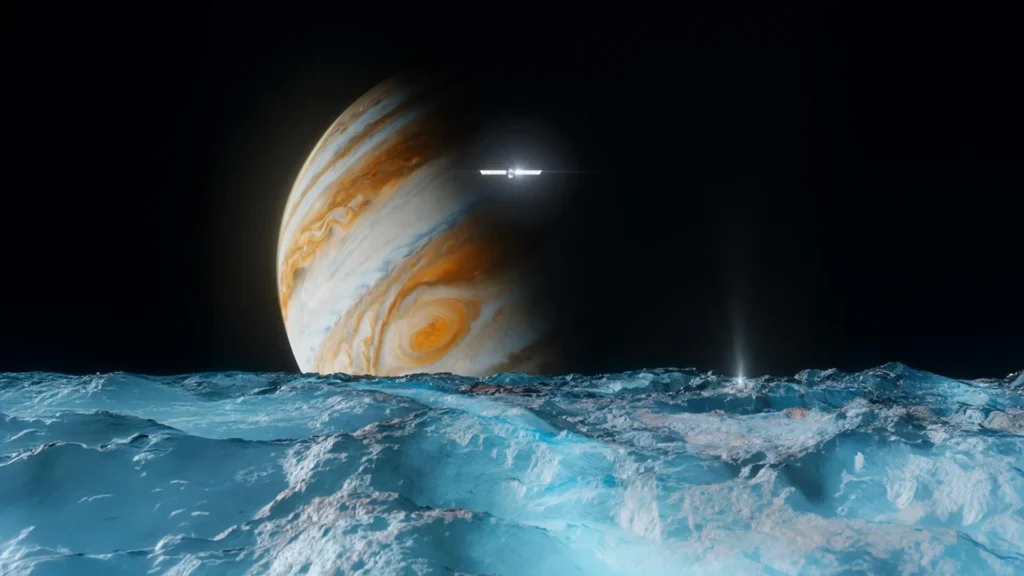
These paradigm-shifting findings emerge at a pivotal moment, as two monumental space missions are en route to the Jupiter system, poised to scrutinize Europa in unprecedented detail. NASA’s Europa Clipper mission, launched in October 2024, is on track to reach Jupiter in April 2030. Its ambitious itinerary involves orbiting the gas giant and executing 49 close flybys of Europa, meticulously gathering data on its ice shell, surface composition, and potential subsurface water. Complementing this effort is the European Space Agency’s Jupiter Icy Moons Explorer (JUICE) mission, which commenced its journey in April 2023 and is slated for arrival at Jupiter in July 2031. JUICE will conduct extensive studies of Jupiter and three of its icy moons, including Europa.
Collectively, these missions are anticipated to furnish a far more comprehensive understanding of Europa’s frozen shell, its surface chemistry, and the presence and nature of any subsurface water. The advanced radar instruments aboard Europa Clipper, for instance, hold the potential to confirm the existence of shallow liquid water reservoirs, map their dimensions, and elucidate their internal structure. However, the new research from Ojha’s team introduces a critical layer of interpretation for these forthcoming observations, suggesting that any detected shallow water may not be a direct window into the deep ocean.
The Physics of Upward Water Migration: A Turbulent Journey
The prevailing theory for how liquid water might reach Europa’s near-surface envisioned water rising through cracks and fractures in the ice shell, a process analogous to how molten rock ascends through Earth’s crust in volcanic dikes. On icy worlds, this phenomenon involving water and ice is often referred to as cryovolcanism. However, Ojha cautioned that the analogy to terrestrial volcanism has significant limitations.
"Ice and liquid water are fundamentally different than lava and the volcanoes that we see here on Earth," he stated. "I think there’s some fundamental physics that’s missing here, and so I wanted to explore that."
A key factor that previous models may have overlooked or underestimated is turbulence. Earlier simulations frequently assumed a relatively smooth and organized flow of water ascending through the ice. The Rutgers-led research, conversely, suggests a far more dynamic and chaotic movement. As water surges upward through a fracture, it is predicted to move rapidly and erratically, engaging in repeated turbulent mixing with the frigid walls of the crack. This intense interaction leads to a rapid transfer of heat from the rising water into the surrounding ice.
"This water that’s going to come up, it’s going to be turbulent," Ojha described. "It’s going to be left and right, it’s going to be up and down, it’s going to have a swirling motion. And when that happens, that liquid water is going to cool very, very fast as it approaches the surface."
The Specter of Freezing and Blockage
As this turbulent water loses heat to the surrounding ice, it can become supercooled—remaining liquid even at temperatures below its normal freezing point. In this supercooled state, tiny ice crystals, known as frazil ice, can begin to form. The simulations indicate that these crystals can accumulate over time, acting like a plug and progressively blocking the fracture.
The computer models revealed that narrow cracks could freeze shut in a matter of hours, effectively halting any upward water migration. While larger fractures might theoretically transport more water under optimal conditions, the persistent turbulence significantly undermines even these scenarios. The research team concluded that to transport a sufficient volume of water to account for some of Europa’s observed surface features, the fractures would need to be unrealistically long or present in exceptionally high numbers.
A Reimagined Europa: Isolated Water Pockets
These findings paint a picture of a Europa where any shallow liquid water discovered may have originated independently of the global ocean. Instead of being a product of deep-sea upwelling, it is more likely that these pockets formed through localized melting events within the ice shell itself, perhaps driven by transient heat sources.
"Our work suggests that Europa’s ice shell may be a stronger barrier between the ocean and the surface than previously assumed," Ojha concluded. "This helps future missions interpret what they find and better understand where to look for signs of habitability."
Background and Broader Context
Europa’s subsurface ocean has been a subject of intense scientific interest since the Voyager and Galileo missions provided compelling evidence of its existence in the late 20th century. The moon’s surface, crisscrossed by vast networks of cracks and ridges, suggested geological activity, and measurements of its magnetic field pointed to the presence of a conductive layer—likely salty liquid water—beneath the ice. The continuous tidal flexing of Europa by Jupiter’s immense gravity is believed to generate sufficient internal heat to keep this ocean in a liquid state, even at such extreme distances from the Sun. This internal heating mechanism, coupled with the presence of water and the potential for chemical interactions with a rocky seafloor, has made Europa a prime candidate in the search for life beyond Earth.
The scientific consensus has long favored the idea that the deep ocean could periodically interact with the surface, bringing essential chemicals to the ice shell and potentially creating plumes of water vapor that could be sampled by spacecraft. Missions like Europa Clipper and JUICE were designed with this very interaction in mind, equipped with instruments capable of detecting organic molecules and other biosignatures.
Timeline of Exploration and Discovery
- 1970s-1980s: Voyager 1 and 2 missions provide initial images of Europa, revealing a geologically active surface.
- 1990s-Early 2000s: The Galileo mission orbits Jupiter and collects extensive data on Europa, including evidence strongly suggesting a subsurface ocean and a non-uniform magnetic field indicative of conductive brine.
- 2010s: Growing interest leads to proposals for dedicated Europa missions. NASA’s Europa Clipper concept gains momentum.
- 2015: Lujendra Ojha and colleagues publish initial research on the potential for water to ascend through Europa’s ice.
- 2017: The Europa Clipper mission is officially approved and funded by NASA.
- April 2023: The European Space Agency’s JUICE mission is launched.
- October 2024: NASA’s Europa Clipper mission is launched.
- July 2031: JUICE is expected to arrive at Jupiter.
- April 2030: Europa Clipper is expected to arrive at Jupiter.
- Ongoing: The Nature Astronomy study by Ojha and his team is published, presenting new modeling results on water ascent.
Data and Supporting Evidence
The research by Ojha’s team relies on complex computational fluid dynamics simulations. These models incorporate various parameters, including the thermal conductivity of ice, the viscosity of water at different pressures and temperatures, and the geometry of potential fractures. While specific quantitative data from these simulations is proprietary to the research paper, the fundamental physics explored include heat transfer mechanisms, fluid dynamics under high pressure, and phase transitions of water in extreme environments. The conclusion that narrow fractures would freeze shut rapidly is based on the rate of heat loss calculated in the simulations. The requirement for unrealistically large or numerous fractures to transport significant water volumes is a direct output of these models, indicating a substantial barrier to ocean-ice shell communication.
Broader Impact and Future Directions
The implications of this research extend beyond our understanding of Europa. It prompts a re-evaluation of the habitability potential of other icy moons in the solar system, such as Enceladus (a moon of Saturn), which also harbors a subsurface ocean. If the physical mechanisms for ocean-to-surface communication are as restricted on Europa as this study suggests, it may indicate that similar challenges exist elsewhere.
For future missions, these findings will inform mission design and observational strategies. Instead of focusing solely on identifying plumes as evidence of ocean upwelling, scientists may need to consider alternative hypotheses for shallow water presence. The search for life may need to be recalibrated, potentially focusing on localized melting events within the ice shell as more accessible, albeit potentially isolated, habitats.
This research underscores the intricate and often counterintuitive nature of planetary science. While the dream of easily accessing Europa’s ocean persists, new scientific inquiry continually refines our understanding, pushing the boundaries of exploration and demanding more sophisticated approaches to answering humanity’s most profound questions about life in the universe. The upcoming missions to Jupiter will undoubtedly provide crucial data to further test and refine these new models, continuing the exciting journey of discovery at the frontiers of our solar system.