In a landmark study that bridges the gap between quantum physics and molecular chemistry, a research team led by Professor Kaifeng Wu at the Dalian Institute of Chemical Physics (DICP) of the Chinese Academy of Sciences has identified a novel energy transfer pathway known as proton shuttle-assisted triplet energy transfer (PS-TET). This discovery, published recently in the prestigious journal Nature Materials, provides a new framework for understanding and controlling the movement of energy in complex molecular systems. By demonstrating how the synchronized movement of protons and electrons can facilitate the transfer of spin-triplet states, the researchers have opened the door to significant advancements in solar energy conversion, photocatalysis, and the development of next-generation optoelectronic devices.
The fundamental interactions between electrons and protons are the bedrock of energy conversion in both biological and synthetic systems. For decades, the scientific community has studied proton-coupled electron transfer (PCET), a mechanism where the movement of an electron is linked to the transfer of a proton. PCET is the engine behind some of the most critical processes in nature, including cellular respiration, nitrogen fixation, and photosynthesis. More recently, the identification of proton-coupled singlet energy transfer (PCEnT) expanded this understanding, showing that proton motion could also influence the transfer of singlet-state energy. However, the influence of proton movement on triplet energy transfer—a process vital for long-lived excited states—had remained largely unexplored until now.
The Evolution of Energy Transfer Research
To appreciate the significance of PS-TET, one must look at the historical context of energy transfer research. For much of the 20th century, scientists focused on the Förster and Dexter mechanisms. Förster resonance energy transfer (FRET) typically involves singlet states and occurs through space via dipole-dipole interactions, while Dexter energy transfer requires an overlap of electron wavefunctions, allowing for the exchange of electrons between a donor and an acceptor.
The emergence of nanotechnology and colloidal quantum dots (QDs) in the late 20th and early 21st centuries provided researchers with new tools to manipulate these energy pathways. Quantum dots, such as those made from Zinc Selenide (ZnSe), offer tunable electronic properties that make them ideal donors for energy transfer studies. Professor Wu’s team sought to determine if the principles of proton coupling, so prevalent in biological electron transfer, could be applied to the more elusive triplet energy states in these synthetic nanomaterials.
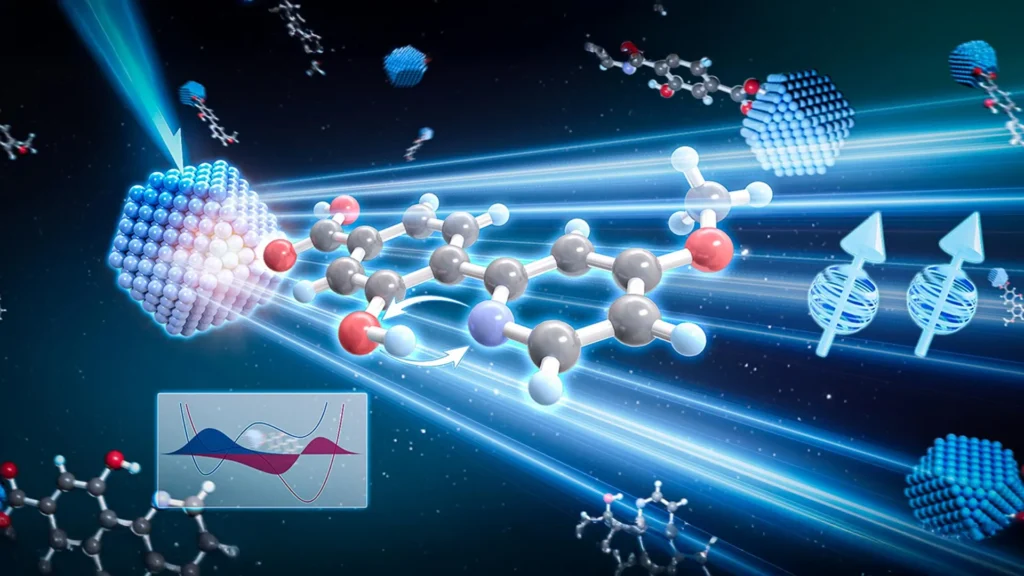
The team’s investigation focused on a hybrid system consisting of ZnSe colloidal quantum dots and phenol-pyridine dyadic acceptors. These acceptors were strategically attached to the surface of the quantum dots, creating an interface where the interaction between the inorganic core and the organic molecules could be observed with high precision using ultrafast spectroscopic techniques.
Unveiling the Proton Shuttle Mechanism
The core of the discovery lies in the "shuttle" action of the proton. When the ZnSe quantum dots are excited by light, they enter a high-energy state. The research team observed that the subsequent transfer of energy to the phenol-pyridine dyad was not a simple, single-step process. Instead, it involved a sophisticated dance of charges.
In the first stage of the mechanism, a "hole" (the absence of an electron) moves from the ZnSe quantum dot to the phenol component of the dyad. Simultaneously, a proton shifts from the phenol to the pyridine. This creates a temporary intermediate state. In the second stage, an electron transfers from the ZnSe quantum dot to the resulting phenoxyl radical. As this electron moves, the proton "shuttles" back from the pyridinium to its original position on the phenol.
The net result of this two-step process is the movement of spin-triplet energy from the quantum dot to the dyad, with the proton ending exactly where it started. While the proton’s net displacement is zero, its temporary migration is the catalyst that enables the energy transfer to occur with unprecedented speed and efficiency. The team compared this system to a methylated analog—a version of the molecule where the proton was "locked" in place by a methyl group. The results were stark: the system with the active proton shuttle performed the triplet energy transfer significantly faster and more efficiently than the version without it.
Quantum Tunneling at Room Temperature
One of the most striking findings of the study is the role of quantum mechanics in this process. Typically, chemical reactions and molecular movements are driven by thermal energy; as temperature increases, the rate of the process increases. However, the researchers found that the rate of PS-TET remained remarkably constant across a wide range of temperatures.
This temperature independence is a classic signature of quantum mechanical tunneling. In this regime, particles like protons do not need to "climb over" an energy barrier through heat; instead, they "tunnel" through the barrier due to their wave-like nature. The team supported this conclusion with complex calculations involving proton vibrational wavefunction overlap integrals. These integrals showed that the quantum states of the system were perfectly aligned to allow the proton to tunnel efficiently, steering the entire system toward the triplet energy transfer pathway while suppressing competing, less efficient relaxation routes.
The ability to harness quantum tunneling at room temperature is a holy grail in materials science. It suggests that devices utilizing the PS-TET mechanism could remain highly efficient regardless of environmental temperature fluctuations, a quality that is particularly desirable for outdoor applications like solar panels or environmental sensors.
Strategic Tuning of Chemical Pathways
The research also demonstrated a high degree of control over the mechanism. By introducing a strongly electron-withdrawing trifluoromethyl (–CF3) group to the pyridine molecule, the team was able to alter the electronic landscape of the acceptor. This modification changed the thermodynamic favorability of the intermediate steps, effectively reordering the sequence of the proton-coupled electron and hole transfer.
This finding is significant because it proves that PS-TET is not a fixed, rigid process but a tunable one. By carefully selecting the chemical substituents attached to the energy acceptors, scientists can "dial in" the desired energy transfer characteristics. This level of molecular engineering allows for the design of materials that are custom-tailored for specific functions, whether that involves maximizing energy harvest or minimizing energy loss.
Implications for Future Technology
The discovery of PS-TET has far-reaching implications across several scientific and industrial domains. Professor Wu noted that the mechanism provides a "profound" new understanding of spin-triplet states, which are notoriously difficult to manage because their transitions to the ground state are "forbidden" by traditional selection rules, leading to longer lifetimes but lower reactivity in standard systems.
Enhancing Solar Energy and Catalysis
In the field of photovoltaics, managing triplet states is essential for exceeding the theoretical efficiency limits of traditional silicon solar cells. Techniques such as singlet fission, which generates two triplet excitons from a single absorbed photon, could benefit immensely from the PS-TET mechanism. By using proton shuttles to facilitate the movement of these triplets, researchers could potentially create solar cells with significantly higher current outputs.
Similarly, in photocatalysis—the use of light to drive chemical reactions like hydrogen production or CO2 reduction—the efficiency of the process often depends on the ability to move triplet energy to a catalyst site. The PS-TET mechanism offers a way to speed up this transfer, reducing the energy lost to heat and increasing the overall yield of the chemical reaction.
Optimizing Lasers and LEDs
In the world of organic light-emitting diodes (OLEDs) and organic lasers, triplet states are often a double-edged sword. While they can be used to harvest more energy, they can also lead to "triplet-triplet annihilation" or other quenching processes that degrade device performance and lifespan. The insights provided by Professor Wu’s team suggest that by "removing" the proton shuttle or modifying the molecular structure to suppress PS-TET, engineers could potentially eliminate unwanted triplet states, leading to brighter, more durable, and more efficient display and lighting technologies.
A New Frontier in Chemical Physics
The work conducted at the Dalian Institute of Chemical Physics represents a significant milestone in the chronology of energy transfer research. It validates the idea that the complex, multi-particle interactions found in biological systems can be replicated and even improved upon in synthetic nanomaterials.
As the scientific community moves forward, the focus will likely shift toward integrating PS-TET into practical devices. The challenge will lie in maintaining the delicate balance of the proton shuttle in diverse environments and at a commercial scale. However, the fundamental blueprint provided by this study ensures that researchers now have the theoretical and experimental foundation needed to explore this new frontier.
By proving that a simple proton, acting as a temporary shuttle, can fundamentally change the speed and efficiency of energy migration, the DICP team has provided a masterclass in how subtle molecular movements can lead to massive leaps in technological capability. The era of proton-controlled energy transfer is just beginning, promising a future where the flow of energy is governed not just by the movement of electrons, but by the synchronized dance of the most fundamental particles in the universe.